
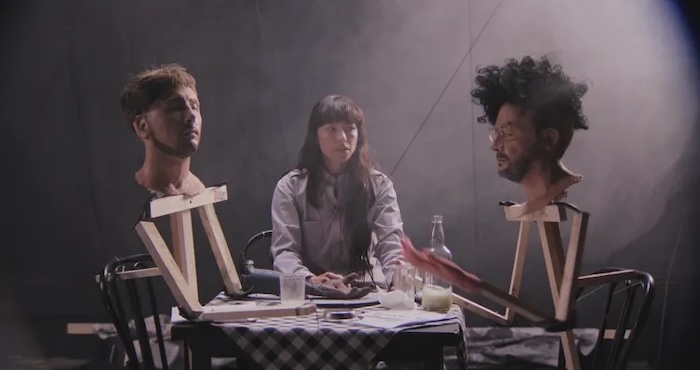
The Chilean filmmaking team of Cristóbal León and Joaquin Cociña is probably better known outside of Chile for the animated sequences they made for Ari Aster’s Beau Is Afraid than they are for their brilliant 2018 debut animated feature The Wolf House, but that isn’t saying much since not as many people saw Beau as Aster probably hoped. The duo’s second feature, The Hyperboreans, will likely win them even fewer fans due to its convoluted narrative and often confounding mixture of media, but it’s still fascinating in its own rarefied way. The title refers to beings of the “extreme north” that the Nazis glorified as a master race, a theme that only really gets going about halfway through this movie. Ostensibly, it’s about a youngish woman (Antonia Giesen) who is trying to recover a movie that she made ten years earlier and in the process ends up investigating the life of Miguel Serrano, a Chilean diplomat and philosopher who admired Hitler while he was in power and believed the führer had survived the war and was hiding out in Antarctica. As ridiculous as this premise sounds, Serrano drew a considerable following, and was said to be intimate with Carl Jung and Hermann Hesse. He was also big on Hinduism after he was posted to India in the 1950s. His pertinence to modern Chile is that following Pinochet’s coup he headed the country’s neo-Nazi faction. Giesen relates all this in a swift, almost comical fashion using lots of papier mache objects and stop-motion animation on a constantly evolving sound stage as she relates Chile’s late 20th century history as it applies to her own life, the movie she never finished, and her subsequent career as a psychoanalyst.
It’s a lot to cover in a movie that’s just barely over an hour long, but León and Cociña, whose own mannequin-like avatars act as the villains in the sci-fi adventure that Giesen’s story turns into, are as interested in the comic aspects of Chile’s political tribulations as they are in the tragic impact those politics had on the people. Though the pair’s visuals often evoke the textural weirdness of Jan Svankmajer, the overall thrust is overtly political without necessarily making the movie dramatically coherent. The development mimics that of a 1950s William Castle potboiler, an approach that often works against the duo’s thematic goals. The Wolf House trod the same territory, but was more narratively concise—and scarier. The Hyperboreans is all over the place, and ends up nowhere definite.
In Spanish and German. Now playing in Tokyo at Theater Image Forum Aoyama (03-5776-0114) along with the short subject Notebook of Names.
The Hyperboreans home page in Japanese
photo (c) León & Cociña Films, Globo Rojo Films
 philipbrasor.com