

Korean cinema’s special facility with genre movies has allowed it to veer from reliable formulas even while exploiting those formulas to the max. Revolver is a shakily plotted crime noir that sticks so resolutely to a single idea that it’s almost a parody of a crime noir, though not quite up to the Coens in terms of wry bite. The great Jeon Do-yeon, who won a Best Actor prize at Cannes for the stultifyingly depressing Secret Sunshine, seemingly works against type as Soo-yeong, a former police detective who is just finishing a 2-year prison term for bribery. We soon learn that Soo-yeong wasn’t the only cop involved in the corruption, but she’s the only one who got time, having taken the fall for her colleagues with the assurance that she’d be compensated for her sacrifice in the end. Once she’s out she expects to get paid, not only in large amounts of cash, but a nice apartment in Seoul. Consistent with the formula, she gets stiffed: No one meets her at the prison gate; no one contacts her later; and the person who was supposed to arrange all these things, she soon learns, has been killed under suspicious circumstances.
A good portion of director Oh Seung-wook’s film is spent renavigating the original crime that sent Soo-yeong up the river, an approach that often makes it difficult to follow the story, but in a sense that isn’t Oh’s purpose. He’s more interested in the mood and atmosphere of the various set pieces, which eschew flashy action for ironic, clever dialogue and head-spinning reversals of expectations. Jeon brings a deliciously dry fatalism to the proceedings. Soo-yeong is damaged goods right from the beginning, and she doesn’t pretend to have been rehabiliated by her stretch in the slammer. If anything, she’s more determined than ever to get what she believes she deserves, and doesn’t mind risking her life for it because, in this world of everyday treachery, she knows she’s right and knows her enemies know she’s right. So even if you don’t always get the motivation behind specific actions and how certain characters fit into the puzzle, the main impetus—Soo-yeong’s single-minded determination to get what’s owed her—keeps things interesting.
It helps enormously that the jerks she’s up against are a peculiarly depraved lot, and when she dispatches them (or, just as often, they end up dispatching themselves) the satisfaction factor is more thrilling than it usually is in these situations. And while Jeon’s predecessors in this kind of comic noir exercise are invariably male, she pulls off the stunt without sacrificing any of Soo-yeong’s feminine wiles. She even seems to be an inspiration for the other damaged goods that populate the movie, an exemplary model of female self-possession.
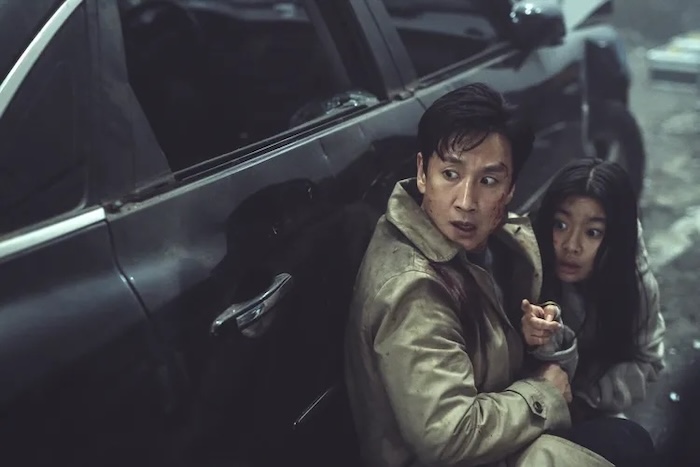
The box office hit Project Silence is a disaster flick, a genre that Korean cinema has been poking at for a good while with limited success. Usually, Korean disaster movies go long on the special effects, and here they don’t always work visually, though viscerally they bring the noise, mainly because Korea is excellent when it comes to vehicular mayhem and the disaster depicted is a huge fog-generated pileup on a long, high suspension bridge that starts to buckle from a perfect combination of fiery conflagration and mass overload. The scene where cars carom into one another and tractor trailers jackknife and slide along the pavement is a terrifying wonder to behold, but as Daffy Duck once said about a neat bit of gasoline-fueled stage entertainment he could perform, you can only do it once. Here, you also have to deal with the story.
Which in the case of Project Silence is way too busy. The late Lee Sun-kyun plays Jung-won, a factotum for the South Korean security minister, who happens to be running for president. Jung-won is also a single father, who is driving his reluctant daughter to the airport to study overseas when the above-mentioned pileup occurs. At the same time, a pack of mutant dogs is being transported across the bridge in order to be disposed of, and they get loose and start terrorizing the survivors of the accident, trapped between the burning tractor trailer at one end and the part of the bridge that threatens to fall into the sea at the other. As with all disaster flicks, the survivors represent a cross-section of hoi polloi, and several get picked off as they act either valiantly or selfishly. Adding to the suspense, it turns out the dogs are part of some kind of government anti-terrorism project that went awry and which Jung-won’s boss approved, so he has to keep a lid on the matter to avoid it leaking to the press.
Plausability is not a requirement for disaster movies, but character motivation needs to be a lot sharper than it is here. Popular leading man Ju Ji-hoon plays way against type as the film’s comic relief, a long-haired, disoriented tow truck driver with a proclivity for larceny that seems to be incited by the mayhem. The only characters who make consistent sense are the dogs, but that’s probably because they’re 100% computer-generated.
Revolver, in Korean, opens Feb. 28 in Tokyo at Toho Cinemas Nihonbashi (050-6868-5060), Toho Cinemas Hibiya (050-6868-5068), Toho Cinemas Shinjuku (050-6868-5063).
Project Silence, in Korean, opens Feb. 28 in Tokyo at Kadokawa Cinema Yurakucho (03-6268-0015), Shinjuku Wald 9 (03-5369-4955), Human Trust Cinema Shibuya (03-5468-5551).
Revolver home page in Japanese
Project Silence home page in Japanese
Revolver photo (c) 2024 Plus M Entertainment, Sanai Pictures and Story Rooftop
Project Silence photo (c) 2024 CJ ENM Co., Ltd., CJ ENM Studios Blaad Studios
 philipbrasor.com