
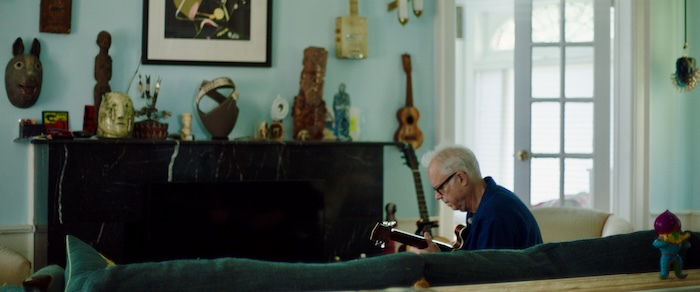
The weird thing about a lot of documentaries about musicians is that they tend to short change the music itself in that, unless they are actual concert films, they rarely showcase full songs. Jazz documentaries tend to be different since there is a feeling that you can’t possibly understand the players unless you understand what and how they play. This Danish documentary is loosely built around the community that has worked with jazz guitarist Jacob Bro over the past 15 years or so, mainly for the Scandinavian label ECM, whose purview extends beyond modern jazz to encompass contemporary classical, experimental, and so-called new age music. Essentially, the directors, Andreas Koefoed and Jorgen Leth, interview the various modern masters with whom Bro has played and have them describe their approach to improvising and composing, though what often emerges is their approach to life in general.
The late saxophone genius, Lee Konitz, for instance, sits in his Brooklyn apartment griping about how age has taken a toll on his reed work, conveying an irascible temperament that’s reflected in his playing. Guitarist Bill Frisell gives off a professorial vibe as he explains how he entered the jazz field through folk music. Though there are a few Black musicians interviewed, like saxophonist Mark Turner and drummer Andrew Cyrille, the lineup is mostly white male Americans and Europeans who approach jazz, as Turner puts it, “as a game.” Compositions are “puzzles” to be solved. In that regard, probably the most representative interviewee is bassist Thomas Morgan who refers to himself as a “nerd” and is meticulous about describing what he does though also quite incoherent. At one point, while trying to come up with an answer to a question, he falls silent for a full minute or two, a pregnant pause that Koefoed and Leth present in its entirety. Cyrille, fellow drummer Paul Motian (deceased), and saxophonist Joe Lovano testify for the old school jazz cat contingent with a jokey, in-crowd demeanor that basically says they just want to have a good time in the studio, an attitude that Mannfred Eicher, the owner of ECM, contradicts with his super-serious explanation of what exactly European jazz stands for. Like Morgan, he finds it almost impossible to put it into words, or, at least, English words. “I get too emotional,” he apologizes.
Jazz non-aficionados may glean little from Music for Black Pigeons (the title is a Konitz epigram and has no racial connotations), and even fans of this particular style of music may desire more. Bro, who is supposed to be the central personality of the film, commands less screen time than experimental Japanese percussionist Midori Takada. But the loose, carefree structure matches the music well. In the end, you may not have a deeper appreciation of European jazz, but you’ll feel you know these people pretty well.
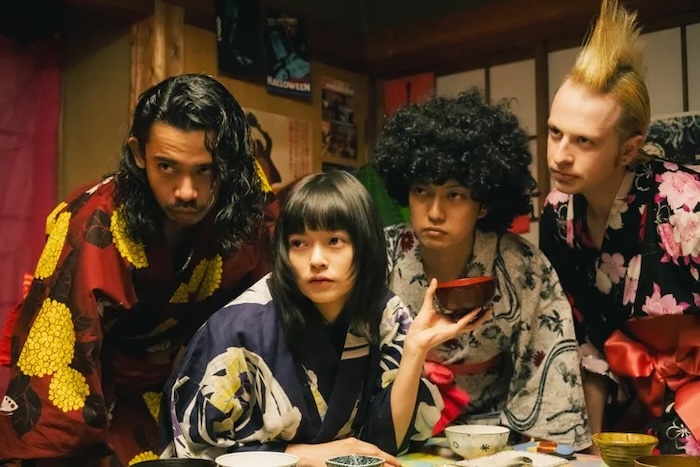
At the end of The Gesuidouz you may feel you know more than you’d like about the titular punk band, who, by definition of the genre, are terrible musicians and even worse social interacters. The lead singer and founder, Hanako (Natsuko), sums up the quartet’s mission by declaring she will be dead by the age of 27, “just like Jim Morrison and Kurt Cobain,” so she only has a year to whip her motley crew into a viable rock unit, which turns out to be more work than it’s worth—for the audience, that is.
Managed by a jerk (Yuya Endo) who is totally dismissive of their intentions, the Gesuidouz—whose name could translate as “The Sewage Systems,” though it seems to mean something else here—leave Tokyo and hole themselves up in a country farm house where they get their agriculture mojo working at the expense of any sort of musical cohesiveness. Obsessed with horror movie themes, they end up with songs that resonate internationally, though director Kenichi Ugana isn’t enough of a storyteller to put across exactly how that feat is accomplished. Similarly, there is much discussion about founding the Japanese equivalent of Glastonbury without explaining the point of such an ambition.
Sentimental by fiat and incomprehensible by design, The Gesuidouz is slight to the point of insignificance, which, given Hanako’s death wish and punk’s general purport, feels almost like a betrayal.
Music for Black Pigeons, in English, Danish and Japanese, now playing in Tokyo at Human Trust Cinema Shibuya (03-5468-5551).
The Gesuidouz, in Japanese, now playing in Tokyo at Theatre Shinjuku (03-3352-1846), Human Trust Cinema Shibuya (03-5468-5551).
Music for Black Pigeons home page in Japanese
The Gesuidouz home page in Japanese
Music for Black Pigeons photo (c) 2022 Rise and Shine World Sales UG/Disk Union Co., Ltd.
The Gesuidouz photo (c) 2024 The Gesuidouz Seisaku Iinkai
 philipbrasor.com