
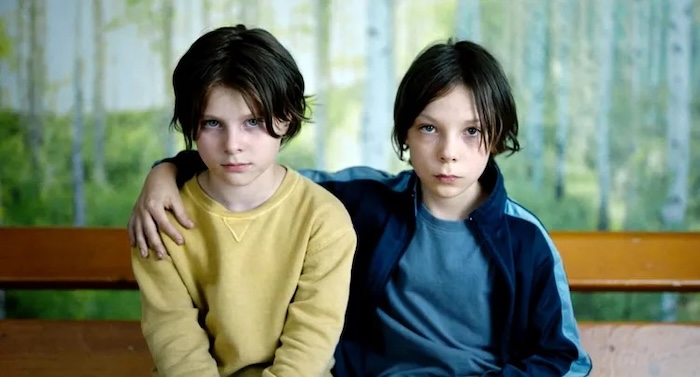
Stories about bullying normally address the power dynamics that develop among children in a closed environment, with adults being out-of-the-loop because victimized children, by nature, resist exposing themselves as being seen as either weak or duplicitous toward their peers. In the Belgian film Playground (the French title translates as “A World,” which is more to the point), the adults get involved, complicating matters in ways that are predictable but no less disheartening, despite whatever good intentions they have. Since the director, Laura Wandel, keeps the POV at the level of her child actors, the adults are forever stooping to address them, and the effect is disorienting, because we see as a matter of course how the grownups don’t realize that their concern is making things worse, even though they surely would have understood it when they were children.
The protagonist is seven-year-old Nora (Maya Vanderbeque), who is tearfully starting her first year of elementary school and clinging to her slightly older brother, Abel (Günter Duret). Nora is awkward and easily intimidated. Socializing with her classmates becomes a painful process, even though most seem friendly enough. One even tries to teach her how to tie her shoelaces properly, a skill that her stay-at-home father apparently neglected to impart to her. Nora’s adjustment, however, is complicated by her observations of Abel’s social interactions in the titular recreational space, where he hangs out with older boys, some of whom abuse him verbally and physically. When she tries to find out why, he’s standoffish and defiant. Then one day, in a scene that Wandel shoots for maximum discomfort, Nora sees the boys dunking Abel’s head in a toilet, and later asks him why they are doing it. All he can say is, “Don’t tell anyone,” but, of course, she does, because her demeanor is immediately affected by the horror she felt, something her teacher has been trained to pick up on. Then her father is informed and he confronts the bullies, which makes matters even worse, not only for Abel, but for Nora, who is now labeled a snitch and ostracized by whatever friends she’s managed to make so far. (She’s also teased for having a dad who doesn’t seem to work) Nora’s and Abel’s studies suffer, and the attention just compounds their pain and confusion. “”What can we do to help you?” one teacher asks Nora, and the answer seems to be: Nothing, because the damage is already done. Abel himself is already turning into a bully.
Playground‘s fatalistic plot development may feel over-determined, as if Wandel wanted to make a point and then steered the story straight toward it; but her naturalistic tone, which mimics the up-close methodology of fellow Belgians, the Dardennes, brings the emotional pain these children feel right up to your face. It’s a confrontational approach that highlights the dead end a bullied child faces: Your mates are cruel and the adults who supposedly protect you can’t. The only solution is to somehow survive it, and the most hopeful sign—maybe the only hopeful sign—in this severely troubling movie is when Nora actively stops Abel from meting out his own cruelty. That takes courage and a rare kind of instinctive drive that you may find more in narrative fiction than in real life.
In French. Opens March 7 in Tokyo at Shinjuku Cinema Qualite (03-3352-5645), Cine Switch Ginza (03-3561-0707).
Playground home page in Japanese
photo (c) 2021 Dragons Films/Lunanime
 philipbrasor.com