
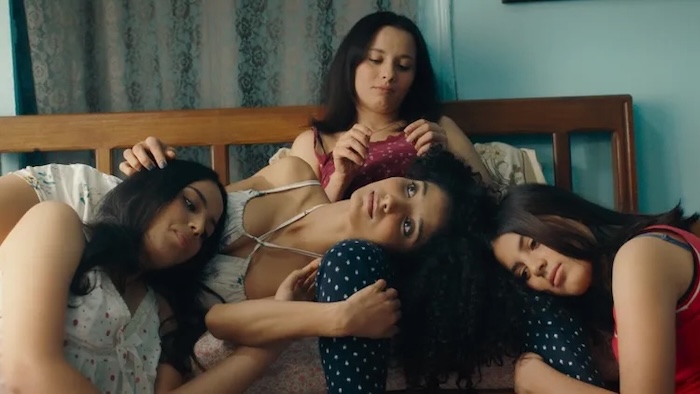
Because of its unconventional methodology, Tunisian director Kaouther Ben Hania’s movie about a family torn apart by religion, which won the best documentary prize at Cannes in 2023, doesn’t scan as a regular documentary, meaning one that’s chiefly invested in relating narrative truths about its subject. Ben Hania decided to use actors to play principals who were no longer available to contribute directly to the story she wants to tell. Specifically, two of the titular daughters of a woman named Olfa were “devoured by the wolf” about ten years ago, and in order to recreate scenes that are important to the story, Ben Hania hired actors to play their parts. In addition, she also hired an actor to play Olfa, who was very much involved in the production, during those times when the material became too emotionally overwhelming for her to play herself. But what ensues is not what you would call a “docudrama.” It’s more like an open-ended, ongoing therapy session that uses theatrical tools to explore how the toxic elements of a specific culture affects the psychology of some of its members, in this case women in the politically volatile environment of Tunisia during and after the Arab Spring, which started in Tunisia.
Even without the historical component, Olfa’s tale is worth hearing. As a Muslim woman and the daughter of a single mother, she was forced into an arranged marriage with an older man whose approach to sex was self-serving, to put it lightly. In the film’s reenactment of their wedding night, Olfa doubles as herself and her older sister, who intervenes to make Olfa understand that it is her duty to allow her new husband to rape her while relatives wait outside the bedroom for proof that she lost her virginity. Olfa resists in a way that is both horrifying and amusing. In fact, as the production progresses, much of the content that, on paper, comes across as tragic or appalling is accompanied by laughter when it is explained or recreated, because that is the only way for Olfa, her two younger daughters, Eya and Tayssir, and the actors playing her two older daughters, Rahma and Ghofrane, can get through events that were traumatizing. After the revolution that overthrew the secular, oppressive government in 2011, Tunisia was thrown into political turmoil while Rahma and Ghofrane traversed their adolescence, which was as fraught as it is for teenage girls anywhere in the world. They flirted with transgressive foreign fashion and music, and coarsened their language before embracing fundamental Islam. There’s a particularly intriguing sequence where the actors playing the two girls explore the style advantages of hijab and then niqab. Under the secular government, head coverings were banned, so in a sense Rahma’s and Ghofrane’s adoption of complete body coverings was as rebellious as were their passing infatuations with goth and punk. But through it all, Olfa, who had since divorced their father and discovered her latent sexuality with a former political prisoner-turned-carpenter, was at a loss as to how to raise her daughters and often resorted to violence out of frustration, even when it became apparent that her new boyfriend was coming on to them. The most powerful scene is probably the one where the actor playing the carpenter calls “cut” and walks off the set because he can’t countenance recreating an attempted rape of one of the daughters.
When the truth about what happened to Rhama and Ghofrane is revealed, it’s accompanied by Olfa, Eya, and Tayssir discussing how the shock of what the two older girls decided forced them to confront their own misguided decisions, as well as the culture that put them in these situations. It’s perhaps overstating one’s reaction to say that Four Daughters is, more than anything, an exploration of female enlightenment, but, to use a cliche, the journey of all the women on screen and, by implication, those behind the camera (men are obviously in the crew, but their insignificance in relation to the import of the tale is indicated by how openly the women talk about sex and bodily functions) during the recording, is manifestly obvious in how much it helps Olfa and her daughters understand what they went through thanks mainly to Ben Hania’s novel technique. That technique may only make sense as applied to these special circumstances, but it makes the movie equally enlightening for the viewer.
In Arabic. Opens March 14 in Tokyo at Shinjuku Cinema Qualite (03-3352-5645), Human Trust Cinema Shibuya (03-5468-5551).
Four Daughters home page in Japanese
photo (c) 2023 TANIT FILMS, CINETELEFILMS, TWENTY TWENTY VISION, RED SEA FILM FESTIVAL FOUNDATION, ZDF, JOUR2FÊTE
 philipbrasor.com