
French novelist and filmmaker Alain Guiraudie has been active since the early 90s but didn’t really make an impression on the wider world until after the turn of the century, and even then his films were mainly categorized as Queer Cinema, a label that certainly applied but didn’t prevent his work from finding a bigger audience and winning Cesars and festival prizes. The fact that it has taken this long for any of his movies to earn theatrical releases in Japan is not necessarily surprising, but if this were the late 90s-early 00s, I’m sure he would have already become an item on the Japanese mini-theater circuit. Distribution of world-class art cinema isn’t as thorough as it used to be here.
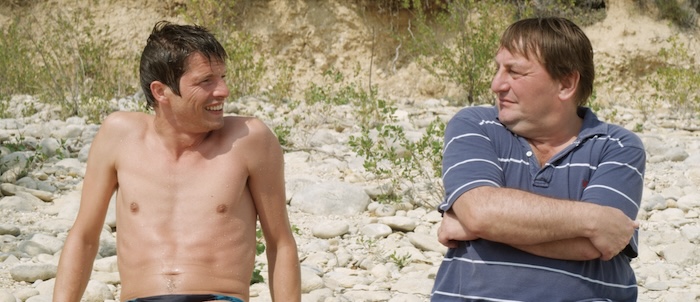
The oldest of the 3 features being released in Japan simultaneously this weekend, Stranger by the Lake, came out originally in 2013 and was the film that made Guiraudie famous internationally after it won the Queer Palm at Cannes and was chosen as the best film of 2013 by Cahiers du Cinema. Though I haven’t seen his previous work, which number a dozen shorts and features, from what I understand Stranger marked a shift in tone away from an aggressive form of confrontational cinema to something more conventional in presentation. Nevertheless, Stranger can still be startling in the way it tries to normalize behavior that many will find gratuitously unwholesome, and it’s not just because it’s set in an exclusively gay milieu, a remote lakeside cruising spot where anonymous, spontaneous sex is the only recreation on offer other than skinny dipping. Guiraudie delineates this aspect by dropping a straight character into the mix, a tubby, middle-aged guy named Henri (Patrick D’Assumçao) who shows up regularly at the beach just to watch what goes on. Our protagonist, a young buck named Franck (Pierre Deladonchamps), makes his acquaintance and the two often talk about life in general until Franck spies someone he likes and pursues him into the bushes. Guiraudie stages these trysts in such a way as to heighten their comical quality, but at one point Franck spies on a mustachioed hunk he’d like to shag who swims out to the middle of the lake with a companion and proceeds to drown the guy. Though he’s shocked, Franck’s ardor isn’t cooled a bit, and eventually he and the hunk, Michel (Christophe Paou), hook up as we in the audience wait for the other shoe to drop. The fact that the police finally show up and can’t penetrate the veil of homosexual solidarity—Franck’s too taken with Michel to rat him out, and thus his life seems even more at risk—heightens the suspense to almost unbearable levels.

There are gay themes in Nobody’s Hero, released in 2021, but the main love story is hetero, even if it’s no less transgressive than the one in Stranger and a lot funnier. A freelance computer programmer of indeterminate age and no discernible charm named Médéric (Jean-Charles Clichet) approaches Isadora (Noémie Lvovsky), a middle-aged prostitute he’s been eyeing for a while, and propositions her for free sex, saying that he is “anti-prostitution.” Isadora initially blows him off but calls back later, intrigued by his gall, and they start to get it on in grand style in a rented hotel room when the TV reports a terrorist bombing in their city and Isadora’s burly, blunt husband barges in and drags his wife away. Guiraudie’s busy script lurches back-and-forth between this awkward and somewhat unappealing affair and Médéric’s parallel relationship with a homeless Arab teen, Selim (Ilies Kadri), who may have been involved in the bombing and is camping out in the hallways of Médéric’s apartment building. The two storylines eventually come together in classical farce style, sending up French attitudes toward minorities and the transience of sexual attraction. Not nearly as provocative as Stranger, Nobody’s Hero is nevertheless weirdly irresistible in its ability to take subjects that most people would consider controversial and treat them with a wry frivolousness.

Guiraudie’s most recent movie, Misericordia, isn’t as funny but still manages to keep you off balance with a story that never takes itself as seriously as it probably should. Jérémie (Felix Kysyl) drives to the rural village he grew up in to attend the funeral of his mentor, the village baker who schooled him in the art of pastries and baguettes. He boards with his mentor’s widow, Martine (Catherine Frot), who seems to be attracted to him, though it soon becomes clear that Jérémie always had a thing for her husband. Her son, the volatile Vincent (Jean-Baptiste Durand), is convinced that Jérémie has designs on his mother and pressures him to leave, thus making Jérémie even more determined to stay and manifest his real attraction toward a doughy old friend, the retired farmer Walter (David Ayala—one thing about Guiraudie’s objects of desire, they aren’t conventionally attractive), who quickly disabuses him of his availability. The real monkey wrench, however, is the elderly local priest (Jacques Develay), whose intentions toward Jérémie are anything but hidden, and when Jérémie becomes the prime suspect in a villager’s disappearance, it is the priest who comes to his rescue, so to speak, with an offer Jérémie can’t likely refuse.
Some critics have called Giraudie’s films “Hitchcockian” in the way they toy with a viewer’s presumptions and primal feelings, but the most affecting aspect of his work isn’t the subversive humor or the weird way he ramps up tension. It’s how he confounds expectations about where his stories are going. His plots bob and weave tantalizingly, and often end up somewhere you would never predict after they make their own intentions clear. You may not appreciate them as much once you get to where they’re going, but you’ll have to admit they’ve taken you on quite a ride.
All three movies, in French, now playing in Tokyo at Theater Image Forum Aoyama (03-5766-0114).
Home page in Japanese
Stranger by the Lake photo (c) 2013 Les Film du WorsoArte/France Cinema/M141 Productions/Films de Force Majeure
Nobody’s Hero photo (c) 2021 CG Cinema/Arte France Cinema/Auvergne-Rhone-Alpes Cinema/Umedia
Misericordia photo (c) 2024 CG Cinema/Scala Films/Arte France Cinema/Andergraun Films/Rosa Filmes
 philipbrasor.com