
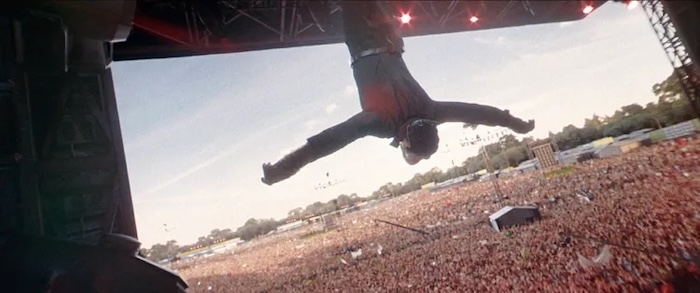
The biopic, especially those about musicians, was rendered a cliche when John C. Reilly cosplayed as a Johnny Cash-like character in Walk Hard, but that movie did nothing to slow the continuing onslaught of “based on true” recreations of the lives of pop stars, a parade of mostly mediocre films that all follow the same story arcs. Michael Gracey’s Better Man is, in theory, another attempt to poke fun at the formula, but not with overt humor. Gracey’s subject is the English singer Robbie Williams, who became a superstar as a member of the boy band Take That and was indirectly forced to go out on his own because of his offstage bad behavior. Gracey actually tells Williams’ story in the typical biopic fashion: kid from problem-addled background grows up rough but follows his dream of being an artist to the top before descending into drugs and poor decisions and then rising like a phoenix to even greater adulation and success. Gracey’s peculiar slant on this kind of story is to make Williams into an ape, in accordance with a conversation he once had with the singer who characterized his career as being that of a “dancing monkey.”
The best part of this conceit is that it’s played absolutely straight. Through excellently wrought CG, Williams (“acted” by Jonno Davies) looks like a real primate and even moves on occasion like one but never alludes to the fact that he’s different, physiologically or any other way, from all the humans around him. Consequently, the viewer is constantly under the impression that what’s happening on screen is not so much the objective truth as much as it is how the Williams “character,” who narrates the story, sees himself. Thus, during Williams’s childhood in a middle class family in Central England, his difficulties with school bullies and a father who eventually abandons his family to pursue his own dreams of show biz glory take on a special, almost bizarre poignance. Likewise, his own rise as a member of Take That and the cheeky way he asserts his unique talents in a group that is supposed to present a unified front has more power. At the same time, the appeal of the music and the group’s image is never taken for granted, and Gracey, who’s already proven his mettle in musical presentation with The Greatest Showman, knows how to stage a production number for maximum excitement, contrasting them with suitable drama after Williams launches a solo career whose highs are both sartorial and chemical, thus providing the story with ample justification for the requisite precipitous drop into notoriety and dashed romantic possibilities afforded by Williams’ relationship with Nicole Appleton of the girl group All Saints.
If the movie eventually runs out of steam it’s mainly because the ape gimmick can’t keep the biopic formula freshly engaging for more than two hours. Halfway through I completely forgot I was watching a simian. The ending, where Williams seems to slay all his inner demons and find something approaching genuine satisfaction with life, felt merely cynical. Of course, that very well may have been intended, but for such an outcome to be effective at all it would have required a completely different approach to what I would describe as movie entertainment.
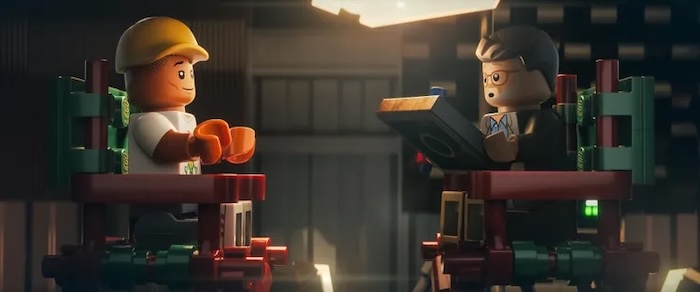
Another musical superstar named Williams, Pharrell to be exact, wanted to do something similarly different with his biopic and, in a sense, his take is even more radical than Robbie’s. At the very beginning of Piece by Piece, Pharrell is seen chatting with the movie’s director, Morgan Neville, about his ideas for the project and Pharrell says he wants to do it as a Lego movie because his story is about “borrowing from what’s already there,” though the real reason seems to be that Pharrell is just a big Lego fan. The kicker is that he has already been introduced as a Lego figure by the time his idea is proposed.
As with Better Man, nothing changes once the gimmick has been put into action. The difference is that Robbie Williams as a monkey is something the audience has to get used to, but the Lego movie style is already very familiar. Previous Lego movies, which were mostly action-comedy fantasies that made fun of established franchises, have conditioned us to expect outrageous visual jokes about cultural touchstones, like the Batman movies. Pharrell tells his story as it happened and early on it becomes obvious that he isn’t using the Lego style to sharpen the irony or heighten any comic possibilities. As he said in the beginning, he just likes it.
So the ups-and-downs typical of the musical biopic are played straight with the main difference being that Pharrell himself has always been pretty conventional as both a person and a professional. He indulged his childhood love of music without any adverse complications, having grown up in a loving, supportive family. He didn’t get into trouble or challenge authority. Along with his Neptunes producing partner, Chad Hugo, he realized his ambitions through hard work and talent, did not indulge in drugs or unwholesome behavior, and always treated mentors and collaborators with respect. This isn’t to say that Pharrell’s career is boring, but rather that the Lego style doesn’t really do much to render it in a more interesting way, except maybe to make Pharrell’s occasional spiritual pronouncements visually trippy. To me, the most enlightening element of the story is that Pharrell cemented his reputation by producing beats for the biggest names in hip-hop, including nominal gangstas, all of whom testify (in their own voices) that, as Jay-Z puts it, Pharrell “has absolutely no street” in his persona, even though he grew up in an African-American housing project. True to the name of the pop act he created with Hugo, N.E.R.D., he’s an otaku before he’s anything else. He just happens to be the richest one in the world. In that regard, making a biopic as a Lego movie is the ultimate vanity project.
Better Man now playing in Tokyo at Toho Cinemas Nihonbashi (050-6868-5060), Toho Cinemas Hibiya (050-6868-5068), 109 Cinemas Premium Shinjuku (0570-060-109), Shinjuku Wald 9 (03-5369-4955), Shinjuku Piccadilly (050-6861-3011), Toho Cinemas Shinjuku (050-6868-5063), Toho Cinemas Roppongi Hills (050-6868-5024).
Piece by Piece opens April 4 in Tokyo at Toho Cinemas Nihonbashi (050-6868-5060), Toho Cinemas Hibiya (050-6868-5068), Toho Cinemas Shinjuku (050-6868-5063), Shibuya Parco White Cine Quinto (03-6712-7225).
Better Man home page in Japanese
Piece by Piece home page in Japanese
Better Man photo (c) 2024 Better Man AU Pty Ltd.
Piece by Piece photo (c) 2024 Focus Features LLC/The LEGO Group
 philipbrasor.com