
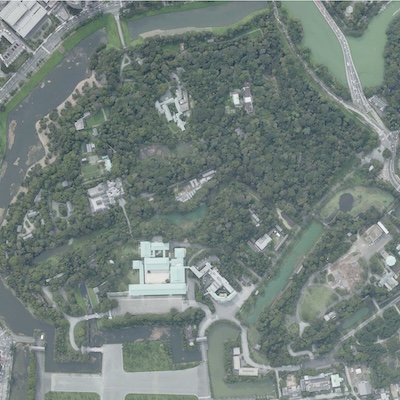
One of the peculiarites of Japan’s family registration (koseki) system is that a citizen can designate any address in the country as their main domicile, or honseki, regardless of where they actually live. A person’s residential address must be registered as such with the proper local government and indicated on the residence certificate, or juminhyo, but the koseki, which delineates one’s family relationships, isn’t so strict. Consequently, a significant number of Japanese people have designated Tokyo, Chiyoda Ward, Ichi-ban (number 1) as their honseki, because that is the address of the imperial palace. Of course, registering as such does not make one a member of the royal family, but, apparently, a lot of people like to dream, as it were.
According to Asahi Shimbun, this trend is becoming a problem for the bureaucrats of Chiyoda Ward. The number of people who live in the ward is about 68,000, but the number of Japanese people who have registered their honseki there is presently 210,000 and rising. Only about 3,000 people have registered the palace as their honseki, but for some reason Chiyoda Ward is the single most common jurisdiction in terms of honsekis nationwide. A lot of people also register Tokyo Station as their honseki, which is in Chiyoda Ward.
The reason it’s a problem is that the koseki is needed for many procedures and transactions, which means the local government designated as the honseki of an individual must assist in these procedures and transactions—taking out insurance policies, applying for loans, registering at schools—by providing copies of the koseki and amending its attachment, the fuhyo. One of the basic functions of the koseki is registering one’s marriage, since those who enter into a marriage are, by definition, “leaving” their parents’ koseki and creating a new one with their partners, and that means choosing a honseki. Though most newlyweds use either their current address or their home town, others prefer something more exotic or romantic, and choose a famous place, like the palace or Tokyo Station. Though registrants are not required to give a reason for using a particular address as their honseki, Chiyoda Ward staff told Asahi that a lot of people who call to inquire about registering their honseki in Chiyoda Ward say that “it’s easier to remember.”
The result has been a huge burden for Chiyoda Ward workers, who now handle on average about 30,000 koseki-related actions a year. These services cost money, which means that actual residents of Chiyoda Ward are paying, through their taxes, for procedures that benefit non-residents. The problem became so severe that last August the ward placed a notice prominently on its home page asking people not to use Chiyoda Ward as their honseki unless they actually lived there. The notice has no legal force. It is merely a desperate plea.
Someone who is new to the discussion will rightly ask: What is the purpose of the honseki if it doesn’t actually indicate the address of the registrant? The Asahi could not come up with a definitive answer. The honseki seems to confirm some sort of attachment to a place, which was more important in the past than it is now. After the juminhyo system was implemented in 1967 to administer public services through one’s local government, the honseki became merely symbolic, since most people only used it as a link to their past or heritage. That’s why Japan’s so-called untouchable class, the burakumin, are difficult to identify today, because the only indication of belonging to the class was one’s address—burakumin tended to be restricted to certain neighborhoods. It was the only aspect of their identity that made them burakumin other than their occupations. Nowadays, it’s almost impossible for someone without specific arcane knowledge to tell who supposedly or historically belongs to the burakumin class.
So why retain the honseki? Asahi doesn’t go that far, but likely the reason is force of habit; or, more precisely, the notion that dismantling any single component of the koseki undermines the rationale for the whole system. Proponents of the koseki see it as the perfect administrative embodiment of what makes Japan unique, and those elements which no longer have any meaning in the current social and cultural environment should nevertheless be kept so as to maintain that uniqueness. It’s why many people can’t countenance separate names for married couples. That would contradict the whole logic of a “family register.”
We’ve even heard that some older people still list “Manchukuo” (the part of northeastern China that’s commonly referred to as Manchuria) as their honseki, since their families emigrated there before World War II, when it was briefly a colony of Japan, but it may be an urban legend. What we’re sure isn’t an urban legend is the intelligence there are still Japanese people who list the Russian-held “northern islands” off Hokkaido as their honseki, something we assume the government encourages since it keeps the dream that those islands still belong to Japan alive, albeit only in some people’s imaginations.
 philipbrasor.com