

Though I see a lot of Korean movies, I don’t know much about the situation surrounding Korean cinema outside of South Korea or Japan, but I think I understand why this successful sequel to the 2015 cop-action comedy Veteran did not retain its Korean title, Veteran 2, for overseas distribution, opting instead for I, the Executioner. Non-Korean audiences, even those who saw the original Veteran 10 years ago, may not be drawn to the idea of a sequel, though they may be attracted by the name of the director of both, Ryoo Seung-wan, one of Korea’s most reliable action filmmakers; so I, the Executioner could possibly entice a few people who have a passing interest in Korean action and are intrigued by the awkward title. But that’s not the only nationally contextual aspect of the movie that foreign audiences could miss. Like Veteran, the sequel features a popular Korean heartthrob cast counter-intuitively as the heavy, thus guaranteeting the huge box office that Veteran 2 achieved easily, sitting at the top of the Korean money-making list for 5 weeks last year. Besides those points, the movie offers little that’s distinctive.
Including lead actor Hwang Jung-min, who returns as detective Seo Do-cheol, a hotheaded old school cop with a core of moral fortitude, meaning, in the Korean sense, that he isn’t averse to beating up bad guys for information but it’s all in the service of saving innocent people. That core is challenged by a vigilante killer dubbed Haechi, who is dispatching criminals, usually murderers, who’ve been released from prison early due to lax judiciary standards or loopholes. As with many recent Korean genre blockbusters, internet culture is heavily represented in I, the Executioner by hordes of social media users cheering on Haechi’s fatal exploits while Seo and his crack team of goofballs, including new MMA-savvy recruit Sun-woo (Jung Hae-in), hunt him down. Much of the initial tension is derived from Seo being charged with preventing a particularly nasty parolee from getting lynched by the public or eliminated by Haechi, and you can pretty much predict the outcome of that assignment. Ryoo injects the requisite measure of social commentary regarding irresponsible social influencers and Korea’s notoriously cruel bullying culture into the mix, but his main concern is navigating a script that shifts drastically from one dangerous scenario to another without derailing the viewer’s train of comprehension.
Ryoo’s skills as an action director make all the difference. The first Veteran was famous for its elaborate fight scenes, especially the climax where Seo and his nemesis battle it out in the middle of a Seoul intersection after a spirited and extremely violent car chase. Here there are several set pieces that defy description, but the result is less satisfying because they seem divorced from the story. The initially interesting vigilante theme is replaced by a standard psycho-killer setup that seems designed to justify the mayhem for its own sake. Moreover, the very bankable Hwang, who has recently ventured outside his comfort zone into more challenging, complicated roles, falls back on his usual comic everyman persona with mixed results. The real veterans of I, the Executioner, Ryoo and Hwang, merely cruise on their reputations.
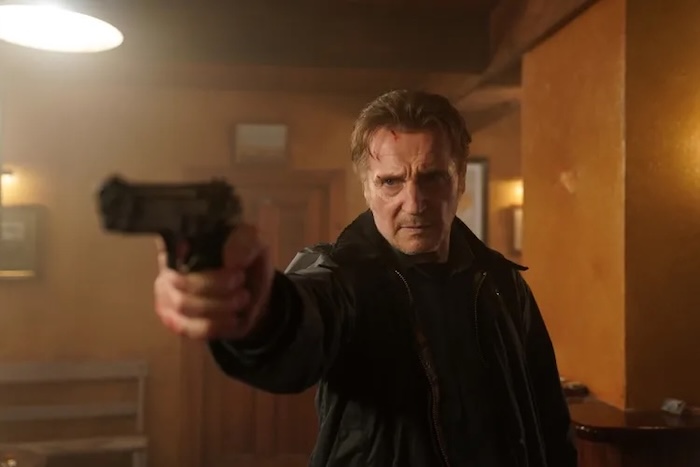
Liam Neeson’s fruitful second-wind career as an action star would seem to be the reverse of Hwang’s, since Neeson made his name initially as a “serious” actor in “serious” movies. Since then he’s been defined by the overdrawn Taken series (and its replicas), in which he played a former American intelligence maven using extreme methods to protect his family from evil internationalists. In the Land of Saints and Sinners carries this image back to Neeson’s native Ireland. He plays Finbar Murphy, a part-time executioner for a Donegal mobster (Colm Meany) in the early 70s. The story takes place as Murphy contemplates getting out of the whacking business to become a simple farmer (His cover is that of a second-hand book dealer, a conceit director Robert Lorenz plays for comic effect), plans that are put on hold by the Troubles going on in neighboring Northern Ireland, which spill over into Murphy’s bailiwick when IRA fugitives from a Belfast bombing-gone-wrong hide out on the property of a friend.
The cast is a who’s who of Irish character actor royalty—Kerry Condon as the vicious leader of the IRA crew, Ciaran Hands as the clueless local Garda and Murphy’s best friend, Niamh Cusack as the middle aged neighbor on whom Murphy is sweet, and Jack Gleeson as Murphy’s over-enthusiastic wannabe replacement—and Lorenz gives them plenty to do within the rather narrow scope of the movie’s purview. In the end, he settles for standard action movie stuff, with shootouts in crowded places and ridiculously contrived standoffs. Since Neeson doesn’t have to contend with an American accent, he seems more relaxed than usual, but Murphy is pretty bland porridge compared to the more anxious characters he portrayed in previous action movies, which, granted, were often terrible, but not because of him.
I, the Executioner, in Korean, opens April 11 in Tokyo at Kadokawa Cinemas Yurakucho (03-6268-0015), Shinjuku Piccadilly (050-6861-3011), Shibuya Cine Quinto (03-3477-5905).
In the Land of Saints and Sinners opens April 11 in Tokyo at Toho Cinemas Hibiya (050-6868-5068), Toho Cinemas Shinjuku (050-6868-5063), Toho Cinemas Nihonbashi (050-6868-5060).
I, the Executioner home page in Japanese
In the Land of Saints and Sinners home page in Japanese
I, the Executioner photo (c) 2024 CJ ENM Co., Ltd., Filmmakers R&K
 philipbrasor.com