

Earlier this week, in a review for another movie, I wrote that Chinese fiction films rarely tackle work as a central theme. In a sense, Wang Bing’s monumental three-part documentary, Youth, says probably everything that needs to be said about the situation surrounding labor in today’s China. Wang’s incredibly long and detailed films have so far mostly dealt with historical matters, in particular the long-term social consequences of the Cultural Revolution; but Youth, which he filmed in the industrial city of Zhili from 2014 to just before the pandemic, feels up-to-the-minute. Part one, Spring, was released in Japan last year, and acted mainly as a primer for how to watch the whole series. It showed the textile workers in Zhili, almost all people in their early 20s, trying to get by in an incredibly competitive environment, since they work on a piece-rate basis without contracts. We saw how they relaxed, what they spent their money on, their romantic intrigues, their fights and rivalries; and in doing so we acquired a real sense of young people’s values in China at the moment.
Part two, Hard Times, goes deeper into the occupational dynamic of Zhili, with its myriad workshops run by marginally solvent entrepreneurs, some of whom disappear in the middle of the night when their debts become too much. Once you get past how skilled these workers are—the most exciting scene in Spring was a contest between two men to see who could sew the fastest—you marvel at how easily they are exploited. Quotas are difficult to meet when machinery breaks down and the slightest mistake is grounds for withholding pay. Wang hangs around various workers who are having cash-flow problems because of delayed paydays. When they confront their employers in their various ways they are met with resistance. One irresponsible young man has apparently mislaid his pay book, a matter his boss uses against him—no pay book, no pay. When another worker gets pushy in his demand for compensation, he is physically attacked by the shop manager and the employer himself ends up in jail, a situation that directly affects the aggrieved worker’s colleagues since they won’t get paid either. Moreover, if the government labor office gets involved the shop may be shut down and they will lose their lodgings, so they try to organize, a somewhat hapless enterprise that leads to incoherent bargaining sessions and the incursion of opportunists who try to buy the shop’s machinery at cut-rate prices. Even some of the workers break into their workplaces to see if they can sell loose parts just to make up their lost pay.
Wang’s completist approach to his subject means focusing on so many individual situations that he can’t properly cover all of them with the thoroughness they deserve. And because none of these young people can articulate their hopes and dreams beyond satisfying their most immediate needs, he doesn’t provide any analysis of what is wrong with the system and how it could possibly be fixed. An exception is one worker who describes a personal history of protest that involved being railroaded by the authorities—he barely escaped a prison term—all for the sake of workers’ rights, which should be guaranteed in a nominally socialist country. Everybody else is just thinking of their next meal or iPhone, the money they need to get married, or how they’re going to get back to their home towns when the holiday arrives, because almost all are migrant workers, a truth that dominates the labor market in China, as Wang so clearly points out in his selection of subjects.
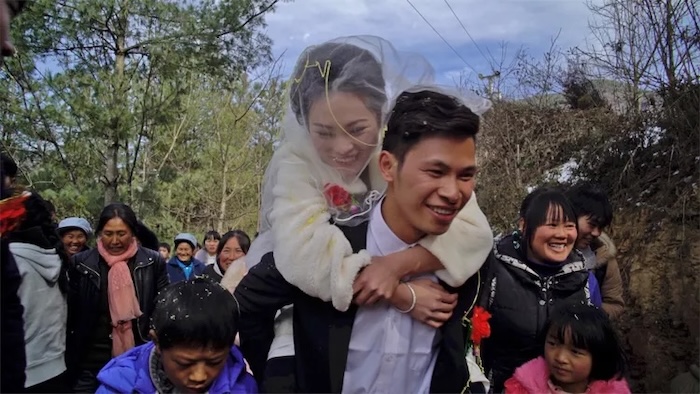
In fact, the transient nature of Chinese labor is the theme of the concluding part of the trilogy, Homecoming. At the end of Hard Times we see several workers, some with their significant others (many married couples work together in Zhili) making the arduous journey back to their home towns and villages for the New Year’s break. At the beginning of Homecoming Wang sticks close to several of these workers as they reconnect with family and friends and ponder what their lives have become and whether the work they do has any meaning for their future. Some of these workers haven’t been paid in months and have to scrounge off elderly parents they had hoped to support.
Unlike the drudgery of Zhili, provincial life affords a level of freedom that some of these young people can’t handle. Gambling is a constant distraction, at least for the men, whose partners seem to have given up on them in that regard. In a rare instance where Wang actually talks to one of his subjects, a young woman, she explains with abrupt frankness that she’s come to realize her husband is “worthless.” In another scene, a woman berates her spouse for being ineffectual, meaning he leaves all daily matters to her. “Marry a man with an education, they said,” she screams as she throws something at him, thus implying that his time in university has just made him a discouraged layabout. In contrast, Wang records an elaborate wedding ceremony in which the couple is exhausted by the rituals. It’s easy to wonder how their marriage will survive once they return to Zhili and have to rely on each other.
Wang doesn’t let us off the hook, since he returns to Zhili and the uncertainty of these people’s lives. The first thing many have to do is scramble for work, since they quit in a huff when they left, perhaps hoping they wouldn’t have to come back; but they do. After nine hours of watching the youth of China trying to make sense of a semi-capitalist system of hand-to-mouth industrial exploitation, you may feel more enlightened than you want to be about the Chinese textile business. The only thing that keeps you from despairing is the natural energy of Wang’s subjects, which he captures with extraordinary skill and sensitivity.
In Mandarin. Both films now playing in Tokyo at Theater Image Forum Aoyama (03-5766-0114).
Youth (Hard Times) and Youth (Homecoming) home page in Japanese
photos (c) 2023 Gladys Glover-House On Fire-CS Production-Arte France Cinema-Les Films Fauves-Volya Films-Wang Bing
 philipbrasor.com