
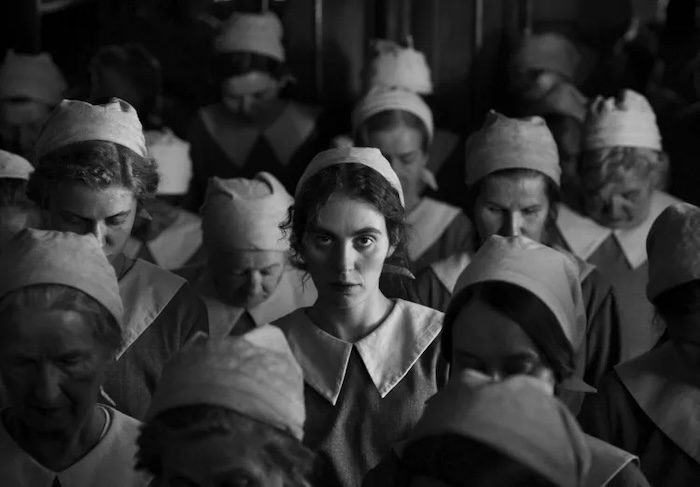
As a movie addressing the psychological torment that can accompany and follow the act of childbirth, Denmark’s most recent contender for an international feature Oscar doesn’t hold anything back, but because it’s set in a time and place that feels alien from our own—Copenhagen right after World War I—the horrors it presents seem like something out of a particularly nasty 19th century gothic novel. Filmed in high-contrast black-and-white, The Girl with the Needle constantly suggests a malevolent spirit at play. Nothing goes right for our protagonist, Karoline (Vic Carmen Sonne), and we’re not made to expect anything different. In the very first scene, she’s evicted from her decrepit apartment for being behind in her rent. As it stands, she believes her husband has been killed in the war, though she can’t claim compensation because she doesn’t have a death certificate. She finds an even more decrepit apartment while working as a seamstress at an industrial apparel maker that’s hit the jackpot producing military uniforms. She begs the owner of the business, Jorgen (Joachim Fjelstrup), for help in trying to wrest compensation from the authorities and he sincerely tries to help, and then invites her out for a walk and promptly has sex with her openly in an alleyway.
The director, Magnus von Horn, seems particularly drawn to bluntness of this sort, not so much because he believes it reflects the customs of the milieu he depicts, but because it makes the storytelling that much more relentless. Suffice to say that once Karoline finds herself pregnant, Jorgen steps up to do the right thing, but his imperious mother won’t have it, and Karoline attempts a self-abortion in a public bath. However, she is interrupted by an onlooker, Dagmar (Trine Dyrholm), who proposes a different solution: have the baby and bring it to her. She will find a loving home for the child. Thus Karoline embarks on a journey of self-loathing and possible redemption, as she eventually becomes Dagmar’s assistant in placing unwanted babies in well-to-do homes, a racket that at first feels charitable (though the mothers are compelled to pay dearly) but which Karoline soon learns is anything but.
Though The Girl with the Needle is based on a real historical crime, von Horn’s fantastical presentation makes it feel more like a parable, albeit one whose psychological implications speak directly to our basest fears. Sometimes the plot devices feel contrived, especially the sudden reappearance of Karoline’s husband with a hideous war injury, a development that feels shoehorned into the action; but the idea that women would be conflicted about bringing children into this horrid world is put across with uncommon power. It’s not just the abject poverty on display that drives the point home, but rather the whole idea that a mother’s feelings are constantly being manipulated by forces she can’t control.
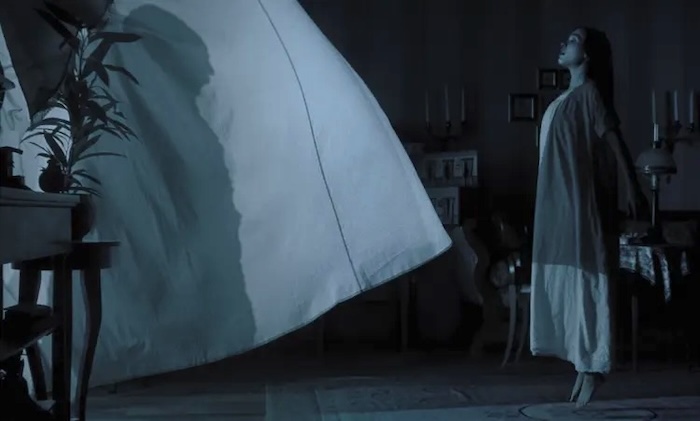
Nosferatu, a deliberate horror movie, has a similar mise en scene, though it takes place almost a century prior to the action in The Girl With the Needle. Based on the F.W. Murnau silent classic, which itself was an unauthorized ripoff of Bram Stoker’s Dracula, this production by Robert Eggers feels even more expressionistic than the original. It’s a color film that looks black-and-white, mainly because it takes place either at night or under overcast skies. Eggers’ ouevre (The Witch, The Lighthouse) is obsessed with a past that’s mostly a product of his singular imagination, and while Nosferatu is an adaptation, it shoots off on tangents that only Eggers could come up with.
The central character is Ellen Hutter (Lily-Rose Depp), a frail woman with prescient proclivities who we see right from the start is in the grip of some force beyond her understanding. Her new husband, Thomas (Nicolas Hoult), is solicitous of her fears but nevertheless leaves her alone for an indefinite period while he carries out an assignment for his real estate broker boss, Knock (Simon McBurney), which entails rugged travel on horseback to the crumbling Romanian castle of Count Orlok (Bill Skarsgård), who wants to buy an estate in Thomas’s German city. Thomas goes through quite a gauntlet of terror while in Orlok’s company but manages to escape with his life. At this point, the word “vampire” hasn’t even been muttered (though the spirited banter among the Roma residents near the castle obviously allude to their neighbor’s evil tendencies), and I found it refreshing that Eggers downplayed the requisite undead lore; but what freaks Thomas out isn’t so much the mysterious puncture marks on his breast but rather Orlok’s almost cartoonish dialect, which is a grossly breathy Slavic rumble that shakes the flatware. Meanwhile, back in Germany, Ellen’s nightmares of a shadowy figure entering her room become more intense, thus summoning the attention of her best friend, Anna (Emma Corrin), and her fatuous husband, Friedrich (Aaron Taylor-Johnson), who believe she has lost her mind and call the doctor (Ralph Ineson), who can do nothing for her and thus in turn contacts a colleague who has studied the black arts, von Franz (Willem Dafoe). It is he who first says the word “vampire,” though he prefers the proper noun “Nosferatu.”
Matters come to a head when Orlok arrives in town by sarcophagus on a ship teeming with rats, which spread plague throughout the city. Knock reveals himself as Orlok’s secret sharer and Thomas returns just in time to learn that his wife was raped by Orlok as a child—and that the count is here to reclaim her. It’s a lot to process and I didn’t bother, but while Eggers’ intention is to shock rather than horrify, his methods inadvertently pump up the inherent melodrama of the material. I found myself giggling on occasion at the arch literary dialogue (“We have been blinded by the gaseous light of science!”) and a sound design that exaggerates every slurp and gulp. It’s not your fanboy brother’s idea of a vampire movie, but it makes sense in its own sick way.
The Girl with the Needle, in Danish, opens May 16 in Tokyo at Shinjuku Piccadilly, Human Trust Cinema Yurakucho, White Cine Quinto Shibuya.
Nosferatu, in English, Romanian, and Romany, opens May 16 in Tokyo at Toho Cinemas Chanter Hibiya (050-6868-5001), Kino Cinema Shinjuku (03-5315-0978), Shibuya Cine Quinto (03-3477-5905).
The Girl with the Needle home page in Japanese
Nosferatu home page in Japanese
The Girl with the Needle photo (c) Nordisk Film Production/Lava Films/Nordisk Film Production Sverige 2024
Nosferatu photo (c) 2025 Universal Studios
 philipbrasor.com