
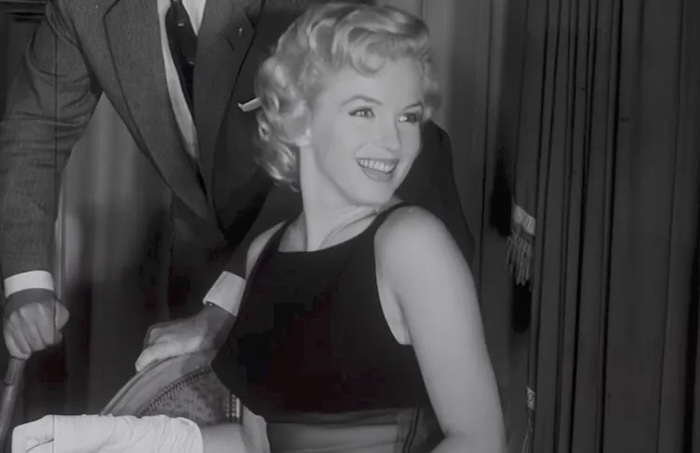
We hardly need another film document about Marilyn Monroe, and the bizarre tone of the English narration here could indicate that A.I. may have had something to do with its creation. Then there’s the movie’s aggressive tabloidy approach, which takes for granted the notion that the late actor did not commit suicide or succumb to an accidental overdose but rather was murdered by mob boss Joe Giancana as payback/warning to the Kennedys. Though it evinces sympathy for Monroe, its coldly analytical methodology feels harsh, as if the A.I. software were prompted by a central concept that attempted to get at the heart of the actor’s everlasting mystique by plumbing her ambition, which is suggested by the title itself. Though the narrative mentions all the men who used her for their own ends, the thesis is that Norma Jean Dougherty could never have become Marilyn Monroe without her own peculiar drive to be a movie star on terms that were not yet acceptable to Hollywood. In a sense, she forced herself on an industry that wasn’t ready for her and in doing so probably changed that industry more than any other single player.
The annoying voiceover, credited to the director, Ian Ayres, alternates with talking head interviews from the past, mostly with people who knew her intimately but weren’t famous themselves. These figures are only too happy to reveal the sordid circumstances behind Norma Jean’s upbringing—the illegitimacy, the foster homes, the abuse both sexual and emotional—and while countless other bios have raked over these stories, here they are presented so matter-of-factly as to suggest they weren’t unique to Norma Jean, which is probably true and thus more pertinent to how she sought to cope with her pain by seeking public approval on a grand scale. Her sexual escapades are presented as being common sensical rather than sordid, a perspective that glibly highlights the French provenance of the production. Monroe’s infamous inability to maintain professionalism on set—she was notoriously late to shoots and often forgot her lines—is offset by her uncanny talent for knowing exactly what the camera wanted from her at the moment. Many of the insiders interviewed explain how she seemed inept on a sound stage only to present layers of meaning in the daily rushes. To the film’s credit, it links this capability to her first acting coach, a French woman with whom she had a love affair, and her experience with the Actor’s Studio. In other words, she was a serious student who just had self-esteem problems, which probably describes almost every actor in the business, but Marilyn Monroe may have been the first movie star to use this dynamic to her advantage.
The upshot, according to the movie, is that Monroe mostly acted on instinct rather than intellect, which may not be a novel analysis but takes into consideration the sexual politics of the era: There was never a time when she could fully assert her independence in the face of crushing male solicitude, and the parade of big swinging dicks who led her to both fame and doom represents a more complete picture of how her world operated. Norman Mailer is never mentioned in the movie, but his book has become the de facto Rosetta Stone for Marilyn studies, and he was as much a trooper in that parade as anyone. As flawed as Dream Girl is, as a documentary it’s a helpful corrective.
In English and French. Now playing in Tokyo at Human Trust Cinema Yurakucho (03-6259-8608), Shinjuku Cinema Qualite (03-3352-5645).
Dream Girl home page in Japanese
photo (c) 2023-French Connection Films
 philipbrasor.com
Pingback: ドキュメンタリー映画『マリリン・モンロー 私の愛しかた』雨の中で灯り続ける小さき炎 | Tiroir du Kinéma ティロワ・デュ・キネマ