
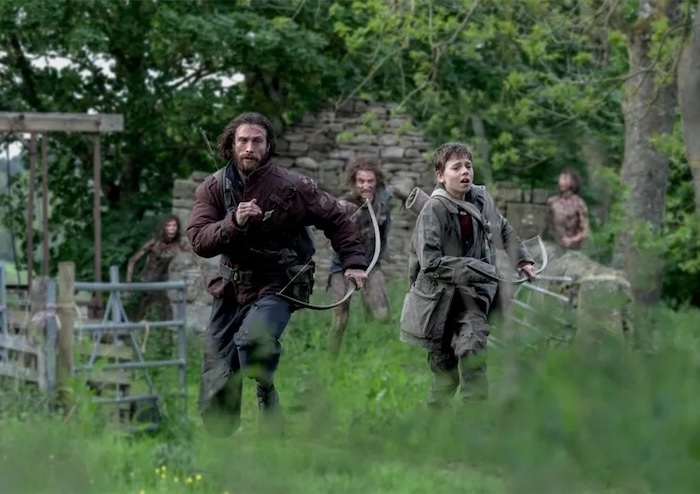
Danny Boyle’s 2002 feature 28 Days Later is considered a watershed movie, since it reinvigorated the zombie genre with new ideas, the most potent of which was that the monsters moved fast and struck fast. Technically speaking, it wasn’t a zombie movie because the monsters were not reanimated dead people but rather living persons who had been bitten by others infected with a man-made “rage virus” who had turned into monsters in the blink of an eye, but the effect that 28 Days Later had on the horror movie landscape was incalculable—there would be no The Last of Us without it. Boyle and his scenarist, Alex Garland, return with the second sequel (though they were merely executive producers of 28 Weeks Later, released in 2007) and, like the original, it comes with plenty of subtext about how the human race has in essence devolved into violence and, specifically, how the UK, where it’s set, has lost its claim to the world’s most civilized character. Great Britain is now internationally quarantined and contains, presumably, the only beings infected with the rage virus. This subset of humanity has “evolved” in various ways that beg the question of their own right to life. The protagonist, a 12-year-old boy named Spike (Alfie Williams), lives on Holy Island off the northeast coast of England in a fortress-like enclave that has returned to pre-modern technology and attitudes. The movie opens with Alfie’s father, Jamie (Aaron Taylor Johnson), taking him to the mainland for his “first kill,” using bows-and-arrows, in what is characterized as a rite of passage. To say that Spike is up for the adventure would be reading too much into it.
Bloodier and even more frantic than the first film, 28 Years Later has a lot on its mind—perhaps too much, given the way the story often lurches away from interesting ideas it might have explored more fully; and, in fact, they may be explored more fully, since Boyle and Garland have already said there will be two more installments. The infected, now naked and covered in sores, still dart around with deadly purpose but there is also a sub-species of bloated creatures that crawl along the ground consuming worms, as well as an “Alpha” who seems to have the intellectual faculties for planning ahead. This development suggests that the infected are indeed still human, a possibility that is put to the test when, late in the movie, as Spike revisits the mainland with his ill mother, Isla (Jodie Comer), to seek out a rumored physician who he hopes can cure her, they encounter an infected female going into labor. When they bring the baby to the doctor, an older man named Kelson (Ralph Fiennes), they come face-to-face with someone whose own humanity, as defined by his vocation, is at sharp odds with those of Jamie and the other inhabitants of Holy Island. Kelson believes all creatures have a right to exist, even the infected, and has erected huge monuments of bones and skulls as a means of giving them dignity in death.
Several side characters indicate that the world outside Britain is pretty similar to the one we live in now but is not necessarily more humane than the people of Holy Island. Boyle and Garland have made comments that 28 Years Later can be seen as a take on Brexit, but viewing it in that way compromises its dramatic power, which is based on our supposed capacity for mercy within the context of self-preservation in a social order that takes for granted the prerogatives of violence. Spike develops a new appreciation of nature and its bounty, including the monsters created by a technology whose purpose was to destroy.
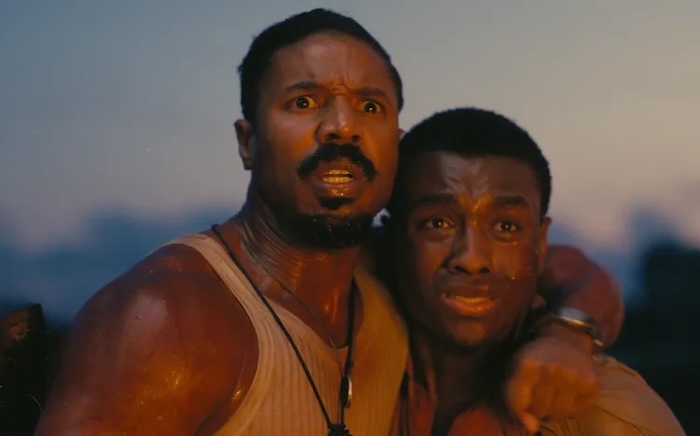
Ryan Coogler’s much-lauded Sinners is another horror movie that subverts its genre elements in order to address a broader horror at large in society, except instead of zombies it’s vampires we have to deal with. Unlike Boyle, Coogler mostly adheres to the standard lore mandated by his chosen genre—stakes through the heart, invitations to enter an abode, avoiding daylight at all costs—and Sinners is way pulpier than 28 Years Later. Set in 1930s Mississippi at the height of Jim Crow, the movie literally sees white people as the devil. In the very first, scene, a bloodied, traumatized young blues singer and guitarist named Sammie Moore (Miles Caton) arrives at church on Sunday morning, where his preacher father reasserts his own admonition that when you play sinful music, the devil will follow you home. Later we’re introduced to the Smokestack Twins (both played by Michael B. Jordan), recently returned from Chicago where for years they worked for underworld elements. They hand a suitcase full of cash over to a stout Klan member in exchange for an old mill they plan to convert into a juke joint. Just as Quentin Tarantino framed the racial dynamic in Django Unchained, the white people in Sinners would just as soon kill a Black person as look at him and from that tension flows the whole logic of the narrative.
In fact, the vampire element doesn’t even appear until halfway through, when a person of Irish background named Remmick (Jack O’Donnell) shows up at the juke joint’s opening revelry with two confederates asking to be let in for a drink. The intentions of Remmick are self-avowedly multi-cultural. He loves the blues and wants to share in its enjoyment, a sentiment that automatically makes him suspicious to these native Southern Black people; but in a sense Remmick’s intentions are pure, because he wants to turn these Black folk into spirits of the night and join his “family,” which sees no color or creed but only worships blood. Better writers than I have already analyzed Coogler’s meaning here; that white people not only want to appropriate Black culture, but appropriate it while effectively erasing the tragic history that gave rise to that culture and which they had a hand in. Maybe the most chilling scene in Sinners is the one where Remmick’s newly turned Black followers join him in a spirited Irish jig.
Sinners‘ horror movie set pieces are more elaborate than those in 28 Years Later, and, again like Django, practically luxuriate in copious amounts of blood. While Coogler has problems trying to tie it all together in the end—there are two-count-’em-two post-credit codas—his penchant for indulging every cinematic impulse is justified by a sufficiently expansive imagination. It’s a great mainstream movie about a fitting subject, and unlike 28 Years Later it doesn’t rely on subtext to make it interesting. Coogler puts everything right there on the screen so that everyone understands exactly what he’s trying to say.
28 Years Later now playing in Tokyo at Toho Cinemas Nihonbashi (050-6868-5060), Toho Cinemas Hibiya (050-6868-5068), Toho Cinemas Shinjuku (050-6868-5063), Toho Cinemas Shibuya (050-6868-5002), Toho Cinemas Roppongi Hills (050-6868-5024).
Sinners now playing in Tokyo at Shinjuku Wald 9 (03-5369-4955), Toho Cinemas Chanter Hibiya (050-6868-5001), Shibuya Cine Quinto (03-3477-5905), Shibuya White Cine Quinto (03-6712-7225).
28 Years Later home page in Japanese
Sinners home page in Japanese
28 Years Later photo (c) 2024 Sony Pictures Entertainment (Japan) Inc.
Sinners photo (c) 2025 Warner Bros. Ent.
 philipbrasor.com