
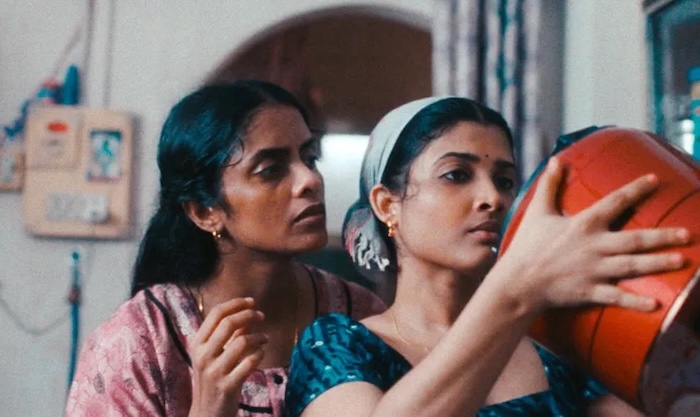
The title of Indian director Payal Kapadia’s Cannes-winning first fiction feature is explained near the end when a character talks about working in a dark place for days on end. It gets to the point, he says, where light is only something you can imagine. This description more or less characterizes the lives of the three principal characters, who are stuck in a kind of existential limbo owing to the fact that they are women in a social milieu that doesn’t fully recognize their needs. But the movie could have easily borrowed the title from one of V.S. Naipaul’s novels, The Enigma of Arrival, in that these three women, co-workers in a hospital, are, like the hordes of commuters that become a visual leitmotif throughout the film, non-natives of the city where they live, Mumbai. Kapadia emphasizes the impermanence of a metropolis this big and varied, not just with the situations of Prabha (Kani Kusruti), the hospital’s head nurse, Anu (Divya Prabha), a young nurse-receptionist, and Parvaty (Chhaya Kadam), a cook on the verge of retirement, but in the struggles of everyone else we meet, including a doctor (Azeez Nedumangad) who is sweet on Prabha but also is considering moving back to his home town because he cannot master Hindi (“Why is the word for ‘yesterday’ the same as the word for ‘tomorrow’?”), and Anu’s secret boyfriend, Shiaz (Hridhu Haroon), a Muslim man who avoids contemplating a future without the Hindu woman he loves. And yet Mumbai is irresistible in Kapadia’s rendering, a swirling carnival of sensation that not only confounds one’s best laid plans but invigorates the fitful imagination of the title.
The plot unspools like a telenovela. Prabha cannot return the handsome doctor’s affections because she is married, having been forced some years ago by her parents into an arranged union, after which her husband moved alone to Germany for work and has since almost completely severed contact, leaving her in a constant state of legal and emotional uncertainty. Anu (Divya Prabha) keeps her affair with Shiaz hidden from all around her, including Prabha, her new roommate who, it is implied, would surely disapprove. Meanwhile, her parents back in her own home town ply her with possible matches. Parvaty (Chhaya Kadam), relatively uneducated but politically savvy, has become bureaucratically non-existent since her husband died without leaving documentary proof of their relationship. When her apartment of 22 years is targeted for redevelopment by a powerful construction company, she is left not just homeless but condemned to a kind of unofficiated netherland. While the movie lingers in Mumbai the three stories remain connected through casual interactions, but when Prabha and Anu help Pravaty move back to her coastal home village to resettle, the three women are offered the chance to reassess their lives away from the mad hustle of the city, with each arriving at a truth they can at least live with.
Prabha’s magical realist epiphany near the end, after she saves a stranger from drowning, is particularly ingenious in explicating the character’s means of escaping total despair. Though Kapadia methodically and effectively shows how these women have become stuck in the roles they’ve been given by their respective cultures, she subsequently revels in how they discover the inner strength necessary to transcend those roles and achieve grace on their own terms. All We Imagine as Light is a miracle of dramatic empathy.
In Hindi, Malayalam and Marathi. Now playing in Tokyo at Bunkamura Le Cinema Shibuya Miyashita (050-6875-5280), Human Trust Cinema Yurakucho (03-6259-8608), Shinjuku Cinema Qualite (03-3352-5645).
All We Imagine as Light home page in Japanese
 philipbrasor.com