
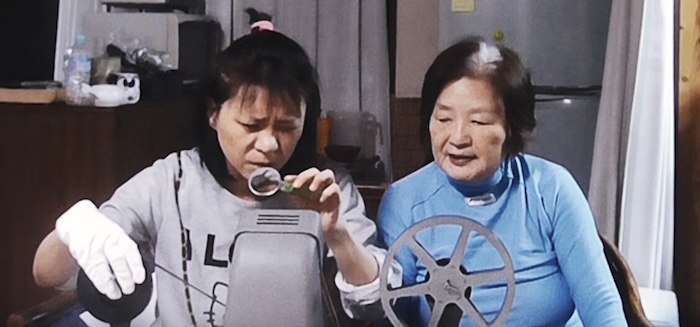
Co-director Park Maeui worked with her veteran documentarian mother, Park Soo-nam, on The Voices of the Silenced, a detailed review of the latter’s life and work as the former digitizes that work, which was originally shot in 16mm. Both Parks are Japan-resident Koreans (zainichi) who speak Japanese throughout the film. Soo-nam, second generation zainichi, switched from writing to filmmaking in the 70s and has almost exclusively covered the zainichi experience, focusing on Japanese historical matters and incidents—the 1923 Kanto earthquake, the Battle of Okinawa, the coal mine of Gunkanjima during WWII, the atomic bombing of Hiroshima, the “comfort women” issue—from the point of view of Korean residents and immigrants, which has been neglected by Japanese historians.
Along the way the elder Park discusses her own matters and incidents, as when she felt rejected by both North and South Korea because of her uncompromising attitude, her fear of “turning Japanese,” and her fierce feminism, which has angered Koreans as much as Japanese (she has never married). On a more immediate tip, Soo-nam is going blind, so the digitizing mission becomes vital, occasionally sparking disagreements between mother and daughter that add a bit of drama to the historical recollections, of which the so-called Komatsugawa Incident (made famous as a feature film by Nagisa Oshima) that resulted in the false murder conviction and execution of a young Korean man in Japan, merits the most screen time, since it basically sparked Soo-nam’s journalistic career.
The doc is, in turns, melancholically nostalgic and bitter, and at two-and-a-half hours could use a bit more editing as the Parks tend to go over some of the material several times. If The Voices of the Silenced draws more attention to the work of Park Soo-nam, which has been neglected by the West, then it will have served a valuable function.
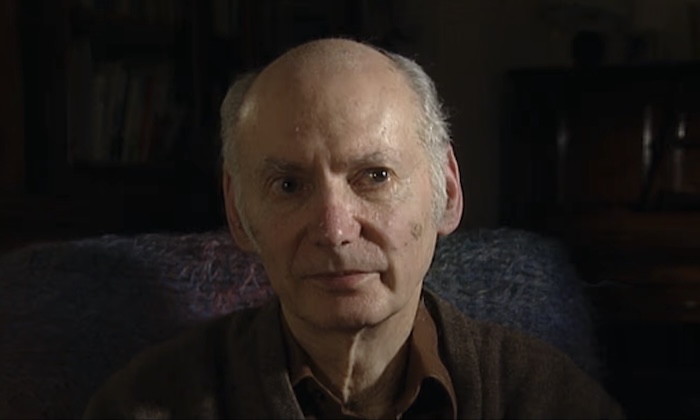
Steve James’ documentary, A Compassionate Spy, also covers a subject more people should know about: How the late American scientist Ted Hall, the youngest person to work on the Manhattan Project, leaked atomic secrets to the Soviets during and after the war and essentially got away with it. The title refers to Hall’s motives: After witnessing what the bomb could do he believed it was too dangerous a weapon to be solely in the hands of the U.S., which he thought would surely use it again, probably against the Soviets in an inevitable future conflict. He committed treason, in other words, to save millions of people from annihilation. Though many will surely take issue with this position—and James interviews several individuals who do exactly that, including the son of Hall’s co-conspirator—in a sense, Hall’s prescience has been somewhat justified since no atomic bombs have been detonated for belligerent purposes since Nagasaki.
Most of the film centers on the testimony of Hall’s wife, Joan, who explains her husband’s gentle, philosophical mien and their life together. Both were avid political leftists who sympathized with Communist doctrine while acknowledging the horrors of Stalinism. Early on, the FBI caught on to Hall’s actions and did what they could to bring him in, but his rigid stoicism confounded them. He was impossible to ruffle, and while Joan insists he never lied in his life, he managed to put up a front under fierce interrogation that couldn’t be breached. In a sense, he was saved by his intellect. Offered a teaching and research position at Cambridge, he moved his family to the UK in the 50s and stayed there the rest of his life, and while the American authorities enlisted British intelligence to continue pressuring him, they were never able to make anything stick. Certainly the most dramatic sequence in the film is Joan’s recollection of the sickness of the soul she and her husband suffered when the Rosenbergs were executed. Whatever crimes the Rosenbergs actually committed (Joan thinks the information they passed on to the Soviets was insignificant) the Halls felt the Rosenbergs were punished for what Ted had actually done and were just convenient scapegoats.
James supplements the Halls’ tale with a history of the changing attitude in the U.S. toward the Soviet Union from the war years to the 80s as a means of showing how fickle official policy was while Ted Hall’s basic tenets remained unchanged—he was always on the side of humanity. In that sense, James sees Hall’s decisions, which he never regretted, as strictly moral ones, and tends to sidestep the legal questions. The narrative is deepened by input from the couple’s two surviving daughters (a third died in an accident at a young age), who inherited their parents’ leftist views but didn’t learn about their father’s secret activities until they were adults. What they have to say about his commitment to his principles may be the film’s most effective advocacy of its point-of-view, because emotions tend to win out every time.
The Voices of the Silenced, in Japanese, English and Korean, now playing in Tokyo at Polepole Higashi Nakano (03-3371-0088).
A Compassionate Spy now playing in Tokyo at Euro Space Shibuya (03-3461-0211).
The Voices of the Silenced home page in Japanese
A Compassionate Spy home page in Japanese
A Compassionate Spy photo (c) Participant Film
 philipbrasor.com