
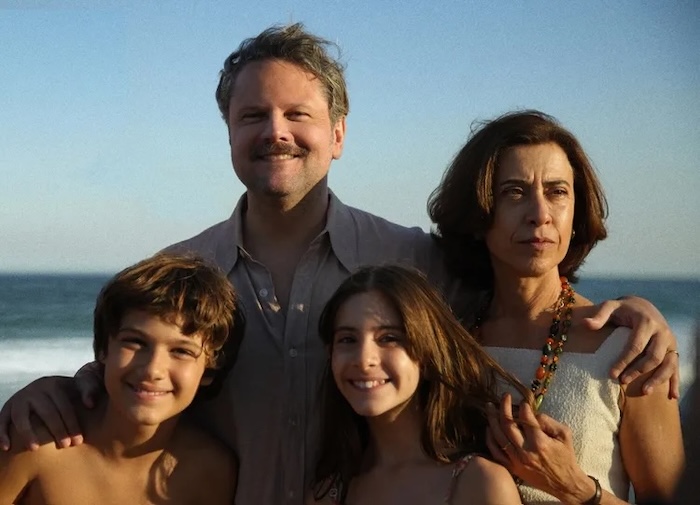
It’s easy to see why Walter Salles’s adaptation of Marcelo Rubens Paiva’s memoir of the abduction and murder of his father in the 1970s by the Brazilian authorities won the Oscar for Best International Feature. It’s earnest in its outrage at the abject cruelty of Brazil’s fascist state at the time, while delving deep into the resulting turmoil that wrecked Paiva’s family, in particular his mother, whose POV the film assumes once her husband is taken away. Nevertheless, while the movie feels painfully personal, it doesn’t say anything beyond the obvious, that what happened to Rubens Paiva (Selton Mello) was an unforgivable crime and that Eunice Paiva’s (Fernanda Torres) campaign to uncover the truth was unrelenting and fierce. I’m Still Here is a model template for that subgenre of films that deal with authoritarianism as it affects individuals.
Salles is thorough in his setup, showing the happy, successful middle class life of the Paivas, who have five children. Rubens is an architect who once held a seat in the national assembly, and while his political views remain under wraps, it’s obvious he opposes the present regime and there are hints he is helping to support underground elements opposed to the government. But for most of the first hour, the script dwells on domestic matters, in particular budding filmmaker daughter Vera’s (Valentina Herszage) move to the UK to study. It is while Vera is away that agents of the government arrive at the Paiva home and subsequently take him to their offices for questioning. Apparently, he is suspected of passing information to persons considered enemies of the state, though this intelligence isn’t revealed until later. It is the last time his family will see him. Eunice is also brought in for questioning, and here Salles cleverly and effectively shows what she is up against, namely, a state apparatus that uses exhaustion to break their prey, with the sounds of torture and suffering echoing down the damp, dark hallways of the facility. But she’s released, and for the rest of the film she works to find out where her husband was taken and what happened to him.
The movie then becomes a kind of procedural, with Eunice accessing every resource at her disposal. She finds out what she needs to know, all the while holding some things back from her children, who she feels are too young to handle the truth, although they surely know their father is not coming back. This development is laced through with nostalgic moments as a means of contrasting years of uncertainty with a time of love and stability. Meanwhile, Eunice goes back to school, becomes a professor and a defender of indigenous people’s rights, as her work to explain the crimes of the former administration make her into a minor celebrity. In fact, a little more distinction between these various roles would have been welcome. As it is, they are simply presented as adjuncts to her central role as mother and widow, which, as admirable as that is, shortchanges her accomplishments.
In Portuguese and English. Opens Aug. 8 in Tokyo at Toho Cinemas Chanter Hibiya (050-6868-5001), Shinjuku Musashinokan (03-3354-5670), Human Trust Cinema Shibuya (03-5468-5551).
I’m Still Here home page in Japanese
photo (c) 2024 Videofilmes/RT Features/Globoplay/Conspiracao/MACT Productions/Arte France Cinema
 philipbrasor.com