
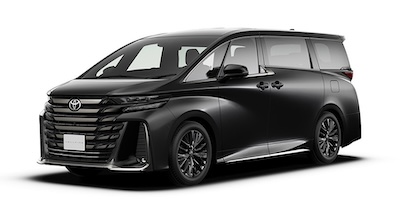
Earlier this month Asahi Shimbun reporter Yotaro Hamada, whose specialty is social welfare, commented on an editorial he had written in July about Japanese opposition parties’ campaign pledges to reduce the consumption tax and social security premiums. Hamada insisted that such cuts would lead to other cuts in pension payouts and social welfare for health care. Later, a physician mentioned Hamada’s editorial on social media, saying his comment reminded him of the “zankure Alphard” phenomenon. Hamada was unfamiliar with the term and had to go to the internet to find out what it meant. His research led him to an animated song on YouTube.
Alphard is a high-end minivan manufactured by Toyota, the price of which starts at ¥5 million. “Zankure” means “residual credit,” meaning the balance of money owed after a payment on a loan or revolving credit plan is made. The animated song depicts a young family that has bought an Alphard using a special type of loan plan where the buyer pays off the loan for a new car until the end of the fifth year, at which point the buyer gives the car back to the maker in a trade-in deal. It’s apparently a very popular credit scheme because young families really like Alphard, which has a certain high-class cachet, and the scheme allows them to afford what is in essence a very expensive vehicle. The gist of the scheme is that when the buyer signs the contract for the car, the projected trade-in value is subtracted from the price and the loan is based on the difference. Consequently, monthly payments are lower than they would be for a normal loan.
In the song, which has a parodistic quality to it, the lyrics say that even though you only make ¥200,000 a month, you can buy an Alphard. However, the song also points out that the interest on this special loan is higher than it would be for a typical car loan, and that if during the five years of “ownership” the buyer exceeds a certain limit on the amount of kilometers driven, then more money must be paid, meaning that the “zankure” or residual credit must be reimbursed to the maker. The same thing happens if the car is returned with any damage, and according to some commentators, even the slightest scratch in the finish could require large post-trade-in payments. Apparently, there is a lot of fine print in the zankure contract, which is why the doctor likened it to Hamada’s explanation of the consequences of tax cuts and reduced premiums—in the end, you’re still likely to pay the full amount.
Though Hamada referred to the “zankure Alphard” phenomenon as a means of bolstering his editorial thesis, we found the phenomenon itself more compelling and tried to find out more about it. The YouTube song has drawn 7 million views in just two months. It’s quite cleverly done but also a bit depressing because it implies that many young families have been fooled into buying a car they really can’t afford. The video has a kind of built-in prejudice that says the types of families who fall for the zankure scheme are less educated “yankee” types—dad didn’t go to university and dresses like a faux punk; mom is stay-at-home and sports long dyed hair; they probably have two or three very young children—who yearn for a bit of outward status, which the Alphard provides. Normal auto loans are between 3 and 5 years; the longer the contract, the lower the monthly payment, but the higher the interest, depending on the bank. The amount of the down payment will also determine monthly payments, but it seems most people who take out zankure loans don’t make down payments because they don’t have to. To give some idea of how this might work, if you put a down payment of ¥1 million for the most expensive Alphard, called the Executive Lounge, which costs over ¥7 million, and took out a 5-year loan, the interest would be around 4.3 percent, and you’d be required to pay ¥34,500 a month in addition to two “bonus time” payments of ¥150,000 semi-annually. But at the end of five years, you will have only paid off 53% of what you owe in total, meaning you would still need ¥3.3 million to settle the loan. One could see how a zankure loan would be tempting.
We then thought that if the zankure scheme was what made these families go for the Alphard, wouldn’t it just make more sense to lease one? That way you still get the status without the credit obligations, since all you have to do is pay a monthly fee for the lease and give the car back at the end of the leasing period without any obligation to pay off a loan. However, once we started down the rabbit hole of leasing cars in Japan, we discovered there is also a lot of small print as well as traps to make the lessee pay more than they would expect.
There are two kinds of car leases in Japan, open-ended and closed-ended, and from the many stories we read on the internet, it seems the difference is rarely explained in a clear way when the lease is signed. The monthly fees for closed-end leases are slightly higher because the responsibility for the car is held by the lessor. Many lessees opt for the open-ended lease since it’s cheaper, at least on the surface. However, since open-ended leases place the responsibility for the car’s condition on the lessee, the lessee can end up paying a lot of supplemental fees after the lease is up. For instance, depreciation, meaning the loss in value of the car during the time it was leased. The lessee does not have to pay depreciation for a closed-end deal.
And like the zankure scheme, when the leased car is returned it is inspected thoroughly, and the slightest scratch can lead to a lot of money charged in compensation. Also, if you cancel the lease for whatever reason before the contracted period is up, the penalties can be quite steep. We read of one man whose employer transferred him to a new office and when he cancelled his lease he was charged a huge amount of money.
Also, lessees who take out open-ended leases have to pay for maintenance of the car, and some insurance plans do not cover leases, meaning any damage or liability has to be paid by the lessee. And like the zankure plan, leases come with distance limits, often on a monthly basis. If the lessee exceeds those limits the charges can be as high as ¥30 per kilometer.
In any case, we found that a lease for an “X-grade Alphard” is about ¥38,000 a month, and for a “Z-grade Alphard” (hybrid) ¥48,000 a month. That still sounds pretty steep for someone making ¥200,000 a month.
 philipbrasor.com
We just bought an Alphard -oops.
Thanks for the fascinating write-up. I looked at leases in the past, but they never quite seemed to make sense (unless done as a corporate expense).