
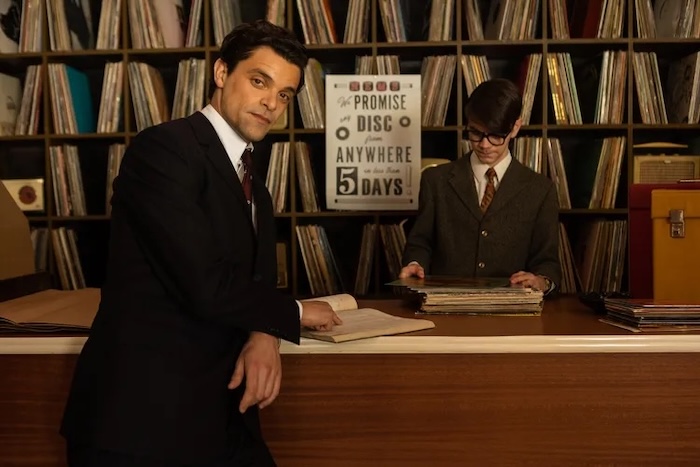
Midas Man, a biopic about Beatles’ manager Brian Epstein, received a qualified rave review from veteran rock critic Greil Marcus this summer. Marcus saw the movie at a film festival in California, and at the time it had not been released in theaters in the U.S.; nor did it seem to have a streaming deal. It had only been shown on Prime Video in the U.K. A month or so later, a reader wrote to Marcus saying that the movie was available in the U.S. on YouTube, but Marcus countered that the YT version was only 90 minutes and the real movie was almost two-and-a-half hours long, so you couldn’t compare the two. The version being released in Japan is 112 minutes, the same length that’s listed on the film’s IMDb page, so I’m not sure if what I saw is the real deal, but Beatles’ fans will probably not be sorry if they search it out, wherever they are. It’s by no means a great film, but it’s got some great sequences that add something to the mythos which doesn’t feel like fronting.
Jacob Fortune-Lloyd plays Epstein as a preternatural epicure, a choice that emphasizes those stereotypical qualities often associated with a certain type of gay man. And it’s this aspect that the filmmakers focus on in Epstein’s interest in the Beatles as something he wanted to be part of, despite the fact that their group sensibility was so opposite of his own. Epstein is from a good, middle class Jewish family in Liverpool and he manages the family’s furniture shop with a keen eye not only for the aesthetic attributes of his merchandise but a level-headed business sense that makes the shop profitable. One of his ideas is to carve out a section of the store for records, since he recognizes in the tastes of his fellow young people a yearning for foreign music. One day, he happens on a crude single from Hamburg by a quartet of Liverpudlians and buys as many copies as he can for his store. Then he goes to see the group at a local club and instantly understands their appeal. He begs them to dump their current, ineffectual manager (played by Eddie Izzard with a kind of growling cynicism) and take him on. They do, grudgingly. He may be too posh for their tastes, but he’s definitely in their corner. The contrast is thus set—the brash, irreverent Beatles versus the businessman with an eye for beauty and a certain predatory facility. (His negotiation with Ed Sullivan is brilliant, though Jay Leno wrecks the scene by portraying Sullivan as a mafia don) From there, the movie scans the well-known points of development—the fitful search for a record company, the replacement of Pete Best by Ringo, the flowering of Beatlemania, the conquering of America—while showing explicitly how it affected Epstein the closeted gay man with a gambling jones, who suffered blackmail and depression when his father (Eddie Marsan) rejected who he really was. In the meantime, the Beatles themselves grew to not only respect his guidance, but came to love him as a kind of older brother figure.
Due to the production’s budgetary or permission issues, the fake Beatles do not play any of the group’s original songs, but they perform a bunch of covers the Beatles made famous and do a creditable job of it. The version of “Money” may not be definitive, but it’s played at full length, punctuating the importance of the milieu the group was working in: They made honest, enjoyable music for young people whose parents couldn’t stand what they stood for, at least initially. Midas Man itself often feels as if it could learn something from this example. It’s too rooted in Epstein’s emotional landscape, even though it often makes fun of that landscape in its visual choices, thus trivializing the tragedy his life became.
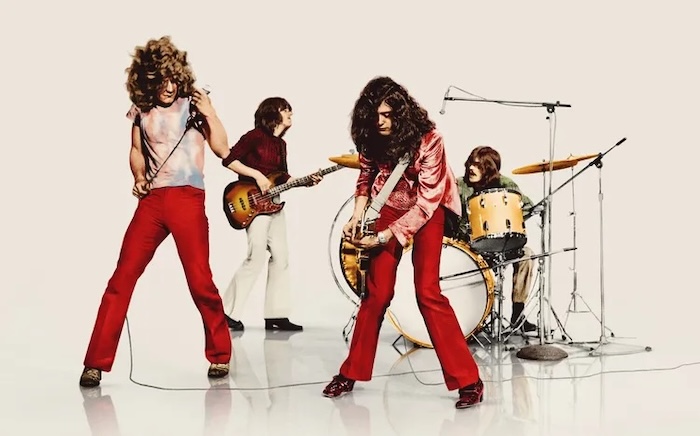
There is a minority critical opinion that Led Zeppelin was the only other band whose artistic contributions to rock were as momentous as the Beatles’. The authorized documentary Becoming Led Zeppelin makes this case up to a point by chronicling in detail how the group came into being, but the contrast with the Fab Foud couldn’t be starker. The Beatles invented themselves as a group from scratch, and with the exception of Ringo each member learned his craft in the band. Led Zeppelin’s members were all fully formed musicians when they got together in 1968 under the auspices of Jimmy Page, who had replaced Jeff Beck as lead guitarist of the Yardbirds in that group’s final incarnation. When the Yardbirds folded, Page needed a new gig and recruited bassist/arranger John Paul Jones, whom he knew from session work. Terry Reid, Page’s first choice for vocalist, had other plans and recommended Robert Plant, who brought along John Bonham, whom he had played with in a short-lived R&B band.
The doc interviews all three surviving members separately and uses snippets of old interviews with Bonham, who died in 1980. It’s all so positive and peppy, and since it only goes as far as 1970 after the release of their breakthrough album, Led Zeppelin II, you get none of the drugs and sex stuff (with underage girls, no less) they were famous for. In fact, it’s all about business, another aspect that distinguishes them from the Beatles. As Page explains it unironically, the formation of the group was more a matter of commercial calculation than creative endeavor. They set their sights on America even before their native UK, specifically Atlantic Records. When they negotiated with Jerry Wexler they already had a finished album to give him. Page was intrigued by the burgeoning FM radio culture, “which played whole sides of albums.” He was sick of the idea of having to come up with hit singles, which is what manager Mickey Most insisted on with the Yardbirds. Consequently, Led Zep conquered America first—and easily, according to the doc—before they even played England.
The only really interesting thing about the band’s early trajectory is that the first album was roundly panned, though because of the hagiographic nature of the production no one bothers to try and figure out why. It’s not a movie that’s interested in analysis. It’s merely self-congratulatory.
Midas Man now playing in Tokyo at Toho Cinemas Chanter Hibiya (050-6868-5001), Cinemart Shinjuku (03-5369-2831), Human Trust Cinema Shibuya (03-5468-5551).
Becoming Led Zeppelin now playing in Tokyo at Toho Cinemas Hibiya (IMAX, 050-6868-5068), 109 Premium Cinemas Shinjuku (0570-060-109), Toho Cinemas Shinjuku (IMAX, 050-6868-5063), Shibuya Cine Quinto (03-3477-5905), Toho Cinemas Roppongi Hills (050-6868-5024).
Midas Man home page in Japanese
Becoming Led Zeppelin home page in Japanese
Midas Man photo (c) Studio Pow (Epstein) Ltd.
Becoming Led Zeppelin photo (c) 2025 Paradise Pictures Ltd.
 philipbrasor.com