
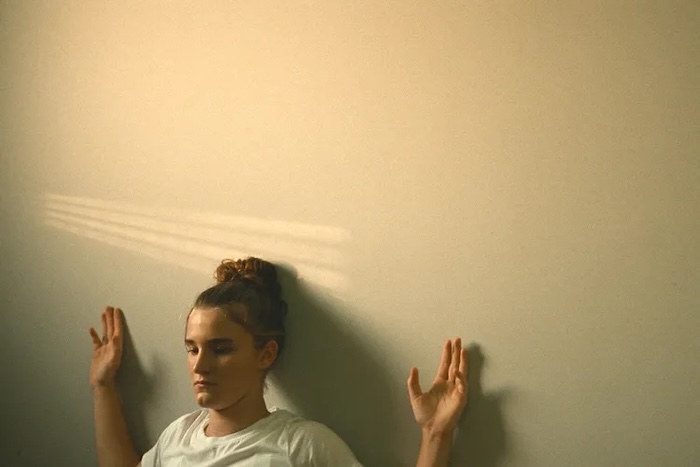
Sports movies usually have a common narrative arc about overcoming adversity, one which this Belgian film refuses to follow almost constitutionally. The title character, played by Tessa Van den Broeck, is a teen tennis prodigy. Everyone knows she’s on the road to greatness and is about to be accepted by the Belgium Tennis Federation, but then her coach, Jeremy (Laurent Caron), disappears amid whisperings of inappropriate behavior toward his younger charges and an investigation that eventually snags on Julie, who refuses to talk about him. That’s pretty much the plot.
The main impetus for the investigation is the suicide of another of Jeremy’s students, but even this story is surrounded by hushed innuendo rather than anything that can be definitely determined. Consequently, Julie’s silence becomes all the more irksome to the people whose job it is to keep the Belgian professional tennis mechanism humming, and she is soon a kind of pariah, forced to train with a new coach (Pierre Gervais) whose methodologies are different from Jeremy’s. She doesn’t like working with him at first and mostly practices on her own. Her grades suffer and even her relationship with her supportive parents is strained to the breaking point. Meanwhile, we come to understand that she is actually in contact with Jeremy, who urges her to stay silent. He is still coaching her in a sense, and yet the viewer doesn’t get the idea that Julie is being manipulated. If anything, her reticence is another facet of the singular discipline that has made her a tennis star: She won’t talk because she has decided she isn’t going to be told what to do. In one revealing scene, she drops her guard to a friend and says she feels persecuted, that the federation’s pressure for her to talk is all about class, since she is a scholarship case rather than a kid from a well-to-do family, which describes most of the other budding pros her age. To people outside and, to a certain extent, the audience Julie seems to be protecting a sexual predator, which, of course, poses questions about the nature of Julie’s and Jeremy’s relationship, questions that become more pointed when the two secretly meet in a cafe and Jeremy’s desperation becomes apparent. Whether he is a serial abuser is still up in the air, but he’s obviously a creep. “I stopped,” he says defensively. Stopped what?
What makes Leonardo van Dijl’s feature debut so arresting is the skillful way he juggles the politics of managing a sports scandal with one athlete’s refusal to engage in those politics while staying true to her athletic ambitions. As Julie’s silence deepens, the tension becomes unbearable, until you wonder if even a hard case like Julie won’t break. But the movie doesn’t necessarily go where you expect it to. The new coach eventually breaks through Julie’s self-regard, and while the movie loses momentum in the process, it feels more naturalistic, as if van Dijl knew he had to sacrifice a measure of drama in order to stay true to Julie’s own arc of self-discovery.
In Dutch, French and German. Opens Oct. 3 in Tokyo at Shinjuku Cinema Qualite (03-3352-5645), Human Trust Cinema Yurakucho (03-6259-8608).
Julie Keeps Quiet home page in Japanese
photo (c) 2024, De Wereldvrede
 philipbrasor.com