
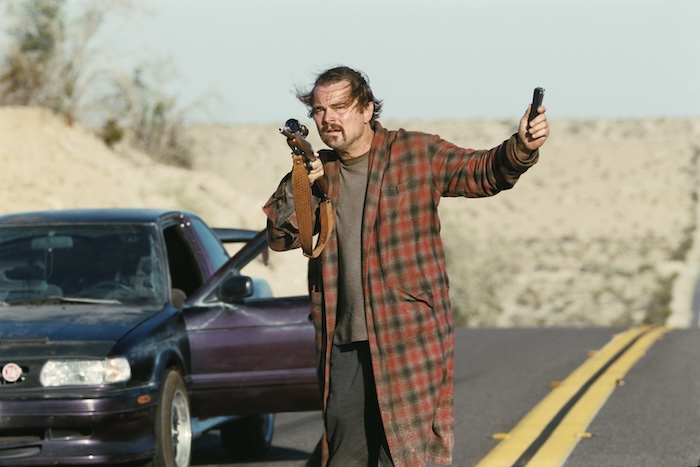
Though I’ve little use for wholesale creative comparisons, the critical observation that Paul Thomas Anderson is this century’s Stanley Kubrick makes a certain kind of sense, if only because no other contemporary director comes close to Kubrick’s playful eclecticism, especially in terms of story material. Though one could make a case for a commmon theme or mood that dominates Anderson’s oeuvre, he never repeats himself when it comes to subject matter, until now. One Battle After Another is Anderson’s second Thomas Pynchon adaptation, a feat in itself since Pynchon’s wild and woolly fiction seems all but impervious to adaptation. Moreover, Inherent Vice and Battle (based “loosely” on Vineland) are both what you would call genre exercises—the former a detective mystery, the latter a large-scale action movie complete with big explosions, gunplay, and car chases. In the end they are totally different in style and effect, but they retain Pynchon’s penchant for the absurd in ways that show how much work Anderson put into them.
And as a genre exercise, Battle may well be Anderson’s most conventional film in that its plot, while not entirely predictable, follows the formulaic development of an action flick. The prologue, as it were, is the best and most exciting part. Opening in the middle of a raid on an immigrant holding facility in what looks like the southwest U.S. by a radical left wing group called the French 75, the story injects us directly into what looks like an extreme partisan struggle for the soul of America, and you’ll have to decide for yourself if it looks at all like the struggle America is going through now. The two members of this group Anderson is most interested in are Perfidia Beverly Hills (Teyana Taylor), a no-holds-barred Black antifascist warrior with a thing for humiliating her enemies, and the white explosives operative called Ghetto Pat (Leonardo DiCaprio). These two are in what at first feels like an unlikely romantic relationship. However, during the raid, Perfidia comes across the super-macho Col. Steven Lockjaw (Sean Penn), whom she mocks sexually for fun and, inadvertently or not, turns him on. Before the title credit is even shown, there’s a rapid-fire montage showing Perfidia and Lockjaw in an occasional wild affair unbeknownst to Pat, Perfidia giving birth to a daughter, and Perfidia getting caught and ratting on her associates before disappearing into Mexico.
The movie proper takes place 16 years later, when the child has grown into a teenage firecracker taking care of Pat, now passing as Bob Ferguson, who has turned into a stoned slacker. Lockjaw has in the meantime endeavored to join a super secret white supremacist cabal, and has been doggedly looking for the fugitive remnants of the French 75 for years, though not for the ostensible reason of wiping out antifa elements (though he very much wants to) but rather because he suspects Bob’s daughter, Willa (Chase Infiniti), may actually be his. For the most part, Anderson presents this premise without a lot of stylistic elaboration, and his action set pieces are brilliantly rendered with a cockeyed verve that plays off the various invented Pynchonisms (the white supremacist group is called the Christmas Adventurers; a convent that shelters undocumented immigrants and leftist fugitives goes by the name of Sisters of the Brave Beaver) and distinctive characters, like Benicio Del Toro’s coolly resourceful karate instructor, who keep the action moving at a rapid but coherent pace. As an action movie, One Battle After Another is extremely satisfying.
And as countless media profiles have already pointed out, it’s also thematically rich, though that would seem to go without saying given the times we live in and Anderson’s choice of updating Pynchon’s story from the 80s to a kind of hyperventilating now. There’s no way a director as thoughtful and imaginative as Anderson would not take advantage of this material to comment on our current predicament, no matter how much he downplays the notion in interviews. So for me, at least, the immediate appeal of the movie is as a genre exercise, and as such it doesn’t quite stick the landing. There’s a two-pronged post-climax coda that feels superfluous and long-winded, as if Anderson felt beholden to certain genre requirements he couldn’t in good conscience subvert. As a director who always identified closely with the people who sit in a movie theater, he seems to have gone a step further by attempting to please everyone, which is, of course, impossible.
Now playing in Tokyo at Toho Cinemas Nihonbashi (050-6868-5060), Toho Cinemas Hibiya (050-6868-5068), Marunouchi Piccadilly (050-6875-0075), 109 Cinemas Premium Shinjuku (0570-060-109), Shinjuku Wald 9 (03-5369-4955), Shinjuku Piccadilly (050-6861-3011), Toho Cinemas Shinjuku (050-6868-5063), Human Trust Cinema Shibuya (03-5468-5551), Toho Cinemas Roppongi Hills (050-6868-5024).
One Battle After Another home page in Japanese
photo (c) 2025 Warner Bros. Ent.
 philipbrasor.com