
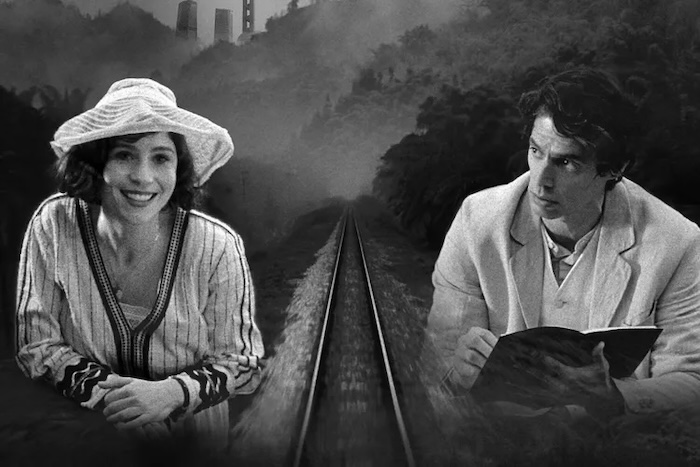
Portuguese critic-turned-director Miguel Gomes is comfortable with anachronism. It was the most obvious narrative device in his era-splitting breakthrough Tabu, and in his latest movie it’s essentially a theme. The title refers to a famous travel itinerary available to Europeans who wanted to see Asia in the early part of the 20th century, when much of the continent was still under colonial control. The tour covered all the major capitals, from Singapore and Manila to Osaka and Shanghai. Gomes uses the tour structurally in telling a story about a British colonial factotum who flees the arrival of his fiancee and does the tour, albeit informally and on the cheap, with the fiancee following close behind. Gomes alternates black-and-white recreations of the drama with 21st century documentary footage of the locations covered, thus offering a kind of comment on what the colonials never got about the places they ruled.
It’s never entirely clear why Edward (Gonçalo Waddington) decides he can’t face his betrothed, Molly (Crista Alfaiate), from whom he’s been separated for some time. The easy answer is that he’s simply a coward who can’t face up to commitment, but with each step of his journey he goes further into a kind of black pit of no return. Traveling from Singapore to Bangkok, his train derails and instead of waiting for help he hires a native to take him through the jungle. In Manila, where we are treated to real modern cock fights, he remains in a constant state of inebriation, and after arriving in Osaka escapes the Japanese authorities by hiding out in a rural temple with a bunch of monks, one of whom happens to speak his language (though the white characters are all supposed to be British, they converse in Portuguese). This mood of fatality is enhanced by the voiceover narration, which is all presented in the language of the place being depicted, and in a kind of heightened literary tone, as if written by an overarching novelist. The second half of the film traces Molly’s pursuit of Edward along the exact same route, but her journey is not desperate. It’s more sympathetic, as she encounters souls who try and usually fail to make her understand the places she visits.
Because Gomes treats the basic melodrama as farce, the colonial comments don’t always hit with as much force as they could, and a lot of Grand Tour comes off as a kind of paste-up travelogue. He doesn’t attempt to mediate the sensibilities of natives and colonists—the latter complain of the smells and inscrutability of the locals, and none think that any of the latter are there to be anything other than disposable servants. It is this aspect that the documentary elements are meant to contrast, by showing the people who live in these cities at home in an environment the colonialists abandoned out of frustration rather than conscience. In its own odd way Grand Tour is a lushly beautiful production about European stupidity, because in the end both Edward and Molly are lost to their hubris. They venture too far into a universe they don’t understand and which doesn’t want them.
In Portuguese, Burmese, Vietnamese, Mandarin, French, Spanish, Japanese and English. Opens Oct. 10 in Tokyo at Toho Cinemas Chanter Hibiya (050-6868-5001), Bunkamura Le Cinema Shibuya Miyashita (050-6875-5280).
Grand Tour home page in Japanese
photo (c) 2024-Uma Pedra No Sapato-Vivo film-Shellac Sud-Cinema Defacto
 philipbrasor.com