
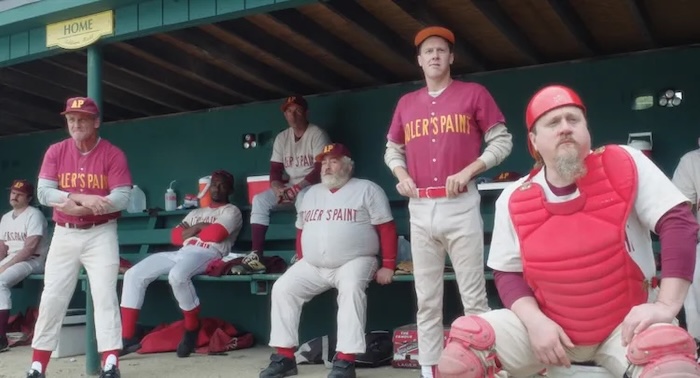
Because of Hollywood, American movies are considered the default cinematic form, meaning any other kind needs to be qualified first; but there are enough American movies that fall outside the perceived Hollywood norm to constitute their own collective genre. This odd indie film about two amateur baseball teams playing the last game on a hallowed community field that’s about to undergo redevelopment sometime in the 1990s is so American in vibe and look that it feels like an outlier. Even I, who was born and raised in a milieu not much different from the movie’s Massachusetts setting, experienced some discomfort in my acknowledgment of the way it accurately depicted a certain by-product of American manhood, an acknowledgment that was mainly felt in the bones.
Eephus, which refers to a pitch that’s so slow as to be almost supernaturally imbued, is a comedy with a lot of jokes but no punch lines, unless you consider the notion that the men on display, most of them middle aged and in bad health, have nothing to look forward to after Soldier’s Field is torn up for the sake of a new middle school is a truth that’s more comical than bitter. The thick atmosphere of small town New England is immediately manifest with the help of a local radio station (whose announcer’s voice is provided by no one less than documentary god Frederick Wiseman) and its surfeit of ads for local restaurants and auto parts stores. The first person we meet is Franny (Cliff Blake), the guy who keeps score for the games seemingly for his own amusement, though eventually he’s called on to umpire when the longhair who’s being paid to officiate walks off because the game has gone on longer than his agreement allows. The two teams, one seemingly unaffiliated, the other sponsored by a paint store, chug beer throughout the day, with one team’s pitcher doing his stuff while becoming increasingly inebriated. There’s one player who is actually nominally qualified to be a pro since he’s on a college team somewhere, but his youth automatically makes him not only an exception but a ringer. The guys use these games less as a means of physical recreation than as an excuse to get out of the house and away from the sublimated pressures of raising families and holding down jobs they hate; and what becomes clear as the very long game proceeds through the afternoon, past twilight, and into the night is that, despite their constant bellyaching, they don’t want it to end because once it does they will have no outlet with which to release their frustrations about what their lives have become. The jokes are all on them, and as darkness descends their situation turns from comically quotidian to comically desperate, and in a very American way.
That’s because director Carson Lund’s script, written with two other men, taps directly into that unique form of American male loneliness. These guys bitch and moan and get on one another’s case for being fat and out-of-shape, but the forced enmity exposes the feeling that they know they likely won’t have any reason to see one another again after this game because they can’t admit that their lives are somehow incomplete. They could always just call and get together for a beer, you think to yourself as they leave the field for the last time in their respective vehicles, but this is the decade before the ubiquity of the cell phone, a technology that kept everyone connected but contrarily encouraged social atomization. Without the premise of an organized excuse, they have no impetus for contact. Eephus shows, albeit indirectly, just how we got to that point spiritually and culturally.
Opens Oct. 17 in Tokyo at Shinjuku Piccadilly (050-6861-3011), Human Trust Cinema Shibuya (03-5468-5551).
Eephus home page in Japanese
photo (c) 2024 Eephus Film LLC
 philipbrasor.com