
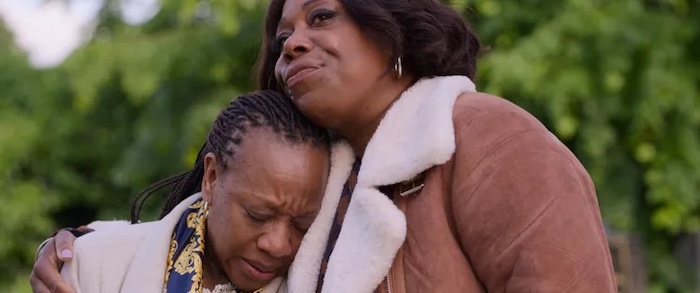
One of the many refreshing things about Mike Leigh’s cinema is the way he disregards certain prejudices in terms of plotting and characterization. There are moments during his movies when viewers may ask themselves why a certain character acts a certain way or why something happened out of the ordinary without an explanation, and Leigh won’t provide an answer. He’s got a story to tell and such considerations are beside the point in the larger scheme of things. His latest is about two Black middle aged sisters. The younger one, Chantelle (Michele Austin), has two adult daughters who are shown at work experiencing various work-related problems that aren’t developed and so feel like non sequiturs. They are also shown ineracting intimately with their mother and it seems natural to wonder where their father is. Leigh doesn’t tell you and doesn’t seem to care. Meanwhile the other sister, Pansy (Marianne Jean-Baptiste), is also shown with her family—a plumber husband, Curtley (David Webber), and an unemployed son in his early 20s, Moses (Tuwaine Barrett)—and the intrafamily dynamics there are essentially what the movie is about, but the contrast with Chantelle’s arrangement is important, and immediately brings to mind Tolstoy’s famous line in Anna Karenina about families. Whatever contributed to Chantelle and her brood’s happiness isn’t Leigh’s concern. It’s what brought Pansy and hers to such a state of abject misery.
As usual in the director’s domestic life movies, the quotidian details are paramount. Pansy lives in middle class comfort in a London suburb, but she is far from comfortable. She is, in fact, mad at everything, all the time. She wakes up in the morning as if from a horrible nightmare and faces the day as if that nightmare has followed her. Her beefs are both unassailable and pointless. She berates Moses for laying around enveloped in headphones, only leaving his room for walks to nowhere. Curtley, who is shown working hard at his job with his voluble assistant, returns home to a constant barrage of needling and fierce bitching. Pansy often naps during the day, a sign of depression, and complains bitterly of aches and pains that may or may not be psychosomatic. Leigh and Jean-Baptiste make it difficult to suss Pansy’s mindset because her behavior is so taxing to watch. In a pharmacy she aims her venomous attention at anyone who looks at her the wrong way, which seems to be everyone. She antagonizes medical personnel and insults sales staff. Her rants might be hilarious if they weren’t so relentless. In the movie’s funniest scene she trades barbs with another rager in a parking lot over a space, a cliche that Leigh handles as a kind of joke on itself, but the punch line is exhausting. Chantelle, on the other hand, lives a life of quiet accommodation, working as a hair dresser in a salon she runs. She listens patiently to her customers gossip about their love lives (“Give him ideas? I’ve got 6 kids!”) and offers sane advice when solicited for it. More significantly, she’s the only person who puts up with Pansy’s insufferable anger, and while some of the source of that anger is explained when the sisters visit their mother’s grave together, it’s obvious Pansy’s inner demons are provoked by another, more contemporary and ongoing tribulation.
Leigh eventually gets to the point, but reveals it in such a plain fashion that the viewer may not get it at first—and not without having to interrogate the central relationship, which is that between Pansy and Curtley, an even more patient being than Chantelle despite the fact that he has to put up with the storm on a daily basis. Pansy’s depression springs from a deep loneliness, but not because Curtley is abusive or neglectful. Far from it. It’s something more fundamentally irreversible and inherently tragic, and it knocks the wind out of you when you understand its provenance. It’s a very hard truth indeed, and not a particularly rare one. What’s rare is Leigh’s insightful approach.
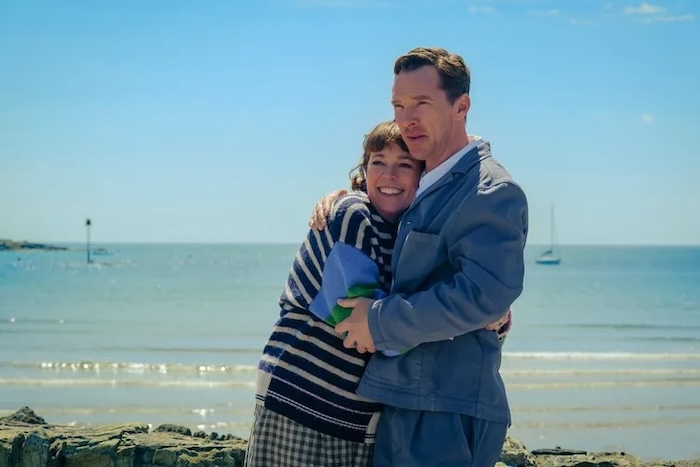
The strife that has visited the marriage of Ivy and Theo Rose (Olivia Colman, Benedict Cumberbatch) is played for laughs in a more conventional way in The Roses, even when its physical manifestation turns potentially deadly. Though clearly British, the pair live in a coastal Northern California paradise with two smart, all-American children. He’s an up-and-coming architect and she’s a world-class cook with unrealized ambitions, but Ivy’s latent frustration isn’t the reason for the couple’s mounting frictions. Theo pushes through an adventurous design for a local museum that ends up ruining his reputation, and while serendipity had much to do with the disaster, his towering ego can’t be discounted in the calculus that determines his firing. Ivy has just opened a seafood restaurant that, due to her lack of aggressive self-promotion, isn’t doing so well, but once she realizes she’s the only paycheck in the family, she doubles down and, voila!, the place becomes the toast of the Bay Area. Theo, who has taken on the double mantle of househusband and stay-at-home dad as he plots his comeback as a master builder, is thus sidelined even more as Ivy’s star rises in the hospitality trade, and therein lies the rub.
It’s also the reason why the movie doesn’t work the way its writer, Tony McNamara, and its director, Jay Roach, intend it to. Based on the same novel that Danny Devito’s caustic 1989 comedy, The War of the Roses, came from, McNamara’s script tries to contend with the changes that middle class marriage has undergone in the last 30+ years. In Devito’s movie (and presumably the novel) the wellspring of the spousal disaffection is the wife’s overflowing resentment after she concludes that she will be stuck at home for the rest of her life dependent on her husband’s financial largesse but only if she tolerates his non-negotiable emotional whims. McNamara has transferred the resentment to the husband: Theo hates that his manhood has been diminished by his wife’s success, a trite situation that the writer attempts to upend by allowing Ivy her own resentments, which are based on the notion that Theo’s effective disciplined parenting methods have turned her children into virtual strangers.
These resentments come to a head after Theo returns to his craft by designing a gorgeous seaside mansion with Ivy’s burgeoning riches. Intramarital hatred at the service of comedy can often be liberating, but despite McNamara’s facility with the kind of witty dialogue that school-trained English thesps like Colman and Cumberbatch throw off with aplomb (after all, McNamara wrote The Favourite, the movie that gave Colman an Oscar), the situations are strained and unnatural. It doesn’t help that the supporting players, which include the usually reliable Kate McKinnon and Andy Samberg, are all American actors working in a comic vernacular that makes for painful dissonance when they come in contact with the two non-American leads, as if they couldn’t really figure out what they were supposed to be doing in the same room together. I assume the Roses are meant to be unsympathetic characters, which is why their vitriol is played so monumentally, but I’m not sure if the actors know that.
Hard Truths now playing in Tokyo at Shinjuku Cinema Qualite (03-3352-5645), Cine Switch Ginza (03-3561-0707).
The Roses now playing in Tokyo at Toho Cinemas Nihonbashi (050-6868-5060), 109 Premium Cinemas Shinjuku (0570-060-109), Shinjuku Piccadilly (050-6861-3011), Shibuya Parco White Cine Quinto (03-6712-7225), Toho Cinemas Roppongi Hills (050-6868-5024).
Hard Truths home page in Japanese
The Roses home page in Japanese
Hard Truths photo (c) Untitled 23/Channel Four Television Corporation/Mediapro Cine S.L.U.
The Roses photo (c) 2025 Searchlight Pictures
 philipbrasor.com