
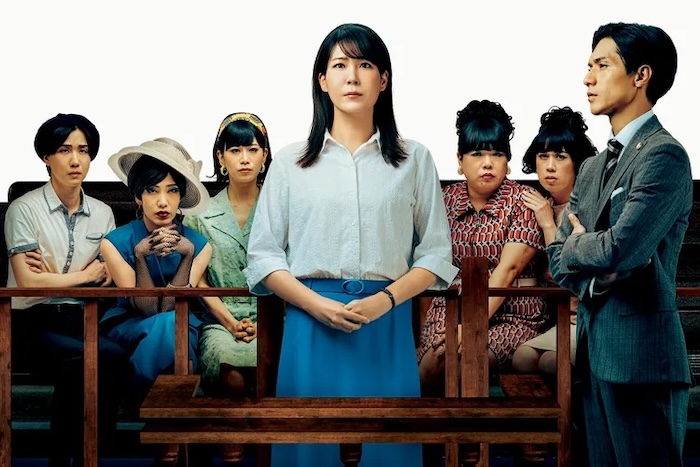
The Japanese constitution, like the American one on which it was modeled, guarantees the people the right to be happy, a rather amorphous concept that’s difficult to pin down legally, but usually it is interpreted to mean that everyone should be able to live their life the way they want to as long as it doesn’t violate another person’s right to live their life the way they want to. During the climactic courtroom scene in this feature film about the 1964 trial of a gynecologist for providing gender assignment surgery for trans women, the main witness, a trans woman who had been a patient of the defendant, was asked by the judge if she was “happy,” and she replies that she thinks she is, but that her idea of happiness may not be the same as another person’s.
Though the witness, whose name is Sachi and is played by the trans actor Miyu Nakagawa, isn’t saying anything particularly profound, in the context of the trial and, by extension, the movie itself, the remark’s ramifications are clear: Who exactly is Sachi hurting by wanting to live her life as a woman? And why should the doctor be punished by making her wish come true? That is, in fact, the kernel of the case, which takes place in 1964, since the police arrested Dr. Akagi (Takashi Yamanaka) not because he provided sex change operations, but because many of his patients were “blue boys,” the local slang for male prostitutes, some of whom were trans women. Prostitution was illegal, but since the law defined prostitution as a transaction between a man and a woman, male prostitutes who served men weren’t doing anything illegal. Even if the blue boys arrested had undergone gender assignment surgery, legally they were still considered men and couldn’t be prosecuted for prostitution, so the police targeted the doctor who made the changes possible, charging him with violating drug and eugenics laws. If that doesn’t make complete sense, it’s mainly because Japanese law is quite malleable in the hands of people who wield it, but that really isn’t the aim of the movie, which is to explore the lives of trans women at the time and how they coped with social oppression. In that regard, Sachi is a ringer, because she is not a prostitute, and though she works as a waitress, she is not in the “water trade,” meaning the night time entertainment business where most of the other trans women in the movie are employed. The infinitely patient and sympathetic defense lawyer, Inaya (Ryo Nishikido), badgers Sachi into testifying because she aspires to be a “normal woman” in that she favors most of the so-called feminine attributes that were considered wholesome during that time. And, in fact, she is living with a man, Iwamura (Ko Maehara), who knows she is trans but wants to settle down with her in a traditional marriage-like situation even if it is legally impossible.
Director Kasho Iizuka, who is a trans man, presents the case and the dramatic side stories in a straightforward way that highlights each character’s stake in the trial, which sometimes means the wider world gets shortchanged. We get a glance into Iwamura’s family life when his mother comes to visit and assumes Sachi is a woman, but the only real contrast to the demimonde depicted is Inaya’s home life, which is mainly provided to show how hard he’s working for his client. In fact, the hardest working people in the movie seem to be the tabloid reporters who sensationalize the trial in expected ways, drawing attention to the group of trans women (all of whom are played by trans actors) whose lives will be most affected by the outcome. That’s the focus of the drama, which entails tragedy and even some hilarity amid the persuasively staged sense of community.
In Japanese. Now playing in Tokyo at Toho Cinemas Nihonbashi (050-6868-5060), Toho Cinemas Hibiya (050-6868-5068), Toho Cinemas Chanter Hibiya (050-6868-5001), Toho Cinemas Shinjuku (050-6868-5063).
Blue Boy Trial home page in Japanese
photo (c) 2025 Blue Boy Jiken Film Partners
 philipbrasor.com