
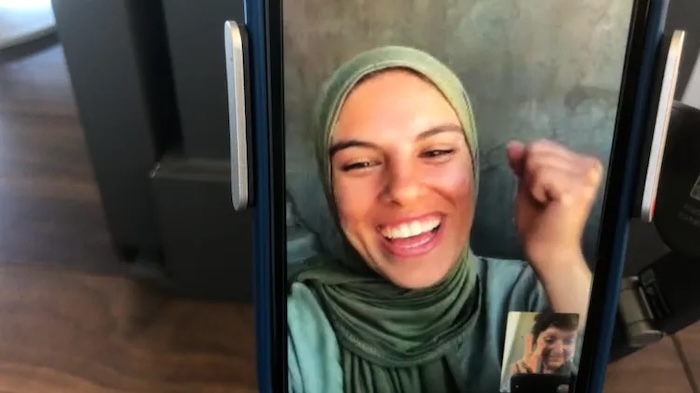
The word “documentary” only applies to Sepideh Farsi’s film in a generic way. Though it certainly is a document of the exiled Iranian director’s nine-month WhatsApp video relationship with the young Palestinian photographer Fatma Hassona, its focus on that relationship at the expense of understanding the Gaza genocide in full makes it come across as something that isn’t meant to edify people who know little about what’s really happening in Gaza. If anything, its appeal as a recording is the way it highlights Hassona as a unique representative of the struggle it’s supposed to be describing. Hassona isn’t a mouthpiece or professional raconteur. Her English is passable, her knowledge of the politics behind the war sketchy, and her ability to convey her own circumstances into something universal unformed. But she makes up for all those things with an exuberance and a love of creative endeavor that’s more than infectious. It’s the very definition of life itself. Just listening to her stumble through her reports on the horrors around her and her attempts to bring the truth of Gaza to the world with her photos feels like a privilege, because we on this side of the screen know we could never be in her position and remain that expressive, that excited about being given the chance to bring her experience to a larger audience.
At the beginning of the film, Farsi explains that when the Gaza crisis exploded following the Hamas massacre, she was thrown back to her own adolescence in Iran during the revolution that overthrew the Shah and wanted to talk to someone in the occupied territory to confirm her feelings. Unable to physically access Gaza or anyone face-to-face who had such access, she resorted to her iPhone and was introduced to Hassona through a journalist friend. On paper, the matchup must have looked merely preliminary since Hassona had no real practical experience as a photojournalist beyond her social media presence, but the chemistry is immediate and binding despite constant interruptions to the feed (Israel purposely limits cell coverage in Gaza to 2G), which Farsi does not edit out, and Hassona’s difficulties with English, which may have to do more with her bursting desire to communicate than with any purely linguistic limitations. As Farsi, who mostly speaks from her home in Paris, eventually characterizes their online relationship, each converstaion is “like a miracle,” and not just because they manage to get through to each other despite the technical issues. Hassona’s invariably beaming countenance keeps Farsi’s fears about her interlocutor’s safety at bay for as long as they talk, and the viewer gets caught up in their rapport even as Hassona discusses loved ones who’ve been killed and her own family’s constant moving around to stay alive amidst the pummeling Israeli violence, which is often audible in the background. Hassona sees her job as documenting how everyday life continues under these conditions, and her photos do exactly that with a matter-of-factness that reflects her own impossible optimism: children playing, women cooking and cleaning, families moving their belongings to somewhere that might be safer for a little while, all against a backdrop of total destruction. Behind the sunny disposition is, of course, anxiety about loved ones she sometimes shares the screen with, and while she occasionally mentions her own lack of material welfare—at one point Farsi calls her from a beach in Greece where she’s obviously taking a break and Hassona gleefully exclaims, “I want your life!”—she insists that Gaza is her home and that is where she wants to stay, even when Farsi floats the possibility that she might be able to get her out of there.
To her credit, Farsi maintains a journalistic objectivity throughout their conversations, evincing from Hassona a reaction to the Oct. 7 massacre that many viewers may not be comfortable with (“We showed the world we can fight”), and even sparring over whether Hassona’s attachment to her hijab is warranted (“I’m too embarrased to take it off in public,” i.e., on screen). But in the end, the director’s own emotional attachment to the subject of what she never expected to be a feature-length documentary is palpable and moving. At one point, she almost breaks down over her inability to do something for Hassona and her community except publicize their suffering, and Hassona comforts her in return, “You are listening to me,” she says with that irrepressible smile. “You are beside me right now and that’s enough.”
In English and Arabic. Now playing in Tokyo at Human Trust Cinema Yurakucho (03-6259-8608), Human Trust Cinema Shibuya (03-5468-5551).
Put Your Soul on Your Hand and Walk home page in Japanese
photo (c) Sepideh Farsi Reves d’Eau Production
 philipbrasor.com