

The term “recovery drama” should induce winces and feelings of trepidation in serious moviegoers. Seeing yet another sad individual overcome the depredations of addiction and stand fully sober in the sun is meant to be soul-lifting but because the genre is loaded with cliches the thinking has become, you’ve see one you’ve seen ’em all. Nora Fingscheidt’s movie, The Outrun, based on a bestselling memoir, induces that feeling early on, mostly by reflex, but due to Saoirse Ronan’s deep sympathy of the complex protagonist, Rona, the movie quickly overcomes its unfortunate allusions to recovery dramas past and makes its own unique statement about what it means to truly get over a destructive, all-consuming habit.
This difficult feat is accomplished with the help of Fingscheidt’s novel structure, which drops us will-nilly into parts of Rona’s life in both London, where she is a graduate student in biology, and the rural, windswept Orkney Islands, where she grew up on a sheep farm. Fingscheidt doesn’t bother to prepare us with time stamps and indicates where we are in Rona’s development by the color of her hair, but we get the idea that, freed from the monotony of life on a farm, Rona overcompensates in the capital by partying a bit too hard, and soon progresses from sloppy drunk to full-bore alcoholic, one who endangers not only herself but her new friends, in particular her lover Daynin (Paapa Essiedu), whose feelings for her shift from tender sympathy to caustic repulsion. She eventually enters a rehab program that cleans her up and she decides that if she remains in London she’s likely to fall off the wagon, so she goes home, initially planning to stay only a few months before resuming her studies, but the Orkneys prove to be trying as well, what with her born again mother hosting Christian hootenanies and her bipolar father living separately on the farm barely keeping it together. Attempting to build a bridge between these two estranged parents, Rona does fall off the wagon with a huge crash, and thus realizes that her only solution is complete isolation, and so takes a job as a nature survey observer on Papay, one of the most desolate islands in the Orkney archipelago.
What Fingscheidt gets particularly right is that feeling of being totally alone with nothing but your thoughts. The last twenty minutes of The Outrun is almost impressionistic in its depiction of Rona’s life in a small house at the end of a dirt road, her days spent looking for evidence of an endangered bird called the corncrake and combing the beach for different species of seaweed. There’s a stillness and beauty to these scenes that convey Rona’s struggle to just be with herself as a huge achievement. Melodrama is unnecessary, as is any demonstrative acting out. After all she’s been through, you breathe her sigh of relief for her.
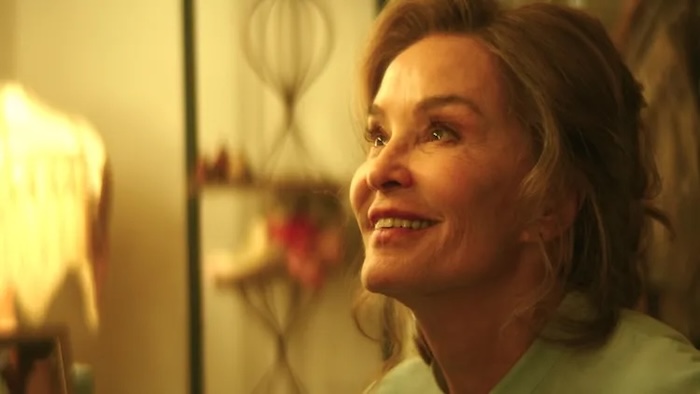
The Great Lillian Hall addresses an addiction of a completely different sort. The fictional title character, played by Jessica Lange, is a legend of the Broadway stage, a “serious” actor whose name seems to be known to everyone, or at least in Manhattan where she lives in a huge, luxurious East Side apartment. As the movie opens, Lillian is in rehearsals for a new staging of The Cherry Orchard directed by a young buck, David (Jesse Williams), as a way of forging the old and the new into something that generates big bucks, or that’s what the producer hopes. Unfortunately, rehearsals aren’t going that well, mainly owing to Lillian’s tendency to forget lines, a situation that’s concerning because she’s done this play many times before and should know it backwards and forwards. Eventually forced by the producer to see a doctor, Lillian discovers she has Lewy body dementia, a debilitating condition that not only makes it difficult for her to remember anything, but also causes hallucinations.
Lillian tries to hide her condition from the cast and crew, as well as from her daughter. The only person who knows is her feisty assistant, Edith (Kathy Bates), who saw her own father succumb to a similar condition and can recognize its effects on Lillian. Since Lange is still one of the best screen actors who can do BIG SCENES without making a fool of herself, the emotional payoffs are rich, but most of the surrounding business has a schematic feel to it. There’s the sexy neighbor (Pierce Brosnan), also an artist (a sculptor, which automatically makes you wonder how he can afford the upper West side), who draws out Lillian’s hopes and fears with witty banter. There’s the daughter (Lily Rabe) who felt neglected in childhood because her mother had no time for her. And there’s the constant visions of Lillian’s dead husband who, of course, was also her most celebrated director. In fact, the whole production may be too much of an inside job, since all the main actors have won or been nominated for Tonys and the director himself, Michael Cristofer, is a seasoned Broadway polymath. Using Chekhov’s play, which is about leaving your old life behind, is probably a bit too on-the-nose, but it’s mainly the dialogue, which is theatrical to a fault. Don’t theater people want to talk like normal human beings when they’re off stage?
The Outrun now playing in Tokyo at Cine Switch Ginza (03-3561-0707), Shinjuku Piccadilly (050-6861-3011), Shibuya Parco White Cine Quinto (03-6712-7225).
The Great Lillian Hall now playing in Tokyo at Toho Cinemas Chanter Hibiya (050-6868-5001), Kino Cinema Shinjuku (03-5315-0978).
The Outrun home page in Japanese
The Great Lillian Hall home page in Japanese
The Outrun photo (c) 2024 The Outrun Film Ltd., Weydemann Bros. GmbH, British Broadcasting Corporation and Studio Canal Film GmbH
The Great Lillian Hall photo (c) 2024 Crazy Legs Features LLC
 philipbrasor.com