
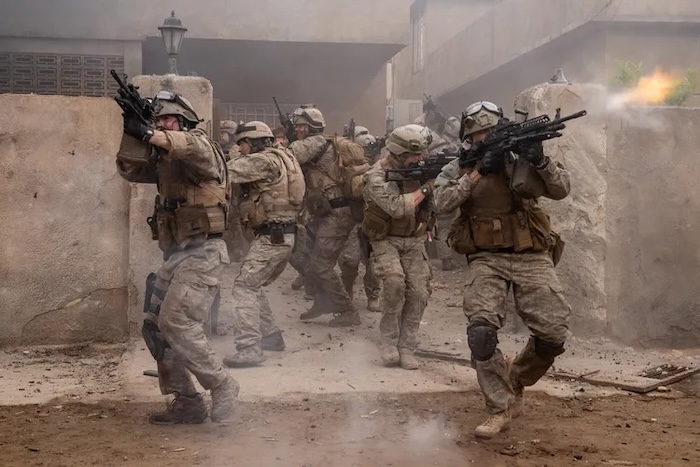
For all its narrative shortcomings, Platoon remains a hallmark of warfare cinema in that it left little to the imagination. War movies have since become almost rote in their presentation of carnage to the point where if you don’t see at least one horribly destroyed human body it seems the filmmaker isn’t doing their job. Alex Garland and Ray Mendoza take this idea back a few steps by offering carnage as only one element in a larger, seemingly more realistic presentation of what it’s like to be in the midst of battle. That means you get not only the gunfire and horrific explosions, but the unbearably tense downtime in between such instances of mayhem.
The opening title cards of Warfare inform us that the movie we’re about to see is based solely on the memories of the men who experienced the depicted operation. Those men were Navy Seals assigned to surveil a neighborhood of Ramadi, Iraq in 2006 that was controlled by an Al Qaeda cell in order to secure the area so that a squad of marines could pass through. In other words, the assignment was not an offensive action, and so the battle that ensues is not central to any strategic aim in the larger war. This seems to be Garland’s and Mendoza’s point, that “warfare” is not just about gaining ground and killing the enemy but rather that much of the time it’s about laying the groundwork for those objectives. Mendoza, who was the technical advisor for Garland’s last film, Civil War, was part of this operation and he and his fellow survivors are played by young actors without providing any background intelligence or insight into their feelings. It’s all rather clinically depicted and so a lot of what these soldiers are doing, such as communicating with their superiors somewhere distant, may be lost on the lay-person viewer, but the purport is very much felt, and Garland the action director knows how to rachet up the suspense and desperation. The sound design is more important than the special effects in that it conveys how the fog of war is made murkier by silence. After the Seals commandeer a house from a civilian Iraqi family they are supposed to remain in hiding, but somehow the cell discovers where they are and attack. We don’t know how the cell found out or what their attack plan was or if it even existed because the only narrative source is the survivors’ recollections.
Almost all the action in the movie involves evacuating two badly wounded Seals, which means, in a real sense, that the “operation” was not a success. That outcome is obvious but somehow lost in the general chaos of the movie’s development. Also lost is the POV of anyone who isn’t a Seal, meaning the Iraqi family (though they are clearly terrified) and the nominal enemy, who are only shown in long shot or through the sight of a sniper’s rifle. Warfare makes no attempt to comment on the Iraq War or American war-making attitudes in general. It’s a technical explication of the mechanics of being a soldier among soldiers, and while it succeeds on that level in the end it feels more like an exercise than a movie.
Opens Jan. 16 in Tokyo at Toho Cinemas Nihonbashi (050-6868-5060), Toho Cinemas Hibiya (050-6868-5068), Marunouchi Piccadilly (050-6875-0075), 109 Cinemas Premium Shinjuku (0570-060-109), Shinjuku Wald 9 (03-5369-4955), Shinjuku Piccadilly (050-6861-3011), Toho Cinemas Shinjuku (050-6868-5063), Kino Cinema Shinjuku (03-5315-0978), Shibuya Cine Quinto (03-3477-5905), Toho Cinemas Roppongi Hills (050-6868-5024).
Warfare home page in Japanese
photo (c) 2025 Real Time Situation LLC
 philipbrasor.com