
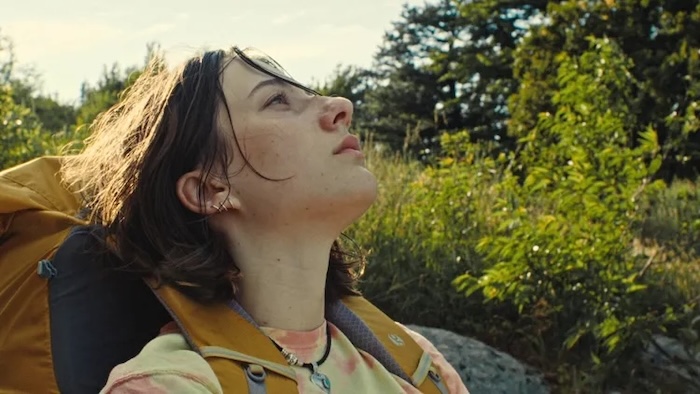
India Donaldson’s insightful debut feature, Good One, has been called a coming-of-age story, but given that the protagonist is a 17-year-old Brooklyn-bred girl who is about to go off to college, it seems more appropriate to call it a post-coming-of-age story. One of the primary points Donaldson is trying to make is that many young people, particularly girls, are more attuned to the vagaries of the human condition than their parents are if only because the latter have been beaten down by the so-called responsibilities of adulthood. Sam (Lily Collias) is the daughter of divorced parents. Her father, Chris (James Le Gros), who has remarried in late middle age to a much younger woman with whom he has a young child, is still on pretty good terms with Sam even if she looks upon his choices with a jaded eye. The movie depicts a camping trip that the two take in the Catskills with Chris’s best friend, Matt (Danny McCarthy), a failed actor who is also divorced and not taking the change as well as Chris took his. In fact, when we first meet Matt he is arguing in the doorway of his brownstone with his son, who was supposed to accompany the trio on their camping trip but now refuses to go for some reason, thus leaving Sam as the only young person with these two insecure men.
Amidst some gorgeous scenery of upstate New York, a clear dynamic is estabished. Sam and Chris are seasoned campers, while Matt is the awkward neophyte who wears jeans, packs too much unnecessary stuff, and forgets his sleeping bag. But even if Sam and Chris exude a certain air of expertise, the camaraderie that apparently highlighted their camping trips in the past has dissipated as Sam has grown more cynical and worldly and Chris less youthful in his enthusiasms. Consequently, the hike is characterized by sarcastic bickering between Chris and Matt as Sam suffers in silence with the onset of her period, which she hides from the two men as best she can. At every opportunity she takes out her cellphone and tries to communicate with her best friend back in the city, who seems to be having a better time than she is. Donaldson keeps matters fairly low key, though, with gentle background music courtesy Celia Hollander and lots of visual cutaways to forest critters. When a bunch of frat boys join them for a campfire meal, you expect something perhaps sinister, but except for the obligatory conversational sexism, Sam doesn’t have to put up with anything untoward. That will come later, when she finds herself alone with a drunken Matt who, you’ll remember, forgot his sleeping bag.
You don’t have to be Salinger to understand Sam’s position in all of this, and when the other shoe drops and she finally pushes back at Chris’s total lack of paternal concern the feeling of total rejection cuts like a knife. Sam is beyond her coming-of-age moment, even if her response is almost petulant. She realizes this in the end, but doesn’t stand down, even after her father moves quickly from anger to disappointment to a kind of grudging acceptance. She’s beyond his reach now, if, in fact, she was ever actually within it.

The father-daughter relationship in Treasure, directed by the German filmmaker Julia von Heinz, is much more settled in its dysfunction than the relationship in Good One. Thirty-six-year-old journalist Ruth (Lena Dunham) is traveling to Poland to visit Lodz, the home town of her mother, who died a year earlier, as well as Auschwitz, which her parents survived. She is accompanied by her father, Edek (Stephen Fry), though it’s apparent right from the start that she would have preferred he stayed back in New York. Edek, who doesn’t really think Ruth needs to take this trip (“What Jew goes to Poland as a tourist?”), is worried she might get taken advantage of in his native land and quickly attempts to commandeer all aspects of the journey, from accommodations to transportation to sightseeing choices, as Ruth resists mightily, determined to find out where her heroically stoical mother came from and why her father is so bent on preventing her from finding out.
The answer isn’t hard to guess for anyone familiar with the cinema of Holocaust remembrance. Since the movie takes place in 1991, Edek is still in his 60s and ebullient enough to fool you into believing that the camps weren’t a big deal for him, though his hesitation to expose his daughter to the kind of Polish social mores that made his Jewish childhood a parade of indignities still seems to be partly justified by what they encounter now that the communist system is kaput. Von Heinz and her production design staff do a creditable job of recreating the greyish feeling of a country that never had a chance to recover from the war, but her depiction of the people seems founded on Slavic stereotypes, none more striking that Edek himself, with his slouch, paunch, and witty disdain for self-seriousness. Ruth, on the other hand, is that hoary cliche, the neurotic New York Jew with an eating disorder, and it’s fascinating to watch Dunham and Fry interact until it in fact becomes a chore. It’s mainly the dynamic. Dunham seemes almost born to this kind of material, which is based on a novel that itself was “inspired by a real story,” meaning it’s auto-fiction. Dunham is as famous as a writer of barely veiled autobiographical teleplays as she is as an actor in those TV productions, and with her own well-documented problems with health and sexual relationships as subtext, she breaks through the cliches and makes Ruth a credible character. Fry, on the other hand, is known for his erudition, and his Slavic accent and purposely messy look come off as merely caricature, the performance instinctively theatrical. Playing against each other the two actors feel like oil and water.
Consequently, the big emotional payoff in the end, as Edek submits to his horrible experiences and Ruth tries to make peace with the memory of a mother who held her at arm’s length for the sake of her own peace of mind, doesn’t provide as many emotional dividends as von Heinz probably thinks it does. Treasure is a comedy at heart, and I wish the director had followed that path more closely.
Good One opens Jan. 16 in Tokyo at Human Trust Cinema Yurakucho (03-6259-8608), Human Trust Cinema Shibuya (03-5468-5551), Shinjuku Musashinokan (03-3354-5670).
Treasure, in English and Polish, opens Jan. 16 in Tokyo at Kadokawa Cinema Yurakucho (03-6268-0015), Kino Cinema Shinjuku (03-5315-0978).
Good One home page in Japanese
Treasure home page in Japanese
Good One photo (c) 2024 Hey Bear LLC
Treasure photo (c) 2024 Seven Elephants, Kings & Queens Filmproduktion, Haiku Films
 philipbrasor.com