
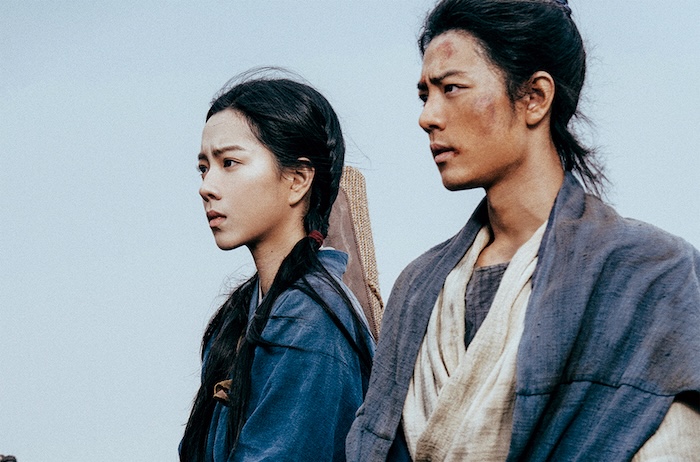
Though two-and-a-half-hours long, Tsui Hark’s distillation of a good portion of Louis Cha’s historical fantasy epic (which has been called China’s Lord of the Rings) feels rushed, at least for the first hour, probably because there’s so much stuff going on in the source series of books that can’t be elided without causing mortal harm to the overall story. At bottom, the movie takes place during the Mongol-Han wars (whether fictional or not) and concerns two fated lovers who find each other by accident, lose each other due to spiteful ignorance, and then spend the rest of the story trying to get back together against ridiculously rough odds. Guo Jing (Xiao Zhan) is a scion of the Song clan that has been defeated by the treacherous and brutal Jin Dynasty. Raised by his mother (Ada Choi) among the Mongols under Genghis Khan (Baya’ertu), who adopts Guo Jing as his son, the young man has divided loyalties that don’t really come into their own until the action-packed ending. During a pilgrimage to study some arcane martial arts and locate the tomb of his father, he meets the free-spirited Huang Rong (Zhuang Dafei), the capably independent daughter of an evil wizard who has taken up with a band of warrior brigands. While Huang Rong expands Guo Jing’s understanding of the philosophical underpinnings of the martial arts he studies, the two come into possession of something called the Novem Scripture, knowledge of which can make one all-powerful, which is why another evil wizard, Venom West (Tony Leung Ka-fai), pursues the pair.
Most of this setup is explicated in truncated fashion using a lot of visual shorthand, including action montages, and by the time Guo Jing returns to Mongolia and the princess whom Genghis Khan long ago decided he should marry, befuddlement at what transpires in the movie’s core plot will naturally occur to those of us who aren’t familiar with the books. It’s obvious why Tsui focuses on this part of the story, since it provides plenty of opportunity for both large-scale battle scenes and more circumscribed one-on-one kung fu dustups. The Jin are now encroaching on Mongol land, and Khan feels it is his “heavenly duty” to punish them, but in order to do that he will have to lead his troops through the last territory controlled by the Song, and the Song say no dice, thus setting up a showdown between Guo Jing’s adopted people and those he is bound to by blood. Meanwhile, he longs for Huang Rong, who has infiltrated the Mongol camp without his knowledge, and Venom West is tailing him to extract the magical text he covets. Without giving away too much, it’s this latter conflict that provides the big climax of the movie, not the Mongol-Song one.
Though the CG can get pretty cheesy, Tsui, the most versatile action producer-director in Hong Kong, knows how to control the emotional temperature of his scenes, whether they contain fighting or not. He seems to know this material inside-out, as if he’s read the books multiple times, and while he probably trusts his Chinese audience too much to understand how the various members of this huge cast of characters get from point A to point Z, his pacing in the second half improves remarkably. The action becomes quite relentless during the monumental fight between Guo Jing and Venom West, which even the assembled armies can’t affect. At this point the elevated diction becomes as pompously florid as the ridiculously convoluted kung-fu moves (with names like “the 12-palmed dragon quake” and “the toad miasma”), which might make you crack up at how seriously you’re supposed to take it. It’s a caveat I offer only to cover my ass. If you’ve never seen a Chinese martial arts historical fantasy, then you’ve just never seen one.
In Mandarin and Mongolian. Opens Feb. 6 in Tokyo at Toho Cinemas Hibiya (050-6868-5068), Cinemart Shinjuku (03-5369-2831), Toho Cinemas Roppongi Hills (050-6868-5024).
Legends of the Condor Heroes: The Gallants home page in Japanese
photo (c) 2025 China Film Co., Ltd.
 philipbrasor.com