
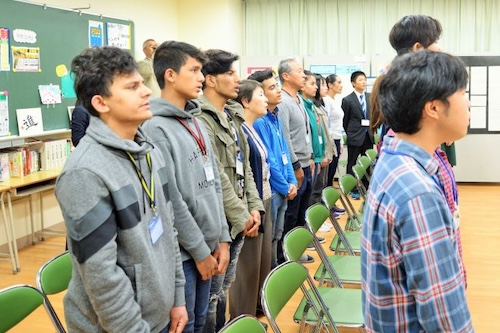
In Japan, compulsory education stops after junior high school, and though the vast majority of Japanese people now graduate from high school, it wasn’t always that way. Up until about 1980, many young people pursued full-time employment right after finishing junior high, and the jobs were not only plentiful but rewarding. I remember when I was teaching English in the late 1980s to company employees who needed intensive English training because they were being sent overseas during the go-go bubble era, a good portion of my students were junior high graduates who had gotten jobs in factories for major companies like NEC and Toyota and then worked their way up through the system. Many had become managers. In the 60s and 70s when these employees entered the work force, private companies were not necessarily looking for graduates of elite universities because their goal was to train new people on-the-job in order to make them fit their particular corporate culture.
But a junior high school education was still important, which is why at the end of the 1940s, so-called night junior high schools were established throughout Japan for the purpose of educating young people of junior high school age who otherwise could not attend conventional daytime public junior high schools because of poverty, family work, or even discrimination. That system remains in effect today, though its role has changed considerably over the years. In addition, there are fewer night junior high schools than there used to be. According to Satoshi Eguchi, an education expert writing in the Koron column of the Asahi Shimbun on Feb. 4, there are now only about 60 public night junior high schools in all of Japan, and they are barely getting by at the discretion of local education committees.
The situation had become such that in 2016, the central government implemented the Education Opportunity Assurance Law, whose mission was to have at least one public night junior high school in each city whose population exceeded 500,000. By doing so, the government thought it could assure at least one public night junior high school in each prefecture.
For the most part, students who entered night junior high schools in the late 1940s and 50s were children who worked on family farms or in family businesses and thus could not attend school during the day. Then in the 60s, after Japan and South Korea normalized relations, families of Japanese persons who were living in South Korea when the war ended and remained there started coming to Japan to live, and night junior high schools became a place where they could study the Japanese language. The same thing happened after Japan normalized relations with China in 1972, since there were many Japanese who had been abandoned as children in China after the war and who wished to “return” to Japan. Many could not speak Japanese and so they attended night junior high schools. By 1981, according to Eguchi, 69 percent of students at night junior high schools were returning Chinese and Koreans, as well as zainichi (Japan-resident) Koreans who had been prevented from attending regular public schools when they were young due to discrimination. What many of these students had in common was that they were adults, meaning not of junior high school age. Their main reason for attending night junior high schools was to become fluent in Japanese, but they also studied other required subjects in order to earn junior high school diplomas.
Shortly thereafter, many of these schools started offering Japanese language classes to general foreigners who were living in Japan. These programs came into their own in the 1990s when the government revised immigration laws to allow foreigners, mostly South Americans but also Chinese, who had Japanese relatives in their family trees to come to Japan to work and live. These new immigrants needed to learn Japanese fast, and the only free system for doing so was the night junior high school.
However, as Eguchi points out, there has never been any standardization for these schools with regard to the central government—no oversight of curricula or special funding, which means they are organized and paid for by local governments. And over the years, as budgets have tightened, many night junior high schools have closed or had their functions severely cut back. An education ministry survey conducted in 2024 found that of the 1,966 students attending night junior high school in Japan 1,256 were foreign nationals, 40 percent of whom were mainly attending to learn “Japanese language conversation.” Though many schools try to arrange classes by level of ability, low budgets and resources mean they often can’t, and so students of a wide range of language ability attend the same class.
Of course, learning Japanese just to get by in a new country is not the main mission of night junior high schools, or, at least, it isn’t based on the original purpose established in the 1940s. That purpose was to allow children who could not, for whatever reason, attend regular junior high school the opportunity to study fundamental subjects, provide “experience in participating in school activities,” and issuing certificates of graduation. But because the central government has never prioritized Japanese language education for people who come to live in Japan and, for whatever reason, do not already have Japanese language ability, locally operated night junior high schools were the only facilities where such people could study Japanese free of charge.
Now that more and more people of foreign nationality are coming to Japan to make up for the labor shortage, the need for free, effective Japanese language instruction has become urgent, but the government has done nothing except, as Eguchi puts it, “pass the buck” to local governments who fund night junior high schools. (There are some government-affiliated Japanese language programs that are free, but these are limited to temporary workers and are mostly remedial.) That’s because the government still refuses to state a comprehensible immigration policy. In the face of a dwindling population, Japan obviously needs foreign workers just to maintain its high standard of living, but the ruling party, spooked by political elements who say that foreigners, regardless of their reason for being in Japan, one-sidedly sap public resources and engage in criminal activities, has not made any sort of coherent statement with regard to foreign residents. During its campaign for last week’s general election, the victorious Liberal Democratic Party, though it has plans to increase immigration, effectively demonized foreigners in order to appeal to those voters who sympathized with the xenophobic rhetoric of parties that espouse a more nationalistic ethos.
In another essay included in Asahi’s Koron column, Iki Tanaka, a representative of a non-profit organization that works on helping people “achieve independence in life,” talked about young people of foreign nationality who are now living in Japan and want to not only learn Japanese, but also attend Japanese high school so that they can have the same opportunities as Japanese nationals. According to the law, in order for them to attend a Japanese high school, they would have to have completed nine years of education in their home country. Either that or they pass a junior high school equivalency examination, but that test is only given in Japanese. Students who cannot fulfill either of these requirements and are 15 years of age or older also cannot attend regular public junior high school, so their only alternative is night junior high school. Tanaka says that while many places in Japan do not have night junior high schools, Tokyo Prefecture has 20, “but not all of them have Japanese language classes” for foreigners. Moreover, because of local budgeting problems, these schools cannot hire teachers who specialize in Japanese as a second language. They get teachers from other disciplines, like math, to teach Japanese language, which means they often have to use translation devices in class.
As it stands right now, 40 percent of local governments in Japan offer no facilities for teaching the Japanese language. Tanaka points out that helping foreign residents learn Japanese is the most vital social integration policy, since “communication is fundamental to being a member of society.” It is also the most direct way for foreign people to learn and appreciate so-called Japanese values, which Japanese leaders constantly tell us are unique. Tanaka’s assertions are, as Japanese people would put it, “atarimae” (no-brainers), but assertions that the Japanese government refuses to take seriously because it doesn’t want to be seen as too welcoming to foreign residents. If that’s really the government’s stance, then it should say so clearly, but, in a way, it’s already true. According to reports, fewer foreigners want to work in Japan, with more actually showing interest in South Korea, which is suffering from its own labor shortage. The difference there is that while the Korean public may be as cautious as the Japanese public, the Korean government and business world has been aggressive in recruiting and training foreign workers. Reality, as it were, seems to be a national construct.
 philipbrasor.com
I’ve lived in Japan for a good many years but never fail to learn something new and valuable from your posts. Many thanks.
Although I’ve lived in Japan for a good number of years, I never fail to learn something valuable from your posts. Thanks for your efforts.