
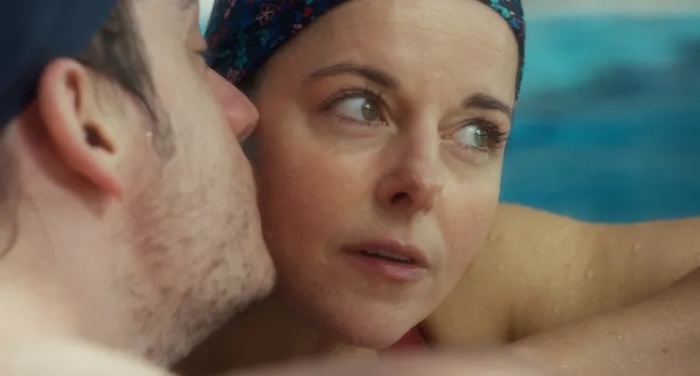
Director Anne-Sophie Bailly piles one melodramatic layer on top of another in her tale about Mona (Laure Calamy), a late middle aged single mother trying to live her life as naturally as she can while caring for her thirty-something special-needs son, Joel (Charles Peccia Galletto). But though her script forces a certain desperation on Mona’s situation, Calamy’s naturalistic performance renders it less self-determined than it initially seems. The first scene, where Mona and Joel swim laps in a public pool, establishes a bond that’s both playful and trusting, thus making every emotional decision Mona makes during the course of the film understandable, regardless of how ill-advised it might be to others.
The two live in a small apartment on the outskirts of Paris. Mona works as an aesthetician and Joel is employed by an NGO for developmentally disadvantaged adults. Joel has fallen in love with a co-worker, Océane (Julie Froger), who eventually becomes pregnant, a situation that causes concern among everyone they know. It is clear that the couple want to keep the child, despite objections from Océane’s father. The social worker tells the parents that Océane and Joel are adults and thus the decision is up to them. Mona at first takes the news stoically but with an edge of disappointment, as if Joel has betrayed her in some way, but the news is also liberating. Having given up a good portion of her life to her son’s welfare—and altogether willingly—she starts acting more impulsively, picking up a Belgian man, Frank (Geert Van Rampelberg), in a bar and taking him back to her apartment, where he unfortunately stumbles upon Joel while looking for the toilet. In the coming weeks, Joel senses his mother’s anxiety over her becoming a grandmother under such circumstances and the two find themselves at emotional odds, thus leading to a rupture that Mona takes reckless advantage of and which Bailly similarly exploits in order to show what it is that Mona is really up against, in particular Joel’s father (Jean De Pange), who, it would seem, abandoned him completely not long after he was born.
The story is hardly fresh, and if it weren’t for Calamy’s hard-bitten portrayal of a woman who has to fight not only unlucky circumstance (while all this is going on, Mona’s mother is dying) but the worst part of her nature in order to be a responsible mother, My Everything might have simply been a series of cliches about the challenges of letting go of an adult child who you think isn’t ready for the world. It’s certainly to Bailly’s credit that she leaves everyone’s fate up in the air, because trying to connect all the dramatic threads would have been futile. Her film is as moving as it needs to be without falling into the kind of miserableness you often get with French films about flawed families.
In French. Opens Feb. 13 in Tokyo at Human Trust Cinema Yurakucho (03-6259-8608), Shinjuku Musashinokan (03-3354-5670).
My Everything home page in Japanese
photo (c) 2024 L.F.P.-Les Films Pelléas/France 3 Cinema
 philipbrasor.com