
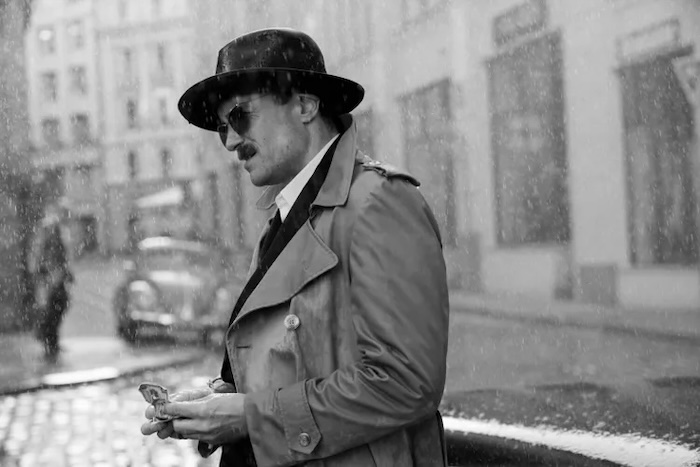
Though based on a French novel, The Disappearance of Josef Mengele, directed by the prolific expatriate Russian director Kirill Serebrennikov, offers enough convincing detail to make it feel not only closely researched but redolent of the historical moments it depicts. Mengele was the Nazi doctor who carried out horrific experiments on prisoners at Auschwitz, thus earning him the moniker “Angel of Death.” He managed to escape capture after the war and around 1950, with the help of a network of fascist sympathizers both German and non-German escaped to Argentina where the authoritarian Juan Peron presided. The novel and the movie presumes to imagine what his life in exile was like (he died in a swimming accident in 1979 in Brazil, though his body wasn’t properly identified until some years later), and though Serebrennikov liberally chops up the timeline it’s fairly easy to get a handle on how that life progressed from the 1950s to his death, and the strongest impression one gets is that the monstrousness of Mengele’s principles not only did not diminish over time, but that a lot more people than you might expect shared them.
There’s a certain measure of cognitive dissonace involved in the sequence that finds him sneaking back into Germany in 1956 to visit his rich family, which is still the dominant economic force in the town of Günzburg. His father and other kin try to convince him to stay. “Nobody is looking for you,” says his brother, and this discomfiting intelligence sets the mood for the rest of the film. Nevertheless, Mengele (August Diehl) is nothing if not self-righteously paranoid and he decides to return to South America, where Peron is soon ousted and he’s forced to flee to Paraguay with his second wife and her children from a previous marriage. Mengele’s paranoia is eventually borne out when Mossad captures Adolf Eichmann and he’s forced to escape to Brazil, where he lives under the radar with a Hungarian farm family who are refugees of the Soviet invasion. But while the couple’s own sympathies may scan right-wing—the money they receive from the Nazi underground for Mengele’s room and board seem to be more persuasive—Mengele’s insufferably imperious demeanor, which insists his hosts speak only German around him, gets him kicked out in the end. In his old age, he has to make do with his own wits, though the script hints that he’s still getting some money from the family. In a repeating, fractured sequence he’s visited in Sao Paulo by his grown son, Rolf (Max Bretschneider), a typical liberal postwar German male, who demands to know if the terrible stories about his father are true. Though Mengele doesn’t cop to his crimes, he berates Rolf about the weakness of his generation and the “natural superiority” of the German-Aryan race, and while these one-sided conversations become mind-numbing in their self-serving repulsiveness, Diehl keeps them organically attuned to the overall arc of the story, which implies that these kinds of anti-humanist impulses are universal and eternal. In fact, Serebrennikov, a vocal opponent of Putin, has said publicly that he made Disappearance as a comment on our present situation rather than as a completely historical document.
Typical of the director, the movie is a bit too long, padded out with redundancies. And while Serebrennikov’s visual style is smooth and sophisticated, some of the devices are unoriginal and self-defeating, such as filming everything in luminous black-and-white and reserving the color shots for 16mm “home movies” of his stomach-turning activities at Auschwitz, a move that conveys the idea that those were the happiest times in his life. We get the point very well without this device, which comes across as sarcastically sentimental.
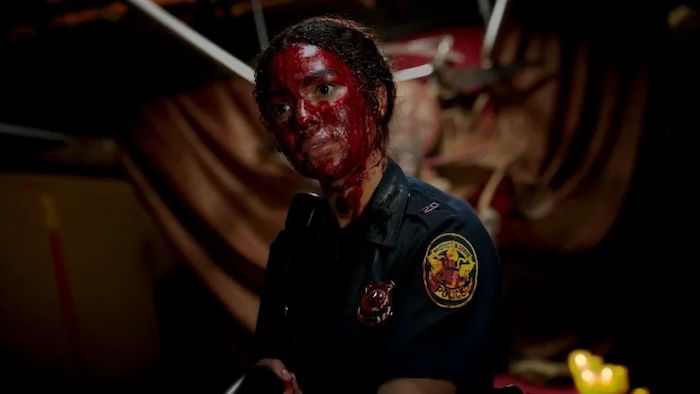
A more literal angel of death is the titular maguffin in the low-budget horror flick Malum, though the character doesn’t actually show up physically until near the end. The setup is everything: a rookie cop, Jessica (Jessica Sula), requests as her first assignment the late night shift at the mostly abandoned precinct station where her father (Eric Olson), also a cop, shot himself exactly a year earlier after killing several suspects of a Satan-worshipping cult that he had painstakingly uncovered. Jessica wants to get to the bottom of the story and, naturally, alienates her new colleagues, who have come to consider her father a guy who took his job too seriously and was driven mad by it. In essence, she’s on her own in the old station, which, on this particular anniversary, is suddenly besieged by malignant forces both within and without. Obviously, the surviving members of the cult are showing up for some kind of payback, but what does that mean?
Malum has a plot that becomes both more intriguing and less credible as the story develops, but the director, Anthony DiBlasi, makes the most of the linear journey with increasingly gory sequences set in the dimly lit hallways of the superannuated police station. In order to maintain momentum he keeps the viewer guessing as to what horrors are actually taking place in front of Jessica’s eyes and which ones are products of her overworked imagination, and I started getting itchy for something more substantial once these two threads merged and became indistinguishable. As often happens with modern horror, nothing is what it initially seems and the reveal turns out to be less compelling than the set pieces used to support it. Malum is not so much style-over-substance as it is vivid technique that overwhelms its poorly worked out intentions.
The Disappearance of Josef Mengele, in German, Spanish, Portuguese and Hungarian, opens Feb. 27 in Tokyo at Cinemart Shinjuku ’03-5369-2831), Cine Switch Ginza (03-3561-0707).
Malum opens Feb. 27 in Tokyo at Shinjuku Piccadilly (050-6861-3011), Human Trust Cinema Shibuya (03-5468-55519.
The Disappearance of Josef Mengele home page in Japanese
Malum home page in Japanese
The Disappearance of Josef Mengele photo (c) 2024 CG Cinema/Hype Studios/Lupa Film/CG Cinema International/BR/Arte France Cinema
Malum photo (c) 2023 Welcome Villain Films
 philipbrasor.com