
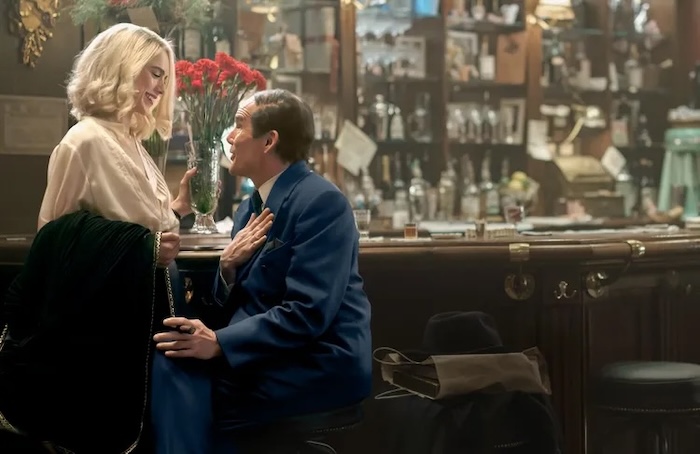
Richard Linklater’s chamber piece about the early 20th century American lyricist Lorenz Hart, Blue Moon, analyzes the nexus of art and entertainment, with the latter prevailing because the movie itself is nothing if not self-consciously witty and contrived. With a dialogue-heavy script by Robert Kaplow and the setting confined to Sardi’s restaurant on the 1943 night that the musical Oklahoma! opened on Broadway, the movie could have just as easily been a play, and often feels too theatrically chatty for its own good. Linklater’s metier is clever conversation, so he would seem to be up to the task, but he does nothing particularly interesting with it here, instead relying on his actors to push what the dialogue is selling. We already know from the opening scene that seven months after this fateful night Hart (Ethan Hawke) will be dead, so there’s a layer of doom coating every pithy bon mot, automatically loading the lines with meaning they may not have the strength to carry.
But Hart is great company, a truly cynical, self-regarding artist. We see him in the audience at the premiere of Oklahoma! seated next to his mother, who seems to be clearly enjoying the spectacle while Hart makes a show of leaving during the curtain calls. He repairs to Sardi’s where, later, the cast and crew will show up to await the reviews per Broadway tradition. Hart confides to the veteran bartender (Bobby Cannavale) his problems with the production, deriding its “third-rate cornpone humor” while praising the music of his long-time songwriting partner Richard Rodgers (“he can always get a melody to levitate”), who has turned to another lyricist, Oscar Hammerstein III, for what Hart correctly predicts will be a huge hit. It’s clear from the choice of words that Hart feels betrayed by Rodgers (Andrew Scott) and Kaplow strategically telegraphs that it’s Hart’s drinking and snobbery that have removed him from the composer’s good graces even though he hasn’t physically shown up in the movie yet to voice these opinions. The banter between customer (who at first contends he is on the wagon) and server, as well as a uniformed serviceman/saloon pianist who knows only a few of the maestro’s songs, also establishes Hart’s gay proclivities, which the bartender takes for granted (thus implying that everyone in the New York theater world does too), through some nicely nuanced criticism of Casablanca, even though Hart prefers to call himself “ambisexual,” a neologism that flies over the bartender’s head. This line of dialogue leads to what Hart claims is his real reason for being in the restaurant, which is to hook up with a young woman (Margaret Qualley) he hopes to have a love affair with, not for the sex but to affirm his celebrity and hallowed stature in the industry (she is an aspiring actress whose mother is a prominent figure in the Theater Guild), thus fortifying his self-importance.
All the actors develop these mutually supporting themes expertly and entertainingly—some of the lines are very funny—and Kaplow manages to insert real-life characters in the story in order to impress those of us who know who they are: E.B. White, Stephen Sondheim (as an adolescent), Weegee, George Roy Hill. Qualley has a moment near the end when her character describes an uncomfortable sexual dalliance in detail, and it comes across as a non sequitur, a well-intentioned acting exercise that seems to be about something else entirely. And that’s the central flaw of Blue Moon, which is supposed to be about the death of a monumental but deluded American artist whose greatness is parlayed only through his reputation and intellectual gamesmanship. I never got the sense of what made Larry Hart the genius he’s cracked up to be, except that he had the right attitude during a circumscribed period in the annals of American popular entertainment. And maybe that made all the difference in the world.
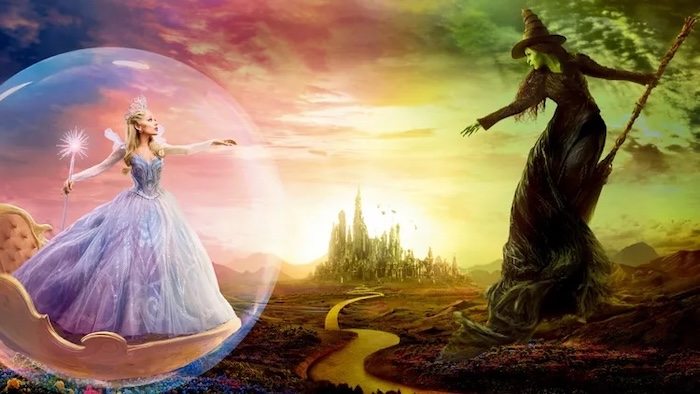
Oklahoma! is considered the first really successful book musical, so Wicked can, by any stretch of the imagination, be approached as its great-grand-progeny. The book is based on an actual book that’s a prequel to The Wizard of Oz, but it’s Stephen Schwartz’s songs that has made it one of the most enduring productions in Broadway history. Its popularity is such that the producers of the movie felt justified in adding a few songs and plot points in order to make two movies of the material rather than just one.
Whatever charms that were contained in part one, simply called Wicked, have mostly been exhausted in part two, titled facetiously Wicked: For Good. For sure, it’s hard to top part one’s big climactic production number, “Defying Gravity,” but the new movie starts slow and never really gains any kind of dramatic momentum, either in the music or in the story, which is oddly self-defeating since, according to reports (I’ve never seen the stage production), the second half of the play just whooshes on by. The whole point of “Defying Gravity” is that Elphaba (Cynthia Erivo), the nominally “wicked” witch of the west, had acquired the magical ability to fly, while her nominally “good” former BFF and fellow student of magic, Glinda (Ariana Grande), is still earthbound (Oz-bound?) because she’s never been able to cultivate any powers. It’s why the fascist enabler Madame Morrible (Michelle Yeoh) fashions a transparent bubble for Glinda to travel around in for the masses, making it look as if she’s got the juice when she doesn’t. This contrast between the two leads plays up the political dimensions of the story, wherein Elphaba is branded the bad guy and Glinda the good guy in order to advance Morrible’s authoritarian agenda with the help of the ineffectual and subservient wizard (Jeff Goldblum). Elphaba is cast as “wicked” because she’s trying to warn the populace of the elites’ plan to turn all of Oz’s heretofore animal citizens into slaves for their purely mercantile aims.
It’s a great story as far as fantastic tales go, but as a self-contained movie part two feels not only stretched out but padded, mainly with new songs and remodeled old songs that attempt to play up the seriousness of the themes, a move that effectively diminishes the overall entertainment value, giving beloved supporting players less to do and overworking the romantic aspects into insignificance. Of course, even viewers with little knowledge of the original musical will brighten up when they realize how several of the newer characters eventually evolve into the central figures of the ur-text, The Wizard of Oz, but it doesn’t make up for all the time you spend glancing at your watch.
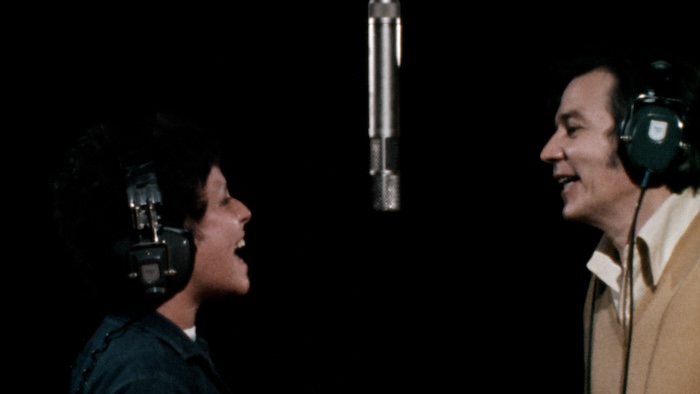
At no point during the documentary Elis & Tom, which uses film footage of Brazilian composer Antonio Carlos Jobim’s Los Angeles recording sessions with the fiery Brazilian vocalist Elis Regina in 1974 as a means of explaining his phenomenal influence on global jazz and pop in the 60s, did I wonder how much time was left, but as with Blue Moon, I left with more questions about the gensis of Jobim’s talents despite all the discourse about those talents from professionals as prestigious as Ron Carter and Wayne Shorter. The reason for this confusion is that the discourse isn’t coherently presented, which is understandable given the 50-year gap involved, but for me this obvious drawback would have simply provided a more compelling reason to dedicate more or the running time to the footage itself. Except for one take of “Aguas de Março,” the opening cut of the album being made, also titled Elis & Tom, the movie never gives us an entire song, but rather, in traditional music doc fashion, only a chorus before cutting back to the narrative, which in this case darts and weaves between first-person testimony about the recording session, a history of bossa nova centered on Jobim’s contributions, and various celebrity-focused addenda that, by themselves, could have made a more interesting movie. I mean, the TV snippet of Jobim and Sinatra dueting on “The Girl from Ipanema” will make the hairs on your neck stand up, and they leave it after the first verse.
More to the point, Regina’s role is given relatively short shrift. To the filmmakers’ credit they delve into her initial dislike of bossa nova, which she felt was too laid back. A singer who was as popular in Europe as she was in Brazil for her energetic performance style, it wasn’t until she actually worked with Jobim that she came to appreciate his novel harmonic approach and the way his style was uniquely suited to the Portuguese language. And perhaps a movie like this is not the place to go into her mental health problems or her death at age 36 from an overdose, but the manic qualities she manifests on film are never addressed as such, even though they dominate much of the footage that takes place in the studio. While some of the surviving musicians who talk about those sessions also elaborate on how bossa nova and Jobim lost their cultural cachet in the 70s, they neglect to point out how Regina herself kept the genre relevant for a younger generation of Brazilian artists.
Of course, if you have any interest at all in bossa nova, 60s pop, or 70s smooth jazz, Elis & Tom is required viewing. Since there is a criminal paucity of documentaries about Jobim and even bossa nova this may be one of the best we’ve got, and its aural riches are abundant. But it could have been so much more.
Blue Moon opens March 6 in Tokyo at Shinjuku Piccadilly (050-6861-3011), Toho Cinemas Chanter Hibiya (050-6868-5001), Human Trust Cinema Shibuya (03-5468-5551).
Wicked: For Good opens March 6 in Tokyo at Toho Cinemas Nihonbashi (050-6868-5060), Toho Cinemas Hibiya (050-6868-5068), 109 Cinemas Premium Shinjuku (0570-060-109), Shinjuku Wald 9 (03-5369-4955), Shinjuku Piccadilly (050-6861-3011), Toho Cinemas Shinjuku (050-6868-5063), Toho Cinemas Shibuya (050-6868-5002), Toho Cinemas Roppongi Hills (050-6868-5024).
Elis & Tom, in Portuguese and English, opens March 6 in Tokyo at Kadokawa Cinema Yurakucho (03-6268-0015), Yebisu Garden Cinema (0570-783-715).
Blue Moon home page in Japanese
Wicked: For Good home page in Japanese
Elis & Tom home page in Japanese
Blue Moon photo (c) 2025 Funny Valentine, LLC
Wicked: For Good photo (c) Universal Studios
Elis & Tom photo (c) 02 Produçöes Artísticas e Cinematográficas LTDA
 philipbrasor.com