
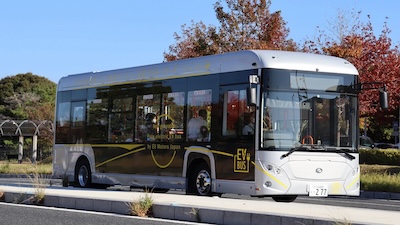
By pretty much every metric last year’s Osaka Expo was a success, an outcome that surprised a lot of people given the problems leading up to it. However, there was one problem that remains unsolved even six months after the event ended and that’s the fleet of 150 buses that was purchased for the Expo. By the time it ended 134 of them were sitting in what automotive journalist Kumiko Kato calls a “bus graveyard” in Osaka.
Sometime after Osaka was chosen as the site for the 2025 Expo, the organizers decided to use electric buses for public transportation, both on-site and between transport hubs and the Expo. Eventually, they made a deal with a company called Electric Vehicle Motors Japan (EVMJ), which is headquartered in Kita Kyushu. In accordance with directives from the transportation ministry, the Expo said it would purchase buses that were produced domestically, and at the time several local governments in Japan as well as private bus lines had already made contracts with EVMJ to provide them with vehicles.
However, Kato eventually discovered that the buses were not made in Japan. They were in fact made in China and brought to Japan in a parallel import arrangement. Parallel imports are essentially goods shipped from one country to another outside of authorized channels, as when someone buys a car overseas and ships it themself to the country they live in. An automobile brought into Japan under such circumstances is still subject to very strict inspection protocols. It’s why U.S. automakers have always claimed that Japan puts up non-tariff barriers that make it difficult for them to sell cars in Japan. However, in the case of the EVMJ buses, even these inspections were somehow not carried out. Kato found that the Chinese manufacturer of the buses imported by EVMJ essentially assembled them from inexpensive parts collected from various other manufacturers.
After the buses were put into use at the Osaka Expo they caused a lot of problems, including at least one serious accident when the brakes failed on one bus during operation. The buses were removed from service before the Expo ended.
These buses were bought from EVMJ through the auspices of Osaka Metro, which administers Osaka City Bus. Initially, Osaka City Bus had decided to buy electric buses from the Chinese company BYD, which is now the largest seller of electric vehicles in the world, but Osaka Metro instructed the company to also look into EVMJ, since Japan’s trade ministry insisted the manufacturer of the buses be a Japanese company. In the end, the BYD plan was cancelled. The proposal to buy buses from EVMJ also received strong support from the Japan Bus Association, which Kato says has a very close relationship with the ruling Liberal Democratic Party’s Parliamentary Group for Bus Industry Promotion, which ostensibly oversees policies related to buses used for public transportation throughout Japan. The Japan Bus Association, which wants the government to increase subsidies for the use of domestic electric buses, is headed by the top executive of Io Tetsu Group, a public transportation company in Shikoku, which also happens to be the largest shareholder of EVMJ.
Through these various government-approved promotional endeavors, EVMJ sold more than 300 vehicles to public transportation entities in Japan in the two years prior to the Osaka Expo deal. In contrast, BYD has sold about 500 buses in Japan over a period of ten years starting in 2015, when it sold five buses to Princess Lines in Kyoto. Consequently, BYD accounts for the largest share, about 60 percent, of electric buses operating in Japan. The only Japanese company other than EVMJ that makes electric buses is Isuzu, but as of the end of 2025, Isuzu had only sold 86.
So how come EVMJ could sell so many? The buses were assembled in China by three different companies that did not bother obtaining CCC, or China Compulsory Certification, which guarantees safety standards for vehicles that operate in China. According to Kato, EVMJ instructed the three companies, two of which had never made buses before, to provide it with vehicles as inexpensively as possible, so the companies just bought parts from parts manufacturers and assembled the buses. Though EVMJ itself announced that it was building a ¥10 billion assembly plant in Kita Kyushu starting in 2023, it appears the company has not built any buses in Japan at all. And yet press releases from various transportation companies that have bought vehicles from EVMJ insist that those vehicles were made in Japan. What Kato discovered is that the EVMJ buses assembled in China did not undergo safety certification because they were being made for export only and then parallel exported to Japan, where they were fitted with fare boxes and destination displays for local use. She points out that safety certification in China is even stricter than it is in Japan, so the EVMJ buses exported to Japan would never have been able to operate in China. When vehicles are imported to Japan, the Japanese authorities check all the parts by having the manufacturer send it all the specifications. But vehicles that are parallel imported fall under a different inspection regimen. These vehicles are inspected individually and the process is very expensive. For some reason that Kato has not uncovered yet, the EVMJ buses were approved for operation in Japan, though by any international standard of compliance they shouldn’t have been.
Last week, Kato appeared on the web news program Democracy Times (for the second time), where she said that due to her initial reports on EVMJ in various media, she has been subsequently contacted by other “related parties” who have given her more information. Four days after the EVMJ bus accident at the Expo last summer, the transportation ministry sent a warning notification to all companies in Japan that had bought EVMJ buses. Then on Sept. 3, the ministry ordered that all of the EVMJ buses being used at the Expo undergo inspection, which revealed problems with the brake hoses in 30 percent of the vehicles. Apparently, the hoses were in contact with the steering columns, whose movement abraded the hoses and made them rapidly fail.
On Oct. 17, a report about this flaw and others was submitted to the ministry, and six ministry staff were dispatched to EVMJ, which then issued a recall for a large number of vehicles on Nov. 28.
Kato implied her investigation is ongoing, which is important because she found that the government subsidies for electric vehicles that EVMJ applied for last year were approved. These subsidies come from both the transport ministry and certain local governments, and can cover as much as 90 percent of the cost of a bus. She wants to see what happens if and when EVMJ applies for the subsidies next year, now that their buses have been recalled. So far the president of EVMJ has resigned, but that seems to be the only demonstration of accountability related to the fiasco.
Addendum, March 10: Kato appeared on Democracy Times yesterday and dropped an interesting detail. According to the conditions, EV buses purchased with government subsidies must be operated for at least five years following the purchase, otherwise the government will demand the subsidy be returned. The buses sitting in the so-called bus graveyard in Osaka would seem to violate this condition, but apparently they don’t because there is no strict definition of “operation.” As long as the buses remain the property of Osaka Metro they are deemed to be “in operation,” even if they’re just sitting there unused.
 philipbrasor.com