
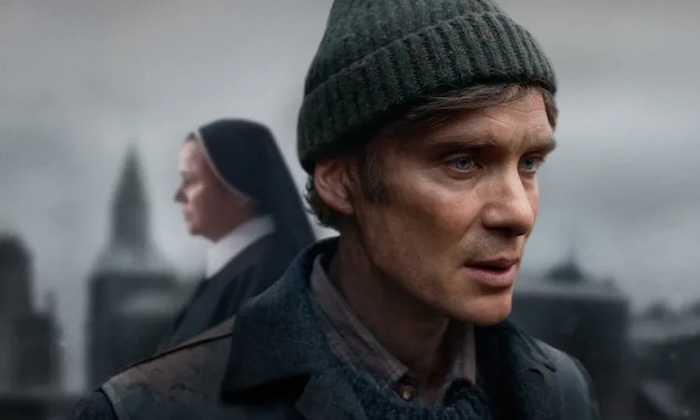
According to Tim Mielant’s drama Small Things Like These, based on a novel by Claire Keegan, Ireland in the mid-1980s was stuck in a time warp. By the end of the decade the country would be enjoying an economic boom, mainly thanks to tech businesses, but the smallish city depicted in the movie seems to exist in a continuum that stretches from the early 1950s to the late 1970s, though there are enough specific references to indicate that it’s actually 1986. This anachronistic quality is important to the movie’s theme and subject, which is how young unwed mothers were treated by the Catholic Church, the overarching political power in Ireland at the time. There have been a number of films and lots of literature produced about the so-called Magdalene Laundries, a catchall term for the way “fallen women” and their babies were deposited at convents and other institutions run by nuns and then made to work as slaves for the Church’s profit while their children were essentially sold to couples. The system wasn’t really addressed until the 1990s, when its abject cruelty was finally exposed, but Mielant’s film is more about how it affected the community, in particular one working man who couldn’t live with what he knew about it.
Cillian Murphy plays Bill Furlong, who delivers heating coal for a living. One of his customers is a convent run by the authoritarian Sister Mary (Emily Watson), where he notices young women being badly treated. One day he encounters a battered girl named Sarah (Zara Devlin) hiding in the coal shed and undergoes a crisis of conscience. As the father of five girls and the son of a single mother who gave birth to him when she herself was a teen, Furlong has an emotional stake in the convent’s exploitation of its female wards, despite Sister Mary’s warnings that she is watching him and anything he does could adversely influence the futures of his daughters, who are attending the school run by the convent. The movie does a fair job of showing how the Church lords over the town in subtle ways that makes Furlong even more depressed as he acknowledges that this monolithic power is unassailable.
The movie explores Furlong’s state of mind as he tortuously reaches a decision that is small in the scheme of things but consequential in terms of his own spiritual well-being. Though Mielant’s presentation is gritty and forceful, and the story quite moving in its simplicity, it’s also rather obvious, setting up an almost innocent working stiff against a monumentally evil religious bully. The point would seem to be that it’s small gestures like Furlong’s that eventually brought the system down, and while such a point is satisfying dramatically, it’s not particularly persuasive.
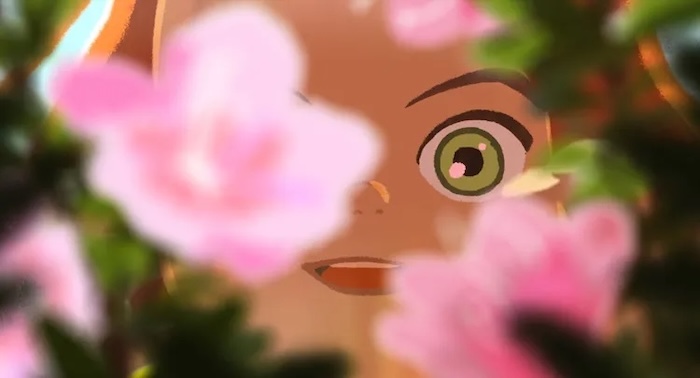
The past is also a strange country in Maïlys Vallade and Liane-Cho Han’s animated feature Little Amélie or the Character of Rain, the country literally being Japan and the time period the 1960s. The title character is the infant daughter of a Belgian diplomat who, for some unexplained reason, is stationed in what looks like the countryside of Kyoto Prefecture. He and his wife already have two young children, and in the opening scenes Amélie narrates, with philosophical self-awareness, her own birth, thinking herself a “god.” The middle-aged Japanese male obstetrician blandly characterizes the newborn as a “vegetable,” a label that doesn’t seem to alarm the parents. Since the viewer is privy to Amélie’s thoughts we know she is not a vegetable, but it takes her a while to decide that it’s worth proving she’s a sentient being that can react to normal stimuli.
The story, as such, deals with Amélie’s growing acceptance of her surroundings, which are Japanese as filtered through a European intellectual sensibility, meaning that the filmmakers are very cognizant of the cultural differences. In this sense, the most important character besides Amélie is Nishio, the young Japanese woman who once lived in the kominka Amélie’s parents are renting and who is now their housekeeper/nanny, much to the chagrin of their stern landlady, who eventually reveals she will never not look upon white people as anything but the enemy. Amélie, of course, despite her godly attributes, is innocent of history and can only observe these intrigues, but the movie is more about her journey of discovery, especially with regard to the inevitability of death and the way nature has a way of not caring what you want or think. She’s also a bit of a feminist as illustrated by her encounter with some nasty carp, all of which remind her of demanding boys and their harsh appetites.
The film’s water-color palette and somewhat pokey pacing are meant to mimic classic anime, though the physical stylings of the characters don’t look particularly Japanese. That may be intentional. From Amélie’s point of view, everything is Japanese—the title refers to her name, which Nishio shows her means “rain” when written as a Chinese character—because that’s all she knows, and at the end of her toddlerhood, when she learns the family is moving back to Belgium, she undergoes a kind of identity crisis, a feeling I’m sure the author of the source material had to inflate in order to interpret her inchoate fear of the future. Little Amélie is a little too self-aware to qualify as anyone’s idea of a blank slate, regardless of the environment she springs from, and while she’s often amusing company she’s obviously the conceit of adults who believe that pre-school childhood is the closest we ever get to the divine.
Small Things Like These opens March 20 in Tokyo at Toho Cinemas Chanter Hibiya (050-6868-5001), Shinjuku Musashinokan (03-3354-5670), Human Trust Cinema Shibuya (03-5468-5551).
Little Amélie or the Character of Rain, in French with Japanese subtitles and Japanese dubbed versions, opens March 20 in Tokyo at Toho Cinemas Nihonbashi (050-6868-5060), Toho Cinemas Hibiya (050-6868-5068), 109 Cinemas Premium Shinjuku (0570-060-109), Toho Cinemas Shinjuku (050-6868-5063), Toho Cinemas Shibuya (050-6868-5002).
Small Things Like These home page in Japanese
Little Amélie or the Character of Rain home page in Japanese
Small Things Like These photo (c) 2024 Artists Equity
Little Amélie of the Character of Rain photo (c) 2025 Maybe Movies, Ikki Films, 2 Minutes, France 3 Cinema, Puffin Pictures, 22D Music
 philipbrasor.com