
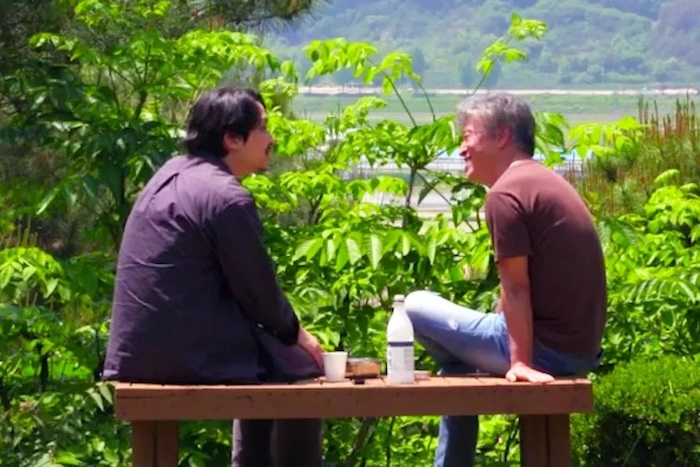
One of the most common figures of romantic stories down through the ages is the unreliable artist-lover. Extrapolated into narratives, such characters often end up being secondary to the protagonist, who is usually a woman and falls for the artist due to his creative endeavors and searching intellect, only to discover later that when it comes to more practical concerns he’s something of a loser. Hong Sangsoo adapts this theme to his own unique cinematic aesthetic in his latest film, which misleads the viewer for a while by complementing the artist-character’s obvious delusions about himself with his interlocutors’ seeming willingness to humor them. The reasons for this dynamic aren’t revealed until the end of the movie, and even then there’s a sense that Hong has it in for everyone on screen, and not just the artist.
Dong-hwa (Ha Seong-guk) is a poet and the son of a celebrity attorney, though he’s quick to point out to anyone he meets that he lives “independently” from his family. The story takes place during one day and one night when Dong-hwa drives his girlfriend, Jun-hee (Kang So-yi), to her family home in a leafy, hilly suburb of Seoul in his 1996 Kia—a personal possession that comes to bear more than its share of thematic baggage. Though his intention is only to drop off Jun-hee, when he gets a glimpse of the fine old house on the hill and Jun-hee explains how her father built it for his mother in her old age, he becomes intrigued and she invites him to get a closer look. Naturally, he runs into Jun-hee’s father, O-ryeong (Kwon Hae-hyo), and we learn it’s the first time he’s met his daughter’s boyfriend, though they’ve been dating for almost 3 years. Over the course of the day, father and potential son-in-law talk about many trivial things in the Hong style, meaning over alcoholic drinks and in a kind of arch, artificially genteel manner. (“You don’t need to speak so formally to me,” Dong-hwa says repeatedly) The young man later meets Jun-hee’s older sister, Neung-hee (Park Mi-so), who suffers from depression and lives at home now, the implication being that she’s unmarriageable; and in the evening Jun-hee’s mother, Sun-hee (Cho Yun-hee). The parents constantly take Dong-hwa’s self-deprecating philosophical pronouncements at face value as he becomes progressively inebriated, and it’s up to Neung-hee to finally administer the dose of common sense that breaks the poet’s aura of self-possession, thus exposing him as someone who isn’t at all in control of his destiny.
Though Dong-hwa’s sudden eruption during the climactic dinner scene is a shock to the movie’s previously placid surface, it’s not really a surprise, and Hong follows it up with an extended coda that finds the parents dissecting his character, which they knew as soon as they met him was not something they would want for their daughter (“He’s never faced anything hard in his life”). Meanwhile, Dong-hwa, who has passed out, wakes up in their home and goes about his business as if nothing of consequence has happened, thus confirming the viewer’s suspicion that he’s not only a wimp, but a phony aesthete. If What Does That Nature Say to You is Hong’s most blatantly obvious critique of the artistic sensibility, it’s also a bold analysis of what’s wrong with Korea’s post-Gen X youth when it comes to affairs of the heart. Maybe I’m reading too much into it, but I learned more about the country’s notorious marriageability crisis from this movie than I have from a whole raft of New York Times special reports.
In Korean. Now playing in Tokyo at Eurospace Shibuya (03-3461-0211).
What Does That Nature Say to You home page in Japanese
photo (c) 2025 Jeonwonsa Film Co.
 philipbrasor.com