
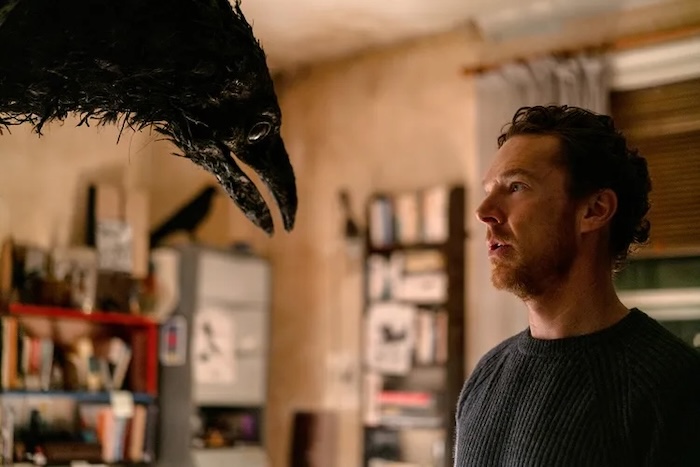
It’s been difficult to take the famous title epigram, adapted from a poem by Emily Dickinson, seriously ever since Woody Allen had fun with it in one of his New Yorker humor pieces. For Dickinson, the thing with feathers was hope. To Allen it was his nephew. In this movie and the novel it’s based on, it’s grief, and the film wastes no time bringing us down. The grieving party is an unnamed graphic novelist played by Benedict Cumberbatch who has just lost his wife. We aren’t told what she died of but the death seems to have been unexpected if not sudden. Dad is left with his two young sons (Richard and Henry Boxall) who are also devastated by the loss but not as demonstratively as is Dad, who isn’t emotionally equipped to raise two children on his own, and for a good part of the action I got the feeling that the boys were coping with their grief much better than their father was. Moreover, they seemed more worried about their father’s lack of parenting wherewithal than they are dispirited by no longer having a mother.
It’s perhaps a natural outcome of these narrative choices that Cumberbatch feels the need to act his ass off, falling easily into weeping jags every ten minutes as if on cue. The story essentially makes him a victim of his grief, which takes the form of a giant crow, voiced by David Thewlis, which hangs about in his London apartment and points out his failures as a father, an artist, and a human being. He’s also being pestered by his editor, who thinks that if he throws himself into his work—and gives him the new comic he’s contracted to deliver—he’ll return more quickly to a normal state of mind, but, of course, the work just becomes more morbid, thus compounding his misery and self-torture. Under the hissing influence of the crow, Dad himself takes on crow-like attributes, his hands at one point turning into claws and his blackest thoughts realized in what are obviously hallucinations. Though The Thing With Feathers is not a horror movie it uses a lot of horror devices in order to externalize Dad’s suffering, but the various scary incidents are arbitrary and never add up to anything coherent. When the boys start referring to someone they call the “crow-man,” you first get the feeling that they are seeing Dad’s tormentor as well, but in the end they are most likely just talking about Dad, further muddying the movie’s message.
And, in fact, what I took away from the story was that Dad was destroyed not so much by grief but rather by disappointment. “I wasn’t the amazing dad they thought I was,” he says at one point to his father-in-law, referring to his sons, and if that line seems central to explaining his mindset then the whole tale loses much of its power. Grief is a stronger dramatic theme than self-pity, so I don’t understand why the director, Dylan Southern, didn’t include a flashback to when the wife was alive in order to give us some sort of clue as to what it is exactly that Dad lost. In the end, he manages to retain his sanity, but we are given no idea as to how he accomplished this feat. The crow, it would seem, is not a destructive force but a constructive one, since he did manage to get a book out of the ordeal. The thing with feathers is a bird with a job to do.
Opens March 27 in Tokyo at Shinjuku Piccadilly (050-6861-3011), Human Trust Cinema Yurakucho (03-6259-8608).
The Thing With Feathers home page in Japanese
photo (c) The Thing With Feathers Ltd./The British Film Institute/Channel Four Television Corporation 2025
 philipbrasor.com