
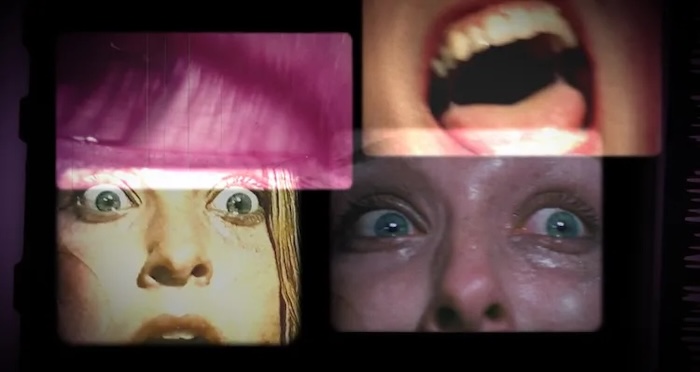
Documentary filmmaker Alexandre O. Philippe has made a tidy living out of studying scary movies, having already put The Exorcist, Psycho, and Alien under the microscope. This 2024 feature takes on what many believe to be the Rosetta Stone of slasher flicks, The Texas Chain Saw Massacre, originally released in 1974. Rather that actually go through the film and discuss its various themes and technical accomplishments, Philippe this time interviews five prominent fans of the movie who explicate their personal connection to it. By doing so, he not only avoids the dissonance that often comes with multiple talking heads working at cross purposes, but brings out aspects of the work that even people who’ve seen it dozens of times may have overlooked. That’s because he’s a good interviewer who zeroes in on his interlocutors’ obsessions, encouraging them to go deep into ideas and theories they may have entertained without interrogating them at length.
Comedian Patton Oswalt comes across as the ultimate TCM fanboy, who first watched it as an adolescent in the early 80s on a friend’s primitive VHS player (“It didn’t even have rewind or fast-forward”). Though he’s seen it 30 times, his reaction is still wonder, because, as he says, the movie plays on the viewer’s expectations as conditioned by Hollywood cliches to intensify the scares. Philippe obligingly illustrates all of Oswalt’s findings with appropriate scenes from the movie, but even more he presents a mini-montage as proof of Oswalt’s claim that TCM is basically about an entire world that’s been driven insane. Director Takashi Miike gets even more personal, relating how he accidentally happened on to a screening of TCM in the late 70s when the Chaplin movie he traveled two hours into Osaka to see was sold out. Miike is the Japanese master of torture horror, and his base appreciation of TCM is for its “beauty,” which is conveyed through its extremely visceral depiction of pain (that meat hook). He claims that his entire ouevre would have been impossible without TCM. Critic Alexandra Heller-Nicholas provides the most parochial take on the movie, pointing out that its color palette, which was washed out the first few times she saw it because the prints were so degraded, perfectly matches the experience of growing up in her native Australia, where it was banned until 1984. She’s always interpreted the movie as an environmental disaster story wherein a family responds to the destruction of their land by killing every living thing that crosses it. Stephen King, certainly the most famous person here, approaches the film from the most technical standpoint, focusing on its use of “real people” and director Tobe Hooper’s brilliant use of distraction, a tool that he ended up adopting for his own horror fictions. He also appreciates the movie’s total disregard for good taste, describing Hooper, whom he knew personally, as a “psychotic” behind the camera. Filmmaker Karyn Kusama saves the hyperbole for last, saying that TCM is a flat-out masterpiece of cinematography and pacing, with every character mapping out a “clear agenda.” As a woman, she sees the movie as a treatise on “broken masculinity.” “Leatherface isn’t a monster,” she exclaims. “He’s us.”
What one takes away from this critical discourse is that, as Kusama puts it, “America is a form of madness,” and while it’s been many years since I saw the film, that sounds pretty close to how the movie resounds in my memory. Though I don’t share these people’s enthusiasm for the film, there’s no mistaking it for anything but an extreme vision of a peculiarly American misanthropy. People in the movie kill at will because that’s what real freedom is about.
In English and Japanese. Now playing in Tokyo at Theater Image Forum Aoyama (03-5766-0114).
Chain Reactions home page in Japanese
photo (c) 2024 QBPIX LLC
 philipbrasor.com