
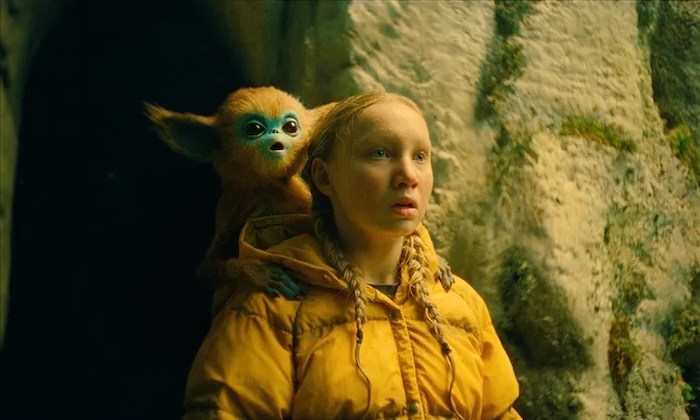
Having mostly passed through the 80s in a blur of distraction, I wasn’t fully up on current pop culture at the time the way I was in the 70s and 90s, and so the 80s revival has never really felt like a revival to me. Though The Legend of Ochi is clearly aimed at youngsters, its 80s vibe will appeal to adults who came of age during the golden age of Spielberg and Joe Dante; and, in fact, the inclusion of Finn Wolfhard in the cast seems intentionally geared toward that kind or audience, since he stars in the mother of all 80s revival projects, Stranger Things.
And of the four principal human characters in the movie, Wolfhard’s feels the most gratuitous. The protagonist, Yuri (Helena Zengel), is an adolescent tomboy living on a fictional island in the Black Sea with her father, Maxim (Willem Dafoe), and adopted older brother, Petro (Wolfhard). The communities on the island have been terrorized for centuries by the mysterious ochi, an ape-like species that kill livestock and generally cause mayhem—or, at least, that’s the story imparted by Maxim, who has made it his life’s mission to wipe out the ochi. How serious his neighbors take this mission is illustrated by his methodology, which is recruiting adolescent boys from surrounding families as his hunting crew. Yuri, whose main interests are bugs and death metal, seems to have little interest in these nocturnal excursions, though she wants to please her father. After one eventful expedition, she has an argument with Maxim who then tells her to go out and check the traps he’s set, and on her rounds she finds a juvenile ochi with his leg caught. Though told to kill an ochi whenever she encounters one she finds it impossible to dispatch the adorable creature and instead brings it back to her room where she patches it up. When Petro discovers the animal in her room she and the ochi escape so that she can return it to its home, wherever that is. On the way, and with Maxim and his boy troops in pursuit, Yuri is rescued by her shepherd hermit mother, who left Maxim and her years ago due to some primal disagreement that had to do with the ochi, with which she can communicate through music and even speech.
As a cockeyed adventure The Legend of Ochi obviously owes a lot to E.T., and Zengel conveys the proper mix of childhood awe and teenage cynicism that makes her character more than just a device. The unusual milieu allows for a lot of cheap but effective jokes that take advantage of Eastern European peasant stereotypes (most of which were probably developed during the 80s, when the area was still under Soviet sway). Writer-director Isaiah Saxon knows he needs to be inventive enough to avoid being compared to the usual suspects, and while the actual “legend” of the ochi, not to mention their culture, is intriguing, it’s couched in a New Age sensibility that’s laughable in the end; or, at least, it is to a real 80s cynic like me, which is why the sentimental ending registers as just so much cream corn. Anyone over 15 who lived through the 80s but was not engaged in the decade will probably understand my point.
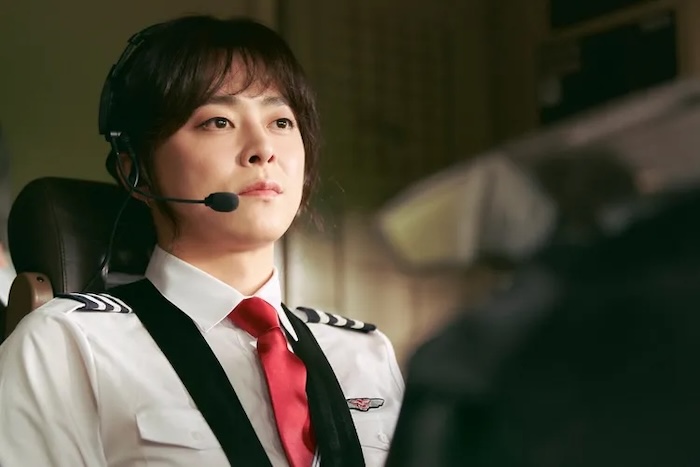
The Korean comedy Pilot operates within a completely different fantasy environment, but one that is also uniquely movie-oriented. Though plots centered on cross-dressing characters are common in Korean movies, they usually take place in historical fictions where young girls pretend to be boys in order to fulfill some kind of life ambition, like joining the court bureaucracy.
The protagonist of Pilot, Han Jung-woo (Cho Jung-seok), is a hotshot celebrity airline pilot who during a big reception thrown by the company he works for makes a patronizing speech that insults the female cabin attendants, thus sparking public ridicule and ending with Han’s being let go. Though his professional credentials are impeccable, his reputation is now dirt thanks to the predatory Korean media, and he can’t get a job at another airline, but learns that a subsidiary carrier of his old company, headed by the go-getting sister of his former boss, is purposely recruiting female pilots in order to make a point socially and commercially, and so he borrows his sister’s name, gets all dolled up like a woman, and applies for a job, which, of course, he gets. This vector of cross-dressing—man turns into a woman—is much more common in Western pop culture, as evidenced by the canonical status of Some Like It Hot, and is almost by definition comical in nature. It’s also pure fantasy. As convincing as Dustin Hoffman was in Tootsie and Robin Williams in Mrs. Doubtfire, no sentient being in real life would have believed these two to be actual females for such an extended period of time. And that’s the comic precept of Pilot, which takes the fantasy to the most ridiculous ends imaginable. The imposture becomes too successful after Han pulls off an impossible emergency landing and becomes an even bigger celebrity pilot than he was before.
Which is where the movie’s basic idea runs off the rails. Pilot is obviously trying to make some sort of point about institutional sexism, but the celebration of a female pilot proving she’s every bit as good as a male one in a situation that requires mad skills and nerves of steel loses some of its power when you know that the pilot is actually a male. For what it’s worth, there is a female pilot in Pilot who seems every bit as capable as Han if not more so, but the filmmakers simply set her up as the movie’s conscience, meaning she doesn’t have much to do as a real person. Priorities, people, priorities.
The Legend of Ochi now playing in Tokyo at Shinjuku Wald 9 (03-5369-4955), Human Trust Cinema Shibuya (03-5468-5551).
Pilot, in Korean, now playing in Tokyo at Marunouchi Piccadilly (050-6875-0075), Shinjuku Piccadilly (050-6861-3011).
The Legend of Ochi home page in Japanese
Pilot home page in Japanese
The Legend of Ochi photo (c) 2024 Kurkamart LLC and IPR.VC Fund II KY
Pilot photo (c) 2024 Lotte Entertainment, Solaire Partners LLC, Shotcake Corp., Movierock Inc.
 philipbrasor.com