
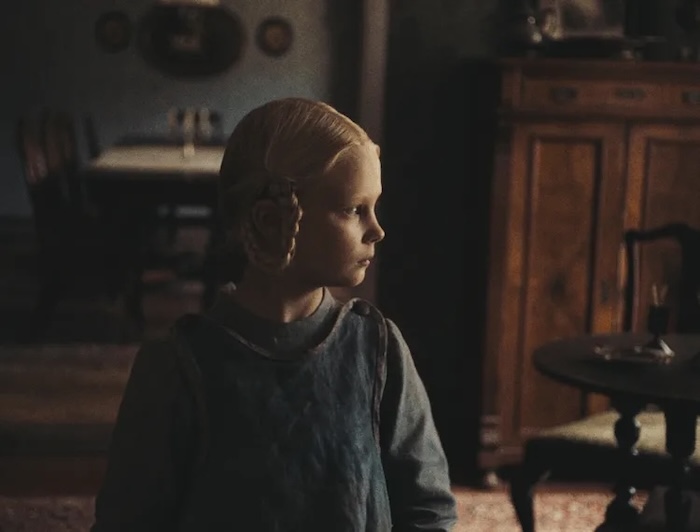
Multigenerational stories that focus on an extended lineage are usually called epics, a term that could apply to Mascha Schilinski’s second feature, Sound of Falling, except that the unifying force over the years depicted isn’t strictly a family but a family farm located in rural eastern Germany. And while the narrative is liberally spread out over four time periods, each is filtered through a girl’s narrowly delineated point-of-view rather than presented as a sweeping portrait. The stories aren’t in chronological order, but rather diced and scattered over the film’s two-and-a-half-hour running time. All four are self-contained while relating to one another in ways that is best appreciated in retrospect. Following the various threads can be frustrating at times owing to Schilinski’s overly subjective treatment of how her characters interact with their environments, but there’s an intrinsic logic at work that connects everything historically and emotionally.
The earliest story takes place around the First World War, after 7-year-old Alma (Hanna Heckt) soon realizes that she is named after another child of her parents who died before she was born. Her understanding of death, a constant reality on the farm where she lives with her many siblings, a chronically ill and ill-disposed mother, and a father of quiet tyrannical purpose, is thus clear to her and colors her understanding of the way life itself is addressed in her household, whether through ritual (funerals “fool the Lord into believing the deceased was a believer”) or customs that are frankly horrifying, such as the housemaids’ mandatory sterilization so that pregnancies do not interfere with their duties (while at the same time making them convenient rape targets for the male servants). Erika (Lea Drinda) is older but still growing up on the same farm during the Second World War, where she creepily stalks her immobile Uncle Fritz (Martin Rother), whose loss of a leg was explained in the earlier story. Angelika (Lena Urzendowsky) anchors the GDR-set tale, when the farm has become a kind of ramshackle collective where incest is common if not exactly acceptable, and dreams of fleeing to the West are interpreted as death wish fantasies. Those impulses are realized in the only section that takes place in the 21st century, wherein a family of smartphone wielding urban hippies buy the old farm to make it into a rural idyll. Their eldest daughter, Lenka (Laeni Geiseler), yearns to escape the safety of this milieu by befriending a local punk named Kaya (Ninel Geiger) simply because her mother died tragically and Kaya doesn’t seem particularly bothered by it.
Schilinski cuts abruptly between eras and related scenes without any loss of logical cohesion, though often the meaning of one scene doesn’t become apparent until much later. Most of her characters learn things by looking through keyholes, windows, doors left ajar, and cracks in walls, fortifying the idea that these girls, some sexually aware, some not, are gaining forbidden knowledge through their natural curiosity, and while that’s not a particularly original device, their curiosity invariably infects our own. A necessary caveat is that one shouldn’t come to Sound of Falling looking for insights into German history, despite the richness of incident depicted in each of the time segments. But Schiliniski trusts her viewers to bring whatever historical knowledge they have to the film, thus making it a much more disturbing viewing experience than would any straightforward melodrama that covers the same well-trod ground.
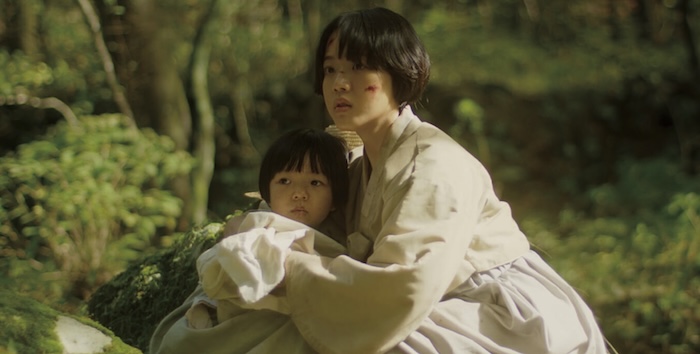
Ha Myung-mi’s Hallan is a more conventional historical feature in that is centers on a specific event, and while its viewpoint is as circumscribed as those in Sound of Falling its purpose is clearly edification. The historical circumstance is the so-called Jeju 4.3 incident, a term that refers to a riot on the Korean island of Jeju on April 3, 1947, to describe a whole 8-year uprising wherein various forces from the mainland then under U.S. and newly liberated Korean control killed tens of thousands of natives who were thought to be communist sympathizers. Ha’s movie boils the action down to a small coastal village whose inhabitants decide to flee up a nearby mountain in order to avoid roaming groups of police, Korean government troops, and right-wing paramilitary groups, who they’ve heard are killing civilians indiscriminately. The main character is Ah-jin (Kim Hyang-gi), a young mother whose schoolteacher husband belongs to a left-wing cell that once fought the Japanese colonizers and now opposes the 1948 elections because they will only take place in the portion of the peninsula controlled by the U.S., and thus, they believe, will effectively split the country in two. The husband has already retreated up the mountain and Ah-jin plans to join him there with a number of other residents, leaving behind her 6-year-old daughter, Hae-saeng (Kim Min-chae), in the care of her elderly mother, assuming the marauding soldiers won’t harm a child and an old woman.
She assumes wrongly, though Hae-saeng manages to escape the carnage—approved by an American officer on-site—and goes up the mountain alone looking for her mother. For the most part, Hallan is a mix of wartime melodrama and action potboiler, with various characters fulfill roles that are basically invented to move the agenda-laden script in the intended direction. The civilians are divided between innocents who simply want to live their lives peacefully and leftist guerillas who are determined to fight back against government oppression, even if it means killing their own to protect their interests. On the other side, there’s a hodgepodge of sensibilities, with the sadistic Sergeant Park (Hwang Jung-nam) at the fanatical anti-red end and the Christian Private Moon (Kim Won-joon) providing the bad guys with a countervailing conscience. As is often the case in war stories, the women set the moral tone while the men act out the historical prerogatives, which are presented in such a way as to point out that violence was endemic on both sides. If the authorities come off worse, it’s because they wield it against anyone with even a suggestion of proletarian instinct. The villagers are proudly working class people who get their sustenance from the sea, which automatically lends them an independent spirit that the dialogue plays up. As a result, the soldiers come across as cartoon villains beholden to an evil force that remains hidden behind a curtain off screen. It’s reductive, but moving nonetheless.
Like Terrence Malick, Ha makes the most of the lush mountain landscape, showing how beauty can turn deadly with the change of the seasons. She gets carried away with multiple endings that keep jerking the viewer’s emotions around before settling on an absolute downer that can’t be denied due to what we now know. For years, the truth about the Jeju genocide was kept from the Korean people, and Hallan (the name of a mountain orchid) is one small attempt to set the record straight, even if it doesn’t provide the larger picture. It’s a survival thriller with a context that demands further study.
Sound of Falling, in German, starts April 3 in Tokyo at Shinjuku Piccadilly (050-6861-3011), Toho Cinemas Chanter Hibiya (050-6868-5001), Human Trust Cinema Shibuya (03-5468-5551).
Hallan, in Korean and various Jeju dialects, starts April 3 in Tokyo at PolePole Higashi Nakano (03-3371-0088).
Sound of Falling home page in Japanese
Hallan home page in Japanese
Sound of Falling photo (c) Fabian Gamper – studio Zentral
Hallan photo (c) Whenever Studio






 philipbrasor.com