
 Critics have at long last realized that the development of Chinese art house cinema over the last decade has been deeply influenced by American and European film noir. The influence probably goes back further, and, for what it’s worth, film noir as an aesthetic idea is so deeply imprinted on film theory that it seems hardly worth mentioning. Bi Gan’s Long Day’s Journey Into Night, which has nothing to do with the O’Neill play, is drenched in both the mood and the attitude prevalent in classic film noir, and thus comes across as a kind of primer for what Chinese art cinema has turned into. The fact that it was something of a hit in China shouldn’t really be surprising.
As with a lot of underworld-set noir, the plot is twisty, even if close attention to detail doesn’t necessarily reap any special rewards. The movie’s time line moves fitfully back and forth between the present day and the year 2000 without being clear about the shifts. Luo (Huang Jue) has returned to his hometown of Kaili, where he once ran a gambling den, in order to attend his father’s funeral and decides to track down an old lover, Wan (Tang Wei). Bi makes the copious flashbacks to that relationship seem like dreams in that their narrative logic springs from an entirely different sensibility than the one that governs the present-day story. Though both strands take place mostly at night, the ruminations on the past are decidedly darker, overshadowed by what feels like a depressive state of mind. This feeling comes from the gradual revelation that Luo and Wan were planning on escaping their dead-end town to Macau, a scheme that apparently didn’t work out.
What happened in between isn’t clear, but it doesn’t seem to have been very good. Luo has mostly drifted, the residue of missed opportunity curdling in his brain like spoiled milk, which is why his desire to see Wan again becomes an obsession. The noir elements become acute as he follows the usual shamus routine, visiting a friend of Wan’s who is now in prison, seemingly a victim of Wan’s fickle behavior, sidetracking to a former colleague who gets caught up in his own memory of gangster deals gone bad. All the while Luo smokes countless cigarettes and looks at the ground. A little of this goes a long way, and when the movie enters its famous 60-minute single take—in 3-D, no less—as Luo’s journey really does take him deep into a night that seems artificially rendered, the sense of contrivance becomes almost too much. It’s mesmerizing but confounds whatever linear plot development Bi has accomplished up to that point—as if he’s abandoned the movie he started and cultivated so carefully for a kind of free-form experiment. It’s successful in and of itself, but leaves the viewer confused and frustrated. Only people who are prepared to be impressed probably will be. The rest of us would rather know what happened.
In Mandarin. Now playing in Tokyo at Human Trust Cinema Shibuya (3-D, 03-5468-5551), Shinjuku Picadilly (2-D, 050-6861-3011), Ikebukuro Humax Cinemas (2-D, 03-5979-1660).
Long Day’s Journey Into Night home page in Japanese.
photo (c) 2018 Dangmai Films Co., Ltd., Zhejiang Huace Film & TV Co., Ltd. – Wild Bunch/ReallyLikeFilms

 As has already been pointed out, the title of Ladj Ly’s debut feature is a kind of piss-take on the classic Victor Hugo opus, a move that both provokes curiosity and confounds expectations. It is about “poor people” in the sense that a put-upon population is pitted against their so-called betters, but Hugo’s story was classist to the core, while Ly’s is more about conflict born of authoritarianism. The “betters” in his case are represented solely by the local police contingency in the Paris banlieu of Montfermeil, where immigrant cultures live in various states of near-destitution. Crime is not exactly rampant here, but it is a mode of survival and thus the tension between the residents and the cops is ever-present and prone to eruptions of emotional if not physical violence.
 Though it’s not vital to appreciating her achievement, Waad al-Kateab was not a trained filmmaker when she started recording her day-to-day existence in the besieged Syrian city of Aleppo in 2012. At the time she was studying for a business degree, and while protests against the regime of the dictator Bashar as-Assad were growing, the civil war that eventually overran the country and destroyed Aleppo had yet to reach its deadliest phase. The beginning of this remarkable documentary contains the kind of casual everyday videos you’d expect from a 26-year-old woman who is pursuing her dream of a better life. They are hopeful and even playful at times. Al-Kateab is clearly on the sides of the rebels, longing for the day when Assad is gone, but as the national army and its proxies start bombarding the town, first to destroy rebel forces and then the IS contingents that move in to take advantage of the chaos, loyalties fade from the picture because survival is the first priority.
 Tongue-in-cheek title aside, there’s not a whole lot in Jay Roach’s takedown of Fox News that’s farcical. If anything, the movie is earnest, even sincere in the way it unloads on male toxicity in the media, but Roger Ailes is dead and Megyn Kelly, though somewhat chastened by her failure at NBC, still willfully spouts ignorant horseshit. In a word, Bombshell is burdened with too much ongoing context.
 I’ll give hot horror director Ari Aster this much: He really knows how to set the stage for his twisty mischief. Like his earlier potboiler, Hereditary, Midsommar opens with a deceptively bleak slice of melodrama. Dani (Frances Pugh), a grad student, has to cope with the tragedy of a bipolar sister in a set piece that would have made an exceptionally interesting film by itself. The trauma eats away at her already disintegrating relationship with her boyfriend, Christian (Jack Reynor), who seems more beholden to his chums, a toxic crew of privileged maleness. The one exception is Swedish softie Pelle, (Vilhelm Blomgren), an exchange student who invites Christian and his pals to his home village in Scandanavia, a kind of primitive hippie commune. Since two in this crew are studying anthropology, they are eager to go to experience the village midsummer festival. Dani’s part in this is not really clear, though Christian seems to want to patch up their relationship, and she really could use a change of scene.
 What’s immediately striking about Terrence Malick’s newest movie is that its premise does most of the work for him. Malick is known for imprinting a characteristic visual style and spiritual tone on all his stories, regardless of their provenance or theme, thus creating his own theme, which usually centers on the nexus between the natural world and God. A Hidden Life is about the Austrian farmer Franz Jagerstatter (August Diehl), who refused to fight for Adolf Hitler because of his religious beliefs. The first half of the film takes place high in the Austrian Alps, a milieu where nature is king and God’s work is taken for granted. Jagerstatter’s life is so simple that he doesn’t even need the Catholic Church to guide his spirituality (“the Church tells you so…”), and he comes off as something of an oddity in the community, a man of deep faith without need for dogma to explain how to channel that faith. He sees God in the trees and the fields and the animals and in his love for his wife, Franzi (Valerie Pachner), who gives him three children. As with many such passages in Malick’s films, this idyll is sometimes overwrought, an excess of beautiful scenes beautifully staged and shot. Some will no doubt find it tiring, but it makes Jagerstatter’s idealism whole and uncomplicated, and that’s important because it determines the choices he makes, ones that very few of us ever even contemplate.
 Justin Kelly’s cinematic retelling of the J.T. LeRoy scandal is the second film I’ve watched in a span of 24 hours about a true-life literary hoax. The day before I watched Marielle Heller’s Can You Ever Forgive Me?, which was about biographer Lee Israel’s two-year project to defraud literary memorabilia collectors by forging letters by famous dead authors. The Heller film is superior to Kelly’s, but mainly for technical reasons. Heller understands how to shoot and edit for maximum emotional resonance and how cinematic time differs from real time. Kelly’s film, which depicts a longer time period, is often confusing in that incidents almost seem to happen on top of one another. And the use of title cards and voiceovers just add to the mess of developmental tricks that are obviously used to paper over lapses in imagination.
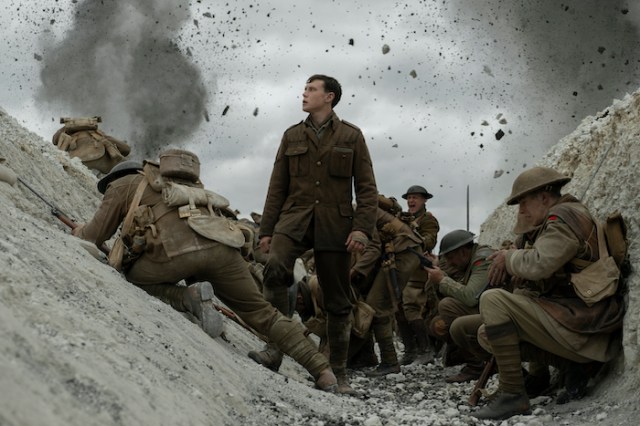 Most bets were on Sam Mendes’s World War I epic to take the Best Picture Oscar at last week’s Academy Awards ceremony, but no one seems to be griping that he was robbed. I guess that most people who saw all of the nominated films probably think that the best one won, but it’s still worth discussing why 1917 was favored in the first place. The thinking is that movies about heavy-duty themes (war) that are also technically challenging (the famous “one take” gambit) have an advantage with Academy voters. Within those narrow parameters, 1917 is quite good and exerts its intended power as you watch it. Afterwards, however, it fails to linger, a function of its gimmick rather than its theme.
 philipbrasor.com