Review: Love in the Big City

Though it’s the usual stylish froth you would expect from a mainstream Korean movie featuring two of the country’s most popular stars, Love in the Big City manages to make a timely statement about the state of affairs for young Koreans with regard to dating and romantic commitment. The two main characters are stereotypical fictional constructs in their own way, but their interactions say something significant about the local brand of toxic masculinity and how it affects the lives of people who simply want to live their lives as they please. The female lead, Jae-hee (Kim Go-eun), is privileged and free-spirited in a way that grates on her fellow university classmates, especially the boys, who find her less than solicitous to their sensibilities. The only one who seems unmoved by her sassy attitude and flouting of social norms is Heung-soo (Noh Sang-hyun), who at first seems slightly annoyed. Eventually we learn that he really doesn’t care that much, because he’s gay.

A closeted gay, of course, an attribute that’s the film’s dramatic centerpiece. Both Jae-hee and Heung-soo are majoring in French literature, and they quickly bond over their interpretation of Camus, a writer who they admire for his iconoclasm. This common interest draws them together and Jae-hee, being both sensitive and nosey, almost immediately realizes Heung-soo is homosexual and is thus even more drawn to him as a friend and fellow non-conformist. Eventually, she invites him to move into her flat, where they create their own kind of semi-impoverished bohemia. The close juxtaposition of their lives puts each in stark contrast to the other’s. Though both are a little too fond of alcohol—Love in the Big City has even more scenes of bingeing than the average Korean feature—they manifest the loss of inhibition differently. Jae-hee would be called sexually profligate in a Western movie, though here she’s mostly just romantically indiscreet, and tends to hook up with guys who can’t handle her candor. Heung-soo is constitutionally paranoid about anyone finding out about his sexual proclivities, and keeps his affairs closely concealed, especially from his mother, who suspects her son’s leanings but refuses to accept them. Heung-soo’s disposition with regard to his sexuality has the opposite effect on his relationships than Jae-hee’s does for hers—he rejects lovers who get too close even when their intentions are sincere and understanding. He just can’t risk it.

Matters come to a head when one of Jae-hee’s boyfriends discovers she is living with Heung-soo, thinking at first that they are secret lovers and thus forcing Jae-hee to reveal that Heung-soo “doesn’t like women,” a statement that turns Heung-soo against her. It’s at this point where what has been implied becomes obvious: Jae-hee and Heung-soo can only be friends in this rarefied world they’ve created, a world that’s automatically delineated by Heung-soo’s fear of being outed. A friend told me that, in terms of social content, Korean films are about 20 years behind the West, and this movie would seem to confirm that opinion, but the central relationship, while steeped in cliches requisite for big budget Korean love stories, is so finely calibrated and the actors so invested in their roles that the movie’s statement hits home. Love in the Big City also projects optimism by showing how the two roommates move beyond their codependency into responsible maturity. 

In Korean. Opens June 13 in Tokyo at Toho Cinemas Nihonbashi (050-6868-5060), Toho Cinemas Hibiya (050-6868-5068), Cinemart Shinjuku (03-5369-2831), Toho Cinemas Shibuya (050-6868-5002), Toho Cinemas Roppongi Hills (050-6868-5024).

Love in the Big City home page in Japanese

photo (c) 2024 Plus M Entertainment and Showbox Corp.
Posted in Movies | Tagged , , , , , , , | Leave a comment

Review: Thelma

Though the central dilemma posed by this action film should be significant for Japanese viewers—an elderly woman is scammed out of a large amount of money by a telephone caller pretending to represent her grandson, who the caller says has been arrested—the cultural distinctions may cause consternation. The freedom with which the title character, played by 94-year-old actor of the moment, June Squibb, goes about her daily routine points up a measure of independence that may feel somewhat alien to Japanese seniors, but I would venture to guess Thelma’s circumstances are invented in such a way so as to make the action prerogatives at least halfway believable. The film’s depiction of the differences between living by oneself in one’s own home and living in a facility should be taken with a grain of salt. Japanese viewers might find it fantastical. 

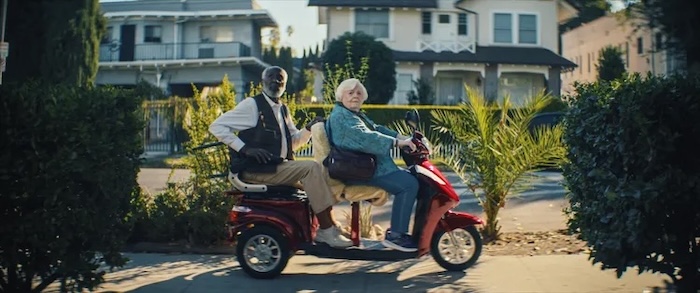
Director Josh Margolin is more concerned with adapting the conventional revenge narrative to the situation of the post-AARP crowd, and he demonstrates enough imagination in that regard to keep you interested without forcing you to consider how preposterous it all is. Thanks to Squibb, Thelma’s reaction to finding out she’s been had feels both correct and slightly batty—she’s the kind of old lady who would never raise her voice but will always make sure she understands what’s going on in order to make her point. So when the police tell her there’s little they can do to get her $10,000 back, she flips her wig, figuratively speaking, and gets to work trying to figure out who the fraudsters are. Margolin gets a lot of mileage out of her relationship to the slacker grandson, Daniel (Fred Hechinger), who loves his grandma and mostly relies on her for economic succor, mainly by lending her his expertise with modern digital life. He’s essentially the tech geek that every crime movie of this ilk requires, but in this case he’s serving an avenger who not only isn’t savvy with devices but is constitutionally against them (“Technology is what got us into this mess in the first place”). But because Thelma is forced to do the leg work herself, she has to improvise much more than John Wick does, and therein lies the movie’s implacable charm. Recruiting her old person’s home-bound best friend, Ben (the late Richard Roundtree—the original Shaft!), mainly for use of his motorized cart but also for emotional backup, she penetrates the criminals’ lair with savvy and moxie, and finds that the motivations for cheating old people are more complicated than they seem on the surface. But, in any event, she gets hers.

As an action movie, Thelma is, by necessity, slower and more deliberate, and it’s in that style where most of the humor is invested. It’s not just age that keeps Thelma from going ballistic (“I move from point to point”), even when she’s brandishing a firearm; but once she’s riled up no one can keep her down, not even Malcolm McDowell, who plays the heavy with a wink, a scowl, and his own batch of senior health issues. He’s the perfect foil for the old dame. 

Now playing in Tokyo at Toho Cinemas Chanter Hibiya (050-6868-5001), Toho Cinemas Shinjuku (050-6868-5063), Shibuya Cine Quinto (03-3477-5905).

Thelma home page in Japanese

photo (c) Universal Pictures

Posted in Movies | Tagged , | Leave a comment

Review: MaXXXine

Director Ti West and his acting collaborator, Mia Goth, have managed to accrue enough hip cachet with their porn/slasher hybrid trilogy to attract a higher class of supporting cast: Kevin Bacon, Giancarlo Esposito, Elizabeth Debicki, Bobby Cannavale, Michelle Monaghan, and even Halsey do grunt work as colorful side characters in the concluding chapter of the series, which sees the 70s-80s adult film star, Maxine Minx (Goth), attempt to scale the Hollywood heights by getting cast in a sleazy establishment-certified horror film being directed by a haughty Brit auteur with visions of John Carpenter crossover grandeur, albeit in the opposite direction. Since MaXXXine is pure, shameless 80s pastiche, there isn’t a whole lot of aesthetic and subtextual distance between what this auteur, Elizabeth Bender (Debicki), is trying to do and what West accomplishes with tongue stuffed implacably in cheek, which gives the viewer pause: Is West making fun of me? I guess you’d have to ask someone who was fully awake to the cultural charms of the 80s, because I mostly slept-walked through the decade.

Maxine, you’ll remember, was the only survivor of the porn production in the first movie, X, that was set upon by the psychotic old lady (also played by Goth), who, as we learned in the second part of the trilogy, Pearl, was sent over the edge when her own dreams of youthful stardom were railroaded by men who only wanted sex. Maxine, now ensconsed successfully in L.A.’s sex business underground (she drives a vintage Mercedes), attempts to break out, but there is a shadowy figure stalking her who knows what happened at Pearl’s farm back in Texas. Is this figure the Night Stalker serial killer who’s all over the news? Does his threat to expose her dirty secret through his private dick proxy (Bacon) have any traction? It’s difficult to say, since Maxine is conceived as such a badass, both socially and professionally, that you can only assume the stalker really doesn’t know who he’s dealing with. 

But that would be assuming too much, because West’s script is so flimsy in terms of motivation and premise-building that you can’t tell where the 80s slasher parody ends and the clever sendup of Hollywood attitude starts. It’s not so much the grotty special effects and the cheesy hard rock guitar score, which are fun in their own diminished way, but rather the sense that West and Goth don’t really seem to have any original ideas of their own. Unlike X, which at least made an effort to scope the close kinship between porn and horror, MaXXXine has nothing on offer except winking jokes about how everyone in L.A. is a failed Hollywood bizzer, including the actual bizzers themselves. Had West focused on that aspect of the movie industry, he might have made something truly terrifying.

Opens June 6 in Tokyo at Toho Cinemas Nihonbashi (050-6868-5060), Toho Cinemas Hibiya (050-6868-5068), Toho Cinemas Shinjuku (050-6868-5063), Shibuya Cine Quinto (03-3477-5905), Toho Cinemas Roppongi Hills (050-6868-5024).

MaXXXine home page in Japanese

photo (c) 2024 Starmaker Rights LLC

Posted in Movies | Tagged , | Leave a comment

Review: We Live in Time

The prerogatives of the romantic tragedy get a solid workout in this over-ambitious tale of a young heterosexual couple trying to have a child as the female partner struggles with cancer. The first thing that points up director John Crowley’s determination to make this weepie significant is the way he presents the timeline out of sequence, a not particularly original idea and one that effectively blunts the more melodramatic elements of the script. Perhaps that was his intention, but as a result the movie can’t quite work up sufficient emotional momentum. The story as it’s styled lacks surprises. 

Nevertheless, there is real chemistry between the principals, Almut (Florence Pugh) and Tobias (Andrew Garfield). When they meet, the latter is just finishing up divorce proceedings with his first wife, a matter that I would have liked to know more about because Tobias seems awfully young to be exiting a failed marriage. Almut is already a celebrated chef-in-the-making in London, while Tobias shuffles about as a breakfast cereal salesman; a contrast that Crowley also handles maladroitly. Though it would be patronizing to call Almut some kind of superwoman, she definitely has it all over Tobias in terms of drive, talent, and common sense. The point seems to be that she loves him for the earnest everyman he comes across as, because she tends to deal with high flyers in her professional life. Moreover, she gave up a promising career as a competitive figure skater for cooking, which she says she loves more. Tobias, on the other hand, exists in a constant funk of under-achievement and can barely express his feelings. Crowley emphasizes this divide with standalone episodes that are narratively brilliant but dramatically redundant: Almut taking part in a televised cooking competition while suffering the acute ravages of chemotherapy; Almut giving birth in a dirty gas station because on the way to the hospital they get stuck in traffic; Tobias crashing Almut’s baby shower to apologize profusely for a recent faux pas. In the end, you wonder how much Tobias is really holding Almut back, even as she trusts him to raise their daughter alone in the event that she succumbs to her ongoing illness.

I suppose that’s an irony designed to deepen the tragedy and the love story, but due to the out-of-sequence exposition it never makes a distinct impression. You invariably react to such gambits intellectually rather than sentimentally, and though I’m always suspicious of sentiment for its own sake, you can’t appreciate a story like this without falling victim to it.

Opens June 6 in Tokyo at Toho Cinemas Nihonbashi (050-6868-5060), Toho Cinemas Hibiya (050-6868-5068), Kino Cinema Shinjuku (03-5315-0978), Shibuya Parco White Cine Quinto (03-6712-7225), Toho Cinemas Roppongi Hills (050-6868-5024).

We Live in Time home page in Japanese

photo (c) 2024 Studiocanal SAS-Channel Four Television Corporation

Posted in Movies | Tagged , | Leave a comment

Media watch: Koreans reconsider unwed parenthood

Last Friday, the Japanese Diet took up the issue of separate names for married couples for the first time in 28 years. Though the debate about bessei—allowing partners who wed to retain their individual birth surnames rather than forcing them to choose one—has been around for the last 30 years at least, the topic has not been discussed in the national assembly owing to the ruling Liberal Democratic Party’s stubborn refusal to countenance any change to family law, saying that allowing separate surnames would undermine the integrity of the Japanese family, despite the fact that almost every other country in the world allows married couples to use separate names legally and the Japanese business community, which is hardly a bastion of liberal thought, has urged the government to change the Civil Code to permit separate names. 

The bill that would change the law is being sponsored by the opposition, which is no guarantee it will pass, but the fact that the matter is being discussed brings the possibility as close to reality as it’s ever been. One aspect that will likely be covered in the debate is the effect the bill would have on Japan’s notoriously low birth rate. Many couples do not marry simply because they want to retain their birth names, and thus if they have children as common law couples those children will be deemed illegitimate in the family register and thus in the eyes of the authorities, a status that still carries a stigma. 

According to an April 21 article in the Tokyo Shimbun, a survey conducted by an organization called Asuniwa, which is lobbying for passage of the bessei bill, found that about “half the people nationwide who would be affected by the bill’s passage,” meaning, presumably, people in common law relationships, said they would legally register their union if it does pass. More significantly, 60 percent of this demographic who are in their 20s said they would marry. The survey, which was conducted in March, was complied by Keio University Associate Professor Yuichiro Sakai, who told Tokyo Shimbun that he received responses from 1,600 people in common law relationships and unattached singles, and 49.1 percent said they would be willing to marry if the bill passes. By applying this rate to the general population, within which he calculates 1.226 million people are currently in common law relationships, that means passage of the bill could result in some 587,000 people becoming legally wed who are not wed right now. About 30 percent of the respondents cited “I don’t want to change my name” as the reason for not being married. 

Continue reading
Posted in Media | Tagged , , | Leave a comment

Review: Dream Girl: The Making of Marilyn Monroe

We hardly need another film document about Marilyn Monroe, and the bizarre tone of the English narration here could indicate that A.I. may have had something to do with its creation. Then there’s the movie’s aggressive tabloidy approach, which takes for granted the notion that the late actor did not commit suicide or succumb to an accidental overdose but rather was murdered by mob boss Joe Giancana as payback/warning to the Kennedys. Though it evinces sympathy for Monroe, its coldly analytical methodology feels harsh, as if the A.I. software were prompted by a central concept that attempted to get at the heart of the actor’s everlasting mystique by plumbing her ambition, which is suggested by the title itself. Though the narrative mentions all the men who used her for their own ends, the thesis is that Norma Jean Dougherty could never have become Marilyn Monroe without her own peculiar drive to be a movie star on terms that were not yet acceptable to Hollywood. In a sense, she forced herself on an industry that wasn’t ready for her and in doing so probably changed that industry more than any other single player.

The annoying voiceover, credited to the director, Ian Ayres, alternates with talking head interviews from the past, mostly with people who knew her intimately but weren’t famous themselves. These figures are only too happy to reveal the sordid circumstances behind Norma Jean’s upbringing—the illegitimacy, the foster homes, the abuse both sexual and emotional—and while countless other bios have raked over these stories, here they are presented so matter-of-factly as to suggest they weren’t unique to Norma Jean, which is probably true and thus more pertinent to how she sought to cope with her pain by seeking public approval on a grand scale. Her sexual escapades are presented as being common sensical rather than sordid, a perspective that glibly highlights the French provenance of the production. Monroe’s infamous inability to maintain professionalism on set—she was notoriously late to shoots and often forgot her lines—is offset by her uncanny talent for knowing exactly what the camera wanted from her at the moment. Many of the insiders interviewed explain how she seemed inept on a sound stage only to present layers of meaning in the daily rushes. To the film’s credit, it links this capability to her first acting coach, a French woman with whom she had a love affair, and her experience with the Actor’s Studio. In other words, she was a serious student who just had self-esteem problems, which probably describes almost every actor in the business, but Marilyn Monroe may have been the first movie star to use this dynamic to her advantage. 

The upshot, according to the movie, is that Monroe mostly acted on instinct rather than intellect, which may not be a novel analysis but takes into consideration the sexual politics of the era: There was never a time when she could fully assert her independence in the face of crushing male solicitude, and the parade of big swinging dicks who led her to both fame and doom represents a more complete picture of how her world operated. Norman Mailer is never mentioned in the movie, but his book has become the de facto Rosetta Stone for Marilyn studies, and he was as much a trooper in that parade as anyone. As flawed as Dream Girl is, as a documentary it’s a helpful corrective. 

In English and French. Now playing in Tokyo at Human Trust Cinema Yurakucho (03-6259-8608), Shinjuku Cinema Qualite (03-3352-5645).

Dream Girl home page in Japanese

photo (c) 2023-French Connection Films

Posted in Movies | 1 Comment

Review: When Fall Is Coming and Dog on Trial

François Ozon’s films are as varied in tone and topic as Steven Soderbergh’s, but since he’s French that tone and those topics exude a European sensibility that doesn’t always export readily to other regions. The title of his latest, When Fall Is Coming (titled more cleverly When Autumn Falls in Anglophone countries aligned with British English), sounds like a gloss on Eric Rohmer, and for the first 15 minutes or so I expected one of Rohmer’s typically dialogue-driven morality tales, but once the spiky plot kicked in it occurred to me that Ozon has been spooked by the sudden international interest in the films of compatriot Alain Guiraudie and decided he could do that too. For much of the film, we’re not sure about the fraught relationship between the main character, an elderly woman named Michelle (Hélène Vincent) who lives comfortably by herself in the French countryside, and her daughter, Valérie (Ludivine Sagnier). Michelle exists for her sole grandchild, 10-year-old Lucas (Garlan Erlos), and as the film opens she is eagerly anticipating his arrival for the summer. However, an unfortunate culinary choice on Michelle’s part lands Valérie in the hospital, and, enraged, she decides to cancel Lucas’s summer vacation with Michelle, which devastates the older woman. There’s obviously bad blood between mother and daughter, but Ozon, like Guiraudie, withholds information until late in the movie.

The vehicle of exposition is Vincent (Pierre Lottin), the ne’er-do-well son of Michelle’s best friend, Marie-Claude (Josiane Ballasko), who has just been released from prison for an undisclosed crime. Michelle, in a gesture that at first seems like a favor to Marie-Claude, hires Vincent to work around her property and then offers him a “loan” to carry out what he really wants to do, open a bar, an enterprise that even Marie-Claude finds problematic given Vincent’s mercurial temperament. Michelle’s largesse becomes even more suspicious when tragedy strikes Valérie, who is going through a messy divorce from Lucas’s father and is having problems at work. Ozon provides plenty of hints that Vincent has something to do with the tragedy and various interested parties, including the viewer, can’t help but wonder if wheels aren’t being greased to bring about a mostly satisfying outcome for both Michelle and Vincent. Even the police get involved, but, like the audience, can’t quite penetrate the hazy veil of ostensibly good intentions that hangs between the known facts and the actual truth. Suffice to say that Michelle’s troubled relationship with Valérie is eventually explained with the kind of forthrightness that Guiraudie rarely exhibits. The movie could have been more accurately titled Secrets and Lies, except that Ozon is too coy to give us any indication of what we should accept as the truth.

He knows how to layer the story. In the end, the gestalt of the attendees at a funeral says more about the social milieu inhabited by Michelle and Marie-Claude than any specific plot point. But the movie throws so many red herrings in the story’s path that you may get the feeling Ozon is just trying to put you on. Michelle is a wonderful character—a truly adorable Gaullist grandma with a steady command of her ethical compass—and a simpler movie about her life would probably have been more appealing. 

One of the hallmarks of the above-mentioned French sensibility in terms of narrative presentation is humor that often feels off to non-Europeans. It’s present in Ozon’s film, but is much more pronounced in actor Laetitia Dosch’s directoral debut, Dog on Trial, which distills several actual cases regarding animal rights in Switzerland into a treatise on how legal arguments can and can’t be applied to situations involving non-human subjects. 

Dosch stars as Avril Lucciani, a self-styled “lawyer for lost causes,” whose boss wants her to be more realistic about the cases she takes, since her dedication to human rights never results in victory in court. Nevertheless, she decides to take on Cosmos, a sad-eyed mutt who has been accused of biting a woman on the face and causing a disfigurement requiring plastic surgery. It is apparently not Cosmos’s first offense and the trial will determine not only if his human companion, a poor, disabled, but spirited man named Dariuch (François Damiens), will have to pay compensation, but also if Cosmos is to be put down. The essential hurdle for Avril is that Swiss law designates animals as “things” without agency or rights, and thus the very idea of a dog being granted due process is not guaranteed, but eventually the timid judge (Mathieu Demy) agrees to hear the case. 

Though hilarity doesn’t immediately ensue, it’s not for want of trying. The lawyer for the plaintiff is a grandstanding demogogue running for mayor who refuses to countenance Avril’s brainy approach to her defense, which involves bringing in animal psychologists, professional dog trainers, and a decidedly ridiculous experiment in cross-examining Cosmos—which he, predictably, fails. Even religious experts are called to testify, leading to an interfaith discussion of the morality of castration. Several distracting subplots include Avril’s adolescent neighbor, Joachim (Tom Fiszelson), whom she believies is being abused by his parents, and Avril’s checkered love life. Dosch treats it all with a disarmingly light touch that can be funny when the mood suits the material, but since she’s addressing a genuine social issue—do domestic animals have rights?—many of the jokes feel flat-footed. Personally, I was quite shocked by Cosmos’s fate, since it was explained in such an offhanded way. The dog who played him certainly had the most expressive face of any of the actors. He deserved better. 

When Fall Is Coming, in French, now playing in Tokyo at Shinjuku Piccadilly (050-6861-3011), Toho Cinemas Chanter Hibiya (050-6868-5001).

Dog on Trial, in French, now playing in Tokyo at Cine Switch Ginza (03-3561-0707).

When Fall Is Coming home page in Japanese

Dog on Trial home page in Japanese

When Fall Is Coming photo (c) 2024-FOZ-France 2 Cinema-Playtime

Dog on Trial photo (c) Bande a Part-Atelier de Production-France 2 Cinema-RTS Radio Television Suisse-SRG SSR-2024

Posted in Movies | Tagged , | Leave a comment

Review: Sasquatch Sunset

As a comedy, this imagined recreation of what a family of the mythical Bigfoot species might do over the course of four seasons places its bets for laughs on behavior that we associate with the ruder persuasion of humanity. The difference, of course, is that sasquatch are by definition wild animals that only partly resemble humans, and the directors, David and Nathan Zellner, see this association as an opportunity to explore the human id for all it’s worth. They don’t give us much to work with—it’s difficult to distinguish the older child from the paterfamilias, though our prejudices tell us the one who consistently tries to rut with the obvious female is probably the dad, but that’s a prejudice I wouldn’t want to stake my life on, since at one point one of the presumed children makes a move on mom. (The actors include Riley Keough and Jesse Eisenberg, but I couldn’t tell you which is which.)

Still, besides the visible genitalia, each of the four members does have an attribute that seems to be distinctive in a human-adjacent way, and which makes for some original slapstick. The younger child, for instance, likes to kiss other animals and earns his/her comeuppance when attempting to meet cute with a snapping turtle. A lot of the action is incomprehensible. Though they don’t possess what we would call language skills, their grunts and hoots do convey meaning of some sort, but the occasional rhythmic beating on trees doesn’t make much sense. I imagine it may be a means of trying to flush out others of their kind—it’s hard to imagine they won’t quickly become extinct given their rather poor decision-making capabilities. One consumes some magic mushrooms with unfortunate results, and another, playing on a log in a river, suffers the same fate as the father in Ken Kesey’s Sometimes a Great Notion, but without the heroics. 

The weirdest scenes are those showing the sasquatch encountering human civilization. Happening upon a paved road, they freak out, pissing and shitting hysterically. Similarly, when they confront a vacant campsite it’s as they’d seen a ghost. The message seems to be that it’s tough to be hairy and bipedal, mainly because no one gives you much respect, including your fellow woodland creatures, most of whom ignore you or, if it’s convenient, eat you, but in all likelihood, the Zellners seem to say, you had it coming just by existing. 

Now playing in Tokyo at Shinjuku Piccadilly (050-6861-3011), Human Trust Cinema Yurakucho (03-6259-8608), Human Trust Shibuya (03-5468-5551).

Sasquatch Sunset home page in Japanese

photo (c) 2023 Cos Mor IV, LLC

Posted in Movies | Tagged | Leave a comment

Review: The Substance

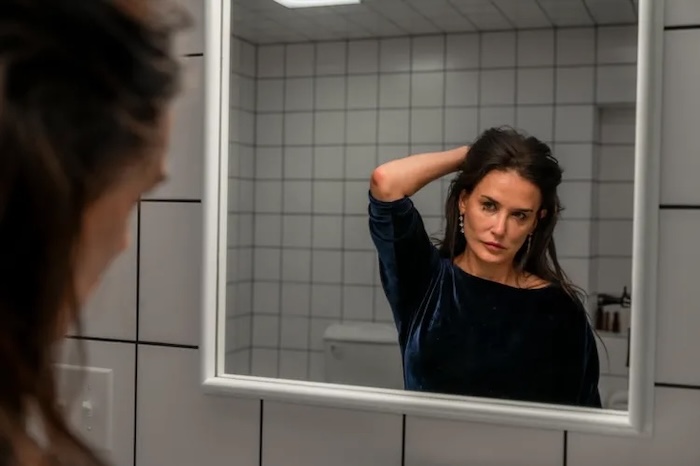
Though much has already been written about Coralie Fargeat’s body horror fantasia about the pitfalls of female self-esteem, not enough of the discussion has focused on Dennis Quaid’s performance as a TV producer named Harvey. Though Quaid’s male chauvinist caricature is repellently hilarious in ways you could imagine, it’s the subtext that grabbed me, since in the same year that Quaid played Harvey he also played Ronald Reagan in a decidedly MAGA-friendly biopic, and I couldn’t get that image out of my head during the scene where Harvey is introduced munching his salad in a particularly grotesque way. Though I would never gainsay Quaid’s acting chops in light of his politics (after all, he played the closeted gay husband in Todd Haynes’ Far from Heaven, though it feels like a million years ago), I really wonder what prompted Fargeat to cast him as this smug POS, who basically starts the plot moving by firing our protagonist, nominally over-the-hill Hollywood star Elizabeth Sparkle (Demi Moore), from her long-time gig as the host of a fitness show in order to replace her with someone much younger. And while I wouldn’t assume that only blatant assholes like Harvey do these kinds of sexist things without a shred of regret (“You won an Oscar? For what? King Kong?”), the fact that it’s this guy sets a very specific tone for the rest of the movie.

The fun starts when Elizabeth, smarting keenly from the insult of losing her only livelihood, is turned on to the titular treatment, which she has to jump through hoops to obtain. The skinny is that the Substance will help you shed years, at least in terms of appearance, and Elizabeth is desperate to get her entertainment mojo back, even though the person who hips her to the treatment adds a warning proviso that Elizabeth doesn’t really hear. When she finally gets her hands on the generically labeled box, which promises to give her “a better version of yourself,” she may not take the usage directions as seriously as she should. She is so intent on getting where she’s going as soon as possible that she doesn’t absorb them. And once the effects kick in she literally emerges from her body as a much younger person who calls herself Sue and is played by Margaret Qualley. Sue proceeds to audition for Elizabeth’s old job as the fitness host and, naturally, nails it, because she knows exactly what’s expected of her from the standpoint of the producers. Consequently, Elizabeth/Sue must maintain a regimen of Substance intake that’s in “balance”—following a transformation she must rest her body, for one thing—otherwise things will go south, as they inevitably do. That’s because, while the invisible person behind the treatment insists that the two personalities are the same being, in reality they act differently for reasons that are instantly apparent: Elizabeth is working from knowledge that has been eating away at her self-confidence for years, while Sue still “feels” she has her life ahead of her. Their needs are totally different, and when those needs clash, things get squishy real fast.

The comedy springs from the extreme contrast between the beautiful lifestyle that Elizabeth live and aspires to—her sky-high apartment with floor-to-ceiling windows says it all—and the physiological decripitude that the Substance accelerates when misused, mainly by Sue, even though, in the end, it’s Elizabeth who suffers. Fargeat accentuates this contrast with a lot of nudity that, at first, is the sort of thing that normally gets the guys’ juices running, but those juices become a little too literal as the movie heads into the final, unbelievable stretch. You can say a lot about Fargeat’s overt fetishization of her female actors, and how easily the attractive surfaces rupture and split, but while you watch The Substance all you can think about is all that flesh and fluid and where the hell it came from. You’ll never look at a can of Diet Coke the same way again.

Now playing in Tokyo at Toho Cinemas Hibiya (050-6868-5068), Toho Cinemas Shinjuku (050-6868-5063), Shinjuku Piccadilly (050-6861-3011), 109 Cinemas Premium Shinjuku (03-6709-6410), Human Trust Cinema Shibuya (03-5468-5551), Toho Cinemas Nihonbashi (050-6868-5060), Toho Cinemas Roppongi Hills (050-6868-5024).

The Substance home page in Japanese

photo (c) The Match Factory

Posted in Movies | Tagged , | 1 Comment

Review: The Girl with the Needle and Nosferatu

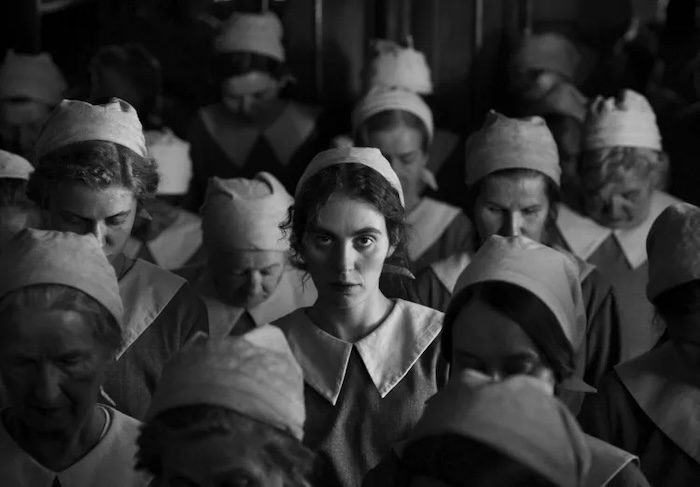
As a movie addressing the psychological torment that can accompany and follow the act of childbirth, Denmark’s most recent contender for an international feature Oscar doesn’t hold anything back, but because it’s set in a time and place that feels alien from our own—Copenhagen right after World War I—the horrors it presents seem like something out of a particularly nasty 19th century gothic novel. Filmed in high-contrast black-and-white, The Girl with the Needle constantly suggests a malevolent spirit at play. Nothing goes right for our protagonist, Karoline (Vic Carmen Sonne), and we’re not made to expect anything different. In the very first scene, she’s evicted from her decrepit apartment for being behind in her rent. As it stands, she believes her husband has been killed in the war, though she can’t claim compensation because she doesn’t have a death certificate. She finds an even more decrepit apartment while working as a seamstress at an industrial apparel maker that’s hit the jackpot producing military uniforms. She begs the owner of the business, Jorgen (Joachim Fjelstrup), for help in trying to wrest compensation from the authorities and he sincerely tries to help, and then invites her out for a walk and promptly has sex with her openly in an alleyway.

The director, Magnus von Horn, seems particularly drawn to bluntness of this sort, not so much because he believes it reflects the customs of the milieu he depicts, but because it makes the storytelling that much more relentless. Suffice to say that once Karoline finds herself pregnant, Jorgen steps up to do the right thing, but his imperious mother won’t have it, and Karoline attempts a self-abortion in a public bath. However, she is interrupted by an onlooker, Dagmar (Trine Dyrholm), who proposes a different solution: have the baby and bring it to her. She will find a loving home for the child. Thus Karoline embarks on a journey of self-loathing and possible redemption, as she eventually becomes Dagmar’s assistant in placing unwanted babies in well-to-do homes, a racket that at first feels charitable (though the mothers are compelled to pay dearly) but which Karoline soon learns is anything but. 

Though The Girl with the Needle is based on a real historical crime, von Horn’s fantastical presentation makes it feel more like a parable, albeit one whose psychological implications speak directly to our basest fears. Sometimes the plot devices feel contrived, especially the sudden reappearance of Karoline’s husband with a hideous war injury, a development that feels shoehorned into the action; but the idea that women would be conflicted about bringing children into this horrid world is put across with uncommon power. It’s not just the abject poverty on display that drives the point home, but rather the whole idea that a mother’s feelings are constantly being manipulated by forces she can’t control. 

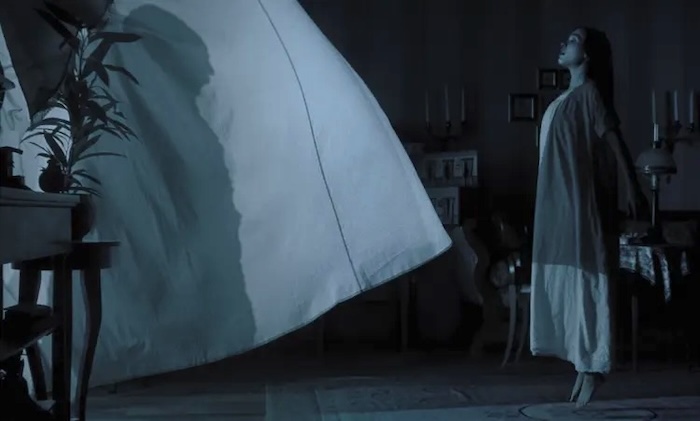
Nosferatu, a deliberate horror movie, has a similar mise en scene, though it takes place almost a century prior to the action in The Girl With the Needle. Based on the F.W. Murnau silent classic, which itself was an unauthorized ripoff of Bram Stoker’s Dracula, this production by Robert Eggers feels even more expressionistic than the original. It’s a color film that looks black-and-white, mainly because it takes place either at night or under overcast skies. Eggers’ ouevre (The Witch, The Lighthouse) is obsessed with a past that’s mostly a product of his singular imagination, and while Nosferatu is an adaptation, it shoots off on tangents that only Eggers could come up with. 

The central character is Ellen Hutter (Lily-Rose Depp), a frail woman with prescient proclivities who we see right from the start is in the grip of some force beyond her understanding. Her new husband, Thomas (Nicolas Hoult), is solicitous of her fears but nevertheless leaves her alone for an indefinite period while he carries out an assignment for his real estate broker boss, Knock (Simon McBurney), which entails rugged travel on horseback to the crumbling Romanian castle of Count Orlok (Bill Skarsgård), who wants to buy an estate in Thomas’s German city. Thomas goes through quite a gauntlet of terror while in Orlok’s company but manages to escape with his life. At this point, the word “vampire” hasn’t even been muttered (though the spirited banter among the Roma residents near the castle obviously allude to their neighbor’s evil tendencies), and I found it refreshing that Eggers downplayed the requisite undead lore; but what freaks Thomas out isn’t so much the mysterious puncture marks on his breast but rather Orlok’s almost cartoonish dialect, which is a grossly breathy Slavic rumble that shakes the flatware. Meanwhile, back in Germany, Ellen’s nightmares of a shadowy figure entering her room become more intense, thus summoning the attention of her best friend, Anna (Emma Corrin), and her fatuous husband, Friedrich (Aaron Taylor-Johnson), who believe she has lost her mind and call the doctor (Ralph Ineson), who can do nothing for her and thus in turn contacts a colleague who has studied the black arts, von Franz (Willem Dafoe). It is he who first says the word “vampire,” though he prefers the proper noun “Nosferatu.”

Matters come to a head when Orlok arrives in town by sarcophagus on a ship teeming with rats, which spread plague throughout the city. Knock reveals himself as Orlok’s secret sharer and Thomas returns just in time to learn that his wife was raped by Orlok as a child—and that the count is here to reclaim her. It’s a lot to process and I didn’t bother, but while Eggers’ intention is to shock rather than horrify, his methods inadvertently pump up the inherent melodrama of the material. I found myself giggling on occasion at the arch literary dialogue (“We have been blinded by the gaseous light of science!”) and a sound design that exaggerates every slurp and gulp. It’s not your fanboy brother’s idea of a vampire movie, but it makes sense in its own sick way. 

The Girl with the Needle, in Danish, opens May 16 in Tokyo at Shinjuku Piccadilly, Human Trust Cinema Yurakucho, White Cine Quinto Shibuya.

Nosferatu, in English, Romanian, and Romany, opens May 16 in Tokyo at Toho Cinemas Chanter Hibiya (050-6868-5001), Kino Cinema Shinjuku (03-5315-0978), Shibuya Cine Quinto (03-3477-5905).

The Girl with the Needle home page in Japanese

Nosferatu home page in Japanese

The Girl with the Needle photo (c) Nordisk Film Production/Lava Films/Nordisk Film Production Sverige 2024

Nosferatu photo (c) 2025 Universal Studios

Posted in Movies | Tagged , , , | Leave a comment