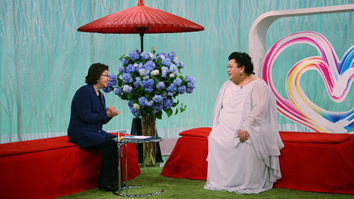
Media Mix, June 23, 2013

Matsuko Deluxe being interviewed on "Heart Net TV"

Matsuko Deluxe being interviewed on “Heart Net TV”

Here’s this week’s Media Mix, about NHK’s nightly series Heart Net TV and its occasional coverage of sexual minorities. Since the show is on NHK’s education channel, its purposes are nominally didactic. Many of the problems faced by LGBT individuals and youngsters experiencing gender confusion center on the education system, since most sexual minorites find their feelings confounded by their circumstances in school. One show aired two weeks ago focused on a small NPO that runs a consultation center for young people who feel they have no place to discuss these feelings. Their frustrations came to a head in school. The head of the NPO, a gay man who admits that he still hasn’t told his own parents about his sexual orientation, explains that more than one thousand young people visit the center every year because it’s the only place where they feel comfortable enough to discuss their lives. NHK interviewed two visitors, both digitally masked and anonymous. One was a gay man who recently graduated from high school and came to the center because he had no idea how “people like me” live their lives. Initially more curious than confounded, while a student he connected to other gay men through the Internet, a situation the center director called “dangerous” because so many sexual predators use the web to find young people. Fortunately, the young man did find someone who was mature and honest about his own homoerotic experiences. He implies they had a sexual relationship because he said they eventually “broke up.” He was devastated, but couldn’t talk to his heterosexual friends about it. He  feels lonely, and the new frustration is that now that he knows something about the homosexual community he also understands how underground it is. In order to meet other gay men he again has to go on the Internet, as if he were sneaking around. “I’m not looking for sex,” he says, but invariably that’s what the people he meets online want, and for a time he believed he was being stalked by someone. Eventually, he went to his school nurse and it was she who recommended the NPO, so obviously some progress is being made in the educational community with regard to helping sexual minorities come to grips with whatever identity issues they have. The other visitor interviewed by NHK was a lesbian who is still in high school. She automatically believes her teachers will never understand her, and mentions a classroom discussion in a health science class about HIV in which one student asked if gays and lesbians contracted HIV and the teacher said, yes, they do, and then started laughing. “It was as if the thought of gays and lesbians having sex disgusted him,” the student told NHK. Later, alone, she cried in frustration at the thought of the teacher’s reflexive callousness. If that is the attitude that most students absorb in school, “then they will automatically think I’m weird if they find out I’m a lesbian,” she said. According to research cited on the show, school is the main focus of consternation among LGBT individuals and people suffering from GID; 58.6 percent of GID people still in school have “contemplated suicide” and 14 percent have “actually attempted suicide.” Apparently, plenty of teachers are sympathetic to sexual minority students but are afraid of saying or doing something wrong around them. It was this bit of intelligence that prompted Kayo Satoh’s comment mentioned at the end of the column that they don’t need to be so scared; that they should just treat each student as an individual. In school, where conformity is introduced and stressed, that may be harder than it sounds.


Posted in Media | Tagged , , , , | Leave a comment

Media Mix, June 16, 2013

Miura and logos

Miura and logos

Here’s this week’s Media Mix, which is about coverage of Yoichiro Miura’s record-breaking climb to the top of Mt. Everest in late May. The gist of the Shukan Bunshun article I refer to is that Miura and his family make a tidy living from alpine sports and thus the accomplishment can’t be separated from its promotional benefits. Of course, when Miura reached the summit every news organization in Japan was on hand at the Miura family compound to record the clan’s reaction, and when Miura and his son, Gota, arrived back in Japan after their feat, they were greeted by 70 students from the Clark Memorial International High School, of which Miura happens to be the principal, though it’s mainly a ceremonial function. The school has nine campuses throughout the Kanto region and some of the students had traveled far to greet their sensei, who has a financial stake in the private schools. They had to stay at airport hotels overnight, and their travel and accommodations were paid for by the school, which was also one of the sponsors for the Everest climb. The Bunshun reporter wrote, “I got the impression that the students had been mobilized for Miura’s arrival,” and then goes on to describe the airport press conference, where “thirty representatives of sponsors” competed with one another to make sure their respective products or names were “prominently displayed” on the dais where Miura and his son took questions. There is nothing underhanded or unsavory about these commercial priorities. As outlined in the column, climbing Everest is a very expensive undertaking. What Bunshun wanted to point out is that it’s particularly expensive for someone Miura’s age, because the risk that normally accompanies such an endeavor has to be reduced to the very minimum, and that requires lots of money. So while Miura is certainly an inspiration to old people everywhere, one has to realize that no chances were taken with regard to his safety, thus undermining the media hype that surrounded the event. The fact that the Miura family used the climb to boost its brand shouldn’t be surprising since that’s what they do, and maybe everyone understands that. You certainly can’t avoid the Suntory logo (for its sesame-related health foods, not its liquor) whenever you see Miura talking about his achievement. It comes with the territory. Nobody’s cynical when everybody’s clued in.

Posted in Media | Tagged , | Leave a comment

June 2013 albums

Here are the album reviews I wrote for the June issue of EL Magazine, which was distributed in Tokyo last weekend.

littleboots13Dido_Cover_GWGA_RGB%20jepg1_3mbNocturnes
-Little Boots (On Repeat/Hostess)
Girl Who Got Away
-Dido (RCA/Sony)
As the pop music cycle goes round and round it sucks in sub-genres and attitudes that on the surface would seem to be anathema to pop, or, at least, the kind of pop we think about when we think about listening to the radio. Four years ago Victoria Hesketh made a splash in her native UK with a synth-based sound that browsed Europop and Eurobeat for ideas without losing sight of the fundamentals—songs no longer than three minutes with catchy choruses and lyrics that make immediate sense. Because she wrote her own tunes, sometimes with the help of a producer or two, she was hailed as a revolutionary, as if Lily Allen were chopped liver. Since then dance music has become the de facto pop music of the moment; in other words, the sound of young people enjoying themselves, which is what radio was until about twenty years ago. Having been thrown to the wolves by Warner in the meantime Hesketh offers up a darker but no less catchy selection of songs on her self-released second album. Nocturnes is a fitting title since it sounds like a party that didn’t get started until 1 a.m., but the sentiments are still cheap and easy to digest. The track lengths are also longer—most clock in at over five minutes, implying the longer attention spans of adults even if the themes are simple enough for adolescents. So if the aim of the debut was instant gratification, here she means to draw you in more slowly until there’s no escape. “Broken Record” is ostensibly about the difficulty of letting go of love, but it’s also a statement of musical purpose. The soporific vocal style doesn’t eschew sex, it just puts the gratification off until later. In that regard, Little Boots could learn something from Dido, whose new album sounds like the sort of thing Hesketh is trying to accomplish: dusky, sinuous, with just enough personality to make it worth returning to. Dido is more of a songwriter though not much more of a singer. She’s also confident enough to let her collaborators do whatever they want with her tracks, and the beauty of Girl Who Got Away is how easily it plays on the dance floor without compromising Dido’s radio-ready appeal. She also has a story to tell, unlike Hesketh who only has fleeting emotions and half-baked ideas to convey. When Kendrick Lamar suddenly shows up on “Let Us Move On” the story gains traction, a witness to the romantic pangs Dido is feeling but can’t quite articulate because of the limitations of her instrument. Her talent for melody is all she’s got, that and a brother who’s one of the hottest producers in the UK, which is enough to attract high-powered collaborators like Greg Kurstin and Brian Eno. Dido may not be as distinctive as Little Boots, but she takes better advantage of her gifts. Continue reading

Posted in Music | Tagged , , , , , , , , , , , , | Leave a comment

June 2013 movies

Here are the movies reviews I wrote for the June issue of EL Magazine, which will be distributed in Tokyo tomorrow.

celesteCeleste and Jesse Forever
Though ostensibly a two-hander, this melancholic romantic comedy is mainly a showcase for Rashida Jones, who co-wrote the screenplay with former signficant other Will McCormack. Jones plays Celeste, a gainfully employed young woman who still has a very close relationship with ex-husband Jesse (Andy Samberg), an artist who has yet to make an impression on the market because he’s so easily distracted. Jesse still holds out for some sort of reconciliation with Celeste and continues to live in a bungalow in back of their modest L.A. house. In fact, it takes a little time for the viewer to realize that they are divorced since the opening scenes show them joking and making plans as if they were still married. Certainly the most vital component of the film is Jones’ and Samberg’s easy chemistry, a virtue that underlines how much romantic comedy has changed since its heyday. The banter is so breezy and situationally specific that it risks alienating the audience, who may feel left out of the gags, but it feels more natural even if the dialogue has been devised to evoke just such a reaction. If the methodology is up-to-the-minute (boomers will likely wince at the diction), the emotional parameters are the same as they’ve ever been in romantic comedies. It’s Jesse who won’t let go, but he’s also the first one to take a stab at dating, and in a plot device that should come across as trite but actually has impact, he knocks up a one night stand (Rebecca Dayan). Though the movie chronicles Jesse’s determination to be a good dad, it mostly lingers on Celeste’s difficulty in accepting the news, since one of the reasons she divorced him is that she didn’t think he could ever be the father of her children, a rationale that, in the beginning, is the movie’s best joke but as the relationship becomes clearer seems more like a convenient excuse that backfires. On the surface, Celeste has everything in that her marketing job fully engages her creative impulses; while Jesse, ostensibly the more creative one by lieu of his status as an “artist,” is so economically at sea that he scans as a loser. The script turns those stereotypes around, mainly through the character of Riley (Emma Roberts), a precocious pop idol assigned to Celeste by her company. When Jesse actually gets a job and seems on the verge of making the sort of life Celeste says she always wanted, her self-regard crumbles and she turns to the petulant, seemingly vacuous Riley for comfort—and finds it in the most disarming way. It’s not enough for a romantic comedy to overturn expectations. It has to do so for a reason, and without sacrificing what makes it a comedy. Celeste and Jesse Forever isn’t perfect in that regard, but it succeeds on its own modest terms. (photo: C&J Forever LLC) Continue reading

Posted in Movies | Tagged , , , , , , , , , , , , , , , , | Leave a comment

The “comfort women” issue in 1997

Unknown

Yoshinori Kobayashi

Here is a column I wrote in 1997 about the “comfort women” issue, which was still relatively new at the time. In light of the controversy sparked by Mayor Toru Hashimoto’s comments, I thought it might be instructive to see how the matter was discussed 15 years ago.

Several groups are now trying to prevent junior high school students from learning about the women who were brought to the front lines to provide sex for Japanese soldiers during the Second World War. These groups object to the inclusion of such information in government-approved textbooks, though they don’t deny that the system existed. Because the euphemism ianfu (comfort women) is going to be used in the books to describe such women—thus reinforcing the implication that they were providing a service—the only logical reason for opposing the inclusion is to keep sex out of the classroom.

On December 2, the Group to Make New History Textbooks held a press conference at a hotel in Tokyo and claimed that merely mentioning “comfort women” in textbooks would have a harmful affect on impressionable adolescent minds, a naive assertion, to be sure. The media bombards junior high school students with sex—much of it violent—and an innocent-sounding term like “ianfu” mentioned in passing in a dull history textbook will not likely cause a mass outbreak of guilt and self-recrimination. The group, however, has a larger purpose, which is to revise what it feels is the “masochistic” reading of its modern history foisted on Japan by the West. Continue reading

Posted in Media | Tagged , , , , | Leave a comment

Media Mix, May 5, 2013

Toshiaki Endo, who is in charge of the LDP's English proficiency proposal, though he admits his English is pretty bad.

Toshiaki Endo, who is in charge of the LDP’s English proficiency proposal, though he admits his English is pretty bad.

Here’s this week’s Media Mix, which is about the government’s proposal to boost English language proficiency, mainly through utilization of TOEFL. Near the end of the column I mention the “parochial” nature of Japan’s world view, a stereotype I normally try to avoid. Japan is no more insular than any other country, but what I hope would be more widely discussed is how language learning or at least exposure to it affects this general outlook. I don’t want to give the impression that a more universal attitude automatically accompanies acquisition of a second language, or that non-acquisition indicates small-mindedness. But I do think the more you know about anything in the world the more likely you are to understand why people do the things they do. What was apparent from Tokyo Governor Naoki Inose’s faux pas regarding the city’s Olympic bid  is that his understanding of Islam and international relations in general isn’t fully formed. How much of that misunderstanding could have been cleared up by a greater command of English is impossible to know, but in this particular circumstance in his own mind he was partially shielded by his use of Japanese, since afterwards he used the tired defense that he had been misunderstood by his interlocutors. That doesn’t wash any more, and had he been more conversant in English he might have been more circumspect with his language, which, in turn, would have made him question his logic. In next week’s column, which will be about Inose, I want to talk about the way people in the public eye tend to get a pass from the media with regard to these kinds of verbal screwups simply because reporters don’t challenge them at the time they’re made. Inose made intemperate remarks to the New York Times because he is used to saying whatever he likes. People who speak a second language are always cognizant that they could be making mistakes. That may sound like a small technicality when it comes to developing a global outlook, but it’s also a part of the process that can’t be discounted. Continue reading

Posted in Media | Tagged , | Leave a comment

The pursuit of happiest: Will and Jaden Smith in Tokyo

Like father like superstar

Like father like superstar

In his newest sci-fi blockbuster, After Earth, Will Smith plays a man who is incapacitated during a crash landing on earth some thousand years into the future and in order to survive he has to send his own son, played by his real life son Jaden Smith, on some perilous errand to retrieve a vital object through a landscape that has “evolved to kill humans.” Apparently, homo sapiens destroyed earth back in the 21st century and had to relocate to some other planet and earth isn’t looking to let bygones be bygones. At least that’s what I got from the 16 minutes of footage that was shown to the media prior to the press conference for the movie in Tokyo. It consisted of the two existing trailers spliced with three complete scenes from the movie. Smith is uncharacteristically stoical in the role. He treats his son as a soldier rather than his progeny, and that seems to be one of the hoary themes of the film, that these two will by the end learn to be father-and-son rather than commander-and-subordinate. That theme also carried over to the press conference, where the Smiths parodied their public image as a way of demonstrating that it wasn’t as serious as we might imagine.

No one sells himself as a movie star as aggressively as Will Smith, not even Tom Cruise, whose self-image is so circumscribed that he seems to have every response scripted. Smith wants you to know how much he enjoys his job and isn’t scared to wing it if it thinks it will endear him to the people who count, and here the people who count were the Japanese press, delighted to be privy to his every awkward ad lib. With Jaden he had a practiced straight man, and while their forced-funny banter was diminished by the dry translating of the interpreter, the audience relaxed immediately and didn’t seem to mind the lack of substance and Will’s penchant for pointless hyperbole. One guy sitting in back of me was a little too relaxed, letting out a studied guffaw at every gag. Continue reading

Posted in Media, Movies | Tagged , , , , | Leave a comment

May 2013 albums

Here are the album reviews I wrote for the May issue of EL Magazine, which was distributed in Tokyo last Thursday.

clapton13thompson13Old Sock
-Eric Clapton (Bushbranch/Universal)
Electric
-Richard Thompson (Proper/P-Vine)
Though he’s still God to some boomers, Eric Clapton hasn’t tried very hard to maintain his edge as a rock artist or even a blue guitarist since…well, he quit heroin. Few popular musicians will ever be able to claim responsibility for something like Layla, the greatest rock guitar album ever made, and this collection of covers, mostly done in a relaxed reggae style, appears to represent what Clapton appreciates as he nears his eighth decade and moves away from the stresses of pleasing a major label. Even those of us who would still pay money to see him play the blues live have a hard time understanding what he gets out of sit-down acoustic versions of Gershwin and Kern, or sappy duets with that other nostalgia-beater, Sir Paul. The sunny sleeve photo and smiley vocals offer answers: the comfort of retirement. Even “Angel,” a dark song by a writer, J.J. Cale, whom Clapton has a close affinity for, is breezier than Montego Bay at sunset. Tempos never accelerate past a trot, and the reggae breaks and backing vocals keep a lid on the energy level. He even adds a children’s chorus to “Every Little Thing,” one of only two originals on the record. However, the other one, “Gotta Get Over,” is a loping blues, and if the vocal growl doesn’t sound lived in enough, the guitar work retains the magic touch that still makes him peerless as an instinctive stylist; and his tribute to Gary Moore, a slow burner done in a cocktail jazz groove, proves that whatever he’s lost in youthful fervor he makes up for with ingrained facility. No one has to try so little to deliver so much. Richard Thompson, another singer-guitarist entering his twilight, has the reputation of trying too much, though as conscientious as he is as both an instrumentalist (he still practices two hours a day) and a songwriter (no one conveys misanthropy with as much verve and variety) he has tread water creatively since his strong run of solo albums in the early 90s. After a decade of mostly acoustic records necessitated by a touring regimen that can’t afford a band, Thompson jumps back in with an album that wears its rock pedigree on its cover. Recorded in Buddy Miller’s Nashville studio, Electric is effusive and brisk, though it doesn’t have the presence of his last album, an original set recorded in front of an audience. That record was mostly electric even if the songs themselves didn’t always lend themselves to the added voltage. The new songs have been designed for maximum volume and rhythmic concision, resulting in a few numbers that nag as incessantly as a Carly Rae Jepsen couplet; and the playing is as knottily compelling as ever. Only time will tell if this collection keeps longer than the last few. The problem with being a serial over-achiever is that no one expects less from you. Continue reading

Posted in Music | Tagged , , , , , , , , , , , , , , | Leave a comment

The Selector, Apr. 25

Here’s the playlist for the InterFM show I programmed last night, with links where available.

Sarcasm & Sincerity: Songs I think would sound good on the radio

M1. “Old World,” The Modern Lovers (1973)
An anti-hippie without being a jerk about it, Jonathan Richman was once the self-declared savior of rock’n roll but retreated into innocence and earnestness. In 1973 a rock musician had to have guts to pledge allegiance to his parents.

M2. “The Funky Western Civilization,” Tonio K. (1978)
At one time Tonio K. rivaled Warren Zevon for the title of Los Angeles’s most cynical singer-songwriter, though he made his money writing conventional songs for other artists. The sarcasm on this particular song is timeless, which is not necessarily a good thing considering the subject matter.

M3. “He Never Got Enough Love,” Lucinda Williams (1992)
A pure country song and one of the few Lucinda has co-written (with Betty Elders), “He Never Got Enough Love” utilizes all the cliches of the form but from a different emotional perspective. A man could never have written this song, much less sing it with any credibility. Continue reading

Posted in Music | Tagged , , , , , , , , , , , , , , , , | Leave a comment

May 2013 movies

Here are the movie reviews I wrote for the May issue of EL Magazine, which is being distributed in Tokyo today.

ekthatigerEk Tha Tiger
Former documentary filmmaker Kabir Khan has become successful in Bollywood with socially charged subjects that don’t necessarily fit the template engineered for the genre. His latest is an espionage thriller. Tiger (Salman Khan) is the Indian intelligence agency’s secret weapon, a killing machine so tireless he has no life outside of work and laments to his superior that he’s never been in love. On assignment in Ireland to keep tabs on an Indian missile scientist who may be trading secrets with Pakistan, Tiger falls in love with the scientist’s student assistant, Zoya (Katrina Kaif), who turns out to be a Pakistani agent. “Of all the countries in the world, you had to fall for a girl from Pakistan,” says Tiger’s colleague. Of course, that’s the point, and the Romeo-Juliet aspects of the relationship don’t get in the way of the action sequences, but there are only two big musical production numbers, and one of them is banished to the closing credit roll. I have no problem with Bollywood taking on touchy themes, but some priorities are sacred. In Hindi and English. (photo: Yash Raj Film Pvt. Ltd.) Continue reading

Posted in Movies | Tagged , , , , , , , , , , , | Leave a comment