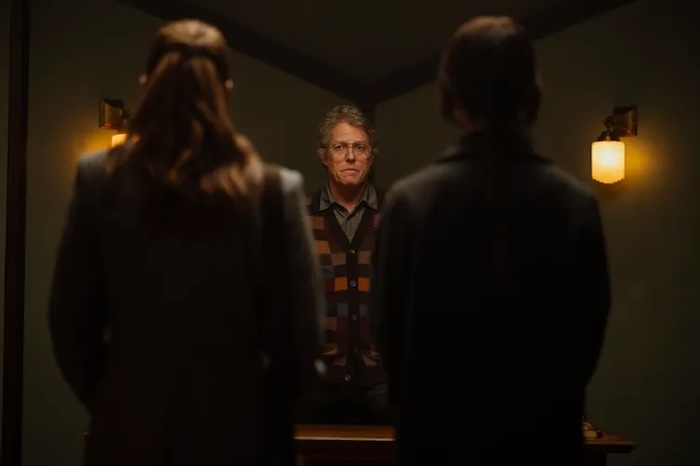
Though it only, and deservedly, received an Oscar for best adapted screenplay at the most recent Academy Awards ceremony, Edward Berger’s film version of Robert Harris’s bestseller, scripted by Peter Straughan, would have likely walked away with the lion’s share of statues had it come out, say, more than 30 years ago. This lush production about the Vatican’s College of Cardinals electing a new pope, featuring a stellar cast of well-known male actors, not to mention Isabella Rossellini, is what used to be known as a “prestige picture”: a movie on a serious subject presented seriously and in effortless good taste. However, it isn’t as self-consciously dull as some Oscar-winning prestige pictures (I’m looking at you, A Man for All Seasons), even if there’s a certain staid propriety in the mounting of the story that almost works against Harris’s pointed displays of transgressive mischief.
Ralph Fiennes plays to his peculiar strengths as Cardinal Lawrence, the dean of the congress whose job it is to manage the conclave, which suits him fine as he is currently struggling with a crisis of faith that makes the task at hand all the more usefully distracting. The main candidates are split cleanly along ideological lines between political progressives and social conservatives—the main villain of the story, Cardinal Tedesco (Sergio Castellitto), wants the Church to return to the Latin Mass. The initial favorite on the liberal side, the voluble American, Cardinal Bellini (Stanley Tucci), confides in Lawrence that he doesn’t want the gig at all (“it’s such a huge burden”), but feels he has to put up a fight to prevent Tedesco from prevailing, which would be a disaster, not only for the Church but for the world. In fact, during one of the ballots, St. Peter’s is attacked by a suicide bomber, causing Tedesco to double down on his pledge to publicly demonize Islam, a rather prescient threat, since an unexpected contender for the piscatory ring is Benitez (Carlos Diehz), the relatively young Spanish priest who was mysteriously elevated to the position of Cardinal of Kabul only a year earlier, and who, in the wake of several shocking revelations, including the intelligence that another front-runner, Cardinal Tremblay (John Lithgow), bought votes on order from the late Holy Father, becomes the spoiler that both Tedesco and Bellini—newly fired up with unbecoming ambition—have to beat.
At times, Berger’s insistence on filling the story with as many cultural anachronisms as he can shake a miter at becomes oppressively busy, but the suspenseful touches are all the more appealing due to how carefully Harris has worked them into proceedings that are set in stone. This aspect provides pleasure in the opportunity to watch not only supposedly pious men grapple with impulses they’d prefer to hide from mere mortals (most notably one another), but also the spectacle of a hidebound institution entering a new millennium with all its bright red cassocks in panicked disarray.
In English and Italian. Now playing in Tokyo at Toho Cinemas Nihonbashi (050-6868-5060), Toho Cinemas Chanter Hibiya (050-6868-5001), Kino Cinema Shinjuku (03-5315-0978), Shibuya Cine Quinto (03-3477-5905), Shibuya Parco White Cine Quinto (03-6712-7225), Toho Cinemas Roppongi Hills (050-6868-5024).
When the Japan Confederation of A- and H-Bomb Sufferers Organizations, better known as Nihon Hidankyo in Japan, won the Nobel Peace Prize last year, there were probably quite a few Japanese who were unfamiliar with the group, which represents survivors—hibakusha—of the atomic bombings of Hiroshima and Nagasaki. The Nobel committee gave Hidankyo the prize because of its work to rid the planet of nuclear weapons, a task that’s doubly difficult given that Japan, due to its security agreement with the U.S., is effectively under America’s so-called nuclear umbrella, and thus cannot do anything that would be seen to undermine the concept of nuclear deterrence. Consequently, the group doesn’t receive as much attention as it would like, since the Japanese media tends to align with government policy when it comes to matters of diplomacy and security.
However, even we were surprised when we read in the March 2 edition of the Asahi Shimbun that the administrative roots of Hidankyo were not in either of the cities attacked with atomic weapons in August 1945, but rather in Suginami Ward, Tokyo. March 1 marked the 71st anniversary of the Daigo Fukuryu Maru Incident, when a Japanese tuna fishing boat was exposed to “death ash” from the U.S. test of a hydrogen bomb at the Bikini Atoll in the South Pacific. The incident was heavily covered by the Japanese press, and thus broke the national silence over nuclear weapons that had been imposed by the U.S. occupation after the war, which ended two years earlier in 1952. Petitions to end nuclear testing quickly circulated all over Japan, with some 32 million signatures collected, proving that the Japanese people knew exactly what happened at the end of World War II and were determined to make sure it would never happen to anyone ever again.
According to Asahi, the origin of the anti-nuclear petition movement was the home of fishmonger Kenichi Sugawara in Suginami Ward. Sugawara’s daughter, Hideko Takeuchi, now 82, recalls how when her father heard of the Daigo Fukuryu Maru Incident, he despaired, not only about the fate of the irradiated fishermen, but also about his business and anyone else who sold fish in Japan. At the time, electrical refrigeration still was not widespread in Japan, and Sugawara kept his wares cool with a large wooden ice box, which meant he had to buy only as much fish in the morning at the Tsukiji fish market as he could sell in a day. It was literally a day-to-day operation: the money he made one day would be used to buy fish for the next day, but after the Bikini incident orders for fish almost completely stopped for him and other fishmongers throughout Japan out of fear of radiation. So they organized a petition drive to ban nuclear testing.
It says something about Oz Perkins’ distinctive contribution to the horror genre that his latest features Nicolas Cage in a supporting role as a serial killer who looks, sounds, and acts nothing like the Nicolas Cage we know and love. In fact, Perkins and the publicity crew at Neon have done a good job of keeping Cage’s character completely under wraps while admitting that he plays the titular devil worshipper, which of course makes the movie all the more irresistible. At this late date it’s not giving anything away to say the character really is something—horrifying and creepy in a unique way. Too bad the movie built around the character doesn’t take proper advantage of him.
Either an homage to or a ripoff of The Silence of the Lambs, Longlegs features another novice female FBI agent thrust into a case that’s been baffling the big boys. Unlike Jody Foster’s Clarice, however, Maika Monroe’s Lee Harker is not tasked with using her particular talents to glean insider dirt from an incarcerated serial killer to help catch one who is still at large. Instead, Harker herself seems to have been targeted by Longlegs, a person who somehow enters homes, either corporeally or spiritually, and then makes one member of the family slaughter all the others before offing themselves, leaving coded messages that Harker seems to be able to decipher. Her cynical but frustrated boss (Blair Underwood) isn’t really keen on letting this young’un have free rein over the case, but he’s under pressure to solve it after almost 30 years of zero leads, and Harker has already shown an ability to intuit killers in her vicinity. Perkins never uses the word “psychic” to describe Harker. It’s more like a sensitivity born of her upbringing in a pious Christian household with apocalyptic leanings. Whenever killers like Longlegs invoke Christian iconography and language, Harker can usually explain their motives and movements because she’s been there, so to speak.
Though Perkins (who, by the way, is the son of Psycho star Anthony Perkins) knows how to maintain tension and create visuals that linger uncomfortably in the viewer’s psyche for days, he’s hung up on process, and as Longlegs’ identity and methodology are clarified he has to juggle several plotlines involving Harker’s mother and her boss’s own family in order to see the story through to its natural conclusion, which is more confounding than it is shocking. But it isn’t as startling as Longlegs himself, who, thanks to Cage, is a piece of work, and one you’re not likely to forget any time soon.
Another aspect that Longlegs has in common with Silence is that it’s set in the 90s, though that’s not necessarily an important aspect. The Sweet East, the indie debut by veteran cinematographer Sean Price Williams, is set in the present, but for almost a half hour I thought it took place in the 70s. The production values, language, clothing, even the film stock felt like it was all trying to copy the laid-back immediacy of the early work of Altman and Ashby and their fondness for the picaresque, so it wasn’t until someone referenced Pizzagate that I realized it was lampooning our current sick society.
The requisite innocent is Lillian (Talia Ryder), a high school girl who is taking her first trip out of South Carolina with her Bible study group to Washington D.C. on a field trip. Adolescent energy eventually overwhelms any desire for edification, and Lillian decides to jump ship by joining a bunch of Antifa-anarchists who are planning a big violent protest. Not so much innocent as provoked by boredom, Lillian manages to escape the mess these clowns get into and then falls into the arms, so to speak, of the other side, specifically a white supremacist academic (Simon Rex) who educates her on the finer points of Nazi symbolism and the literature of Edgar Allen Poe. Though the seduction of nubile Lillian initially seems to be his scheme, the girl’s chronic “whatever” attitude seems to put him off and soon she’s being recruited off the streets of New York by two indie filmmakers (Ayo Edebiri, Jeremy O. Harris) who are making a movie about, of all things, the construction of the Erie Canal. Paired with a hunk actor (Jacob Elordi, the current definition of the term), Lillian is still unimpressed, but somehow parlays the part into minor celebrity status that also fails to impress her.
It’s difficult to determine exactly what Nick Pinkerton’s script is supposed to be saying, except that maybe some people are incorruptible because they just don’t give a shit, but the director has a great time making his set pieces look as presentable as possible on 16mm. This, after all, is the guy who shot such impossibly frantic indies as Good Time and Her Smell, and he manages to infuse a story that doesn’t know what it’s really about with a strong feeling of forward momentum. It goes nowhere fast.
Longlegs now playing in Tokyo at Toho Cinemas Nihonbashi (050-6868-5060), Human Trust Cinema Yurakucho (03-6259-8608), Shinjuku Piccadilly (050-6861-3011), Human Trust Cinema Shibuya (03-5468-5551), Toho Cinemas Roppongi Hills (050-6868-5024).
The Sweet East now playing in Tokyo at Human Trush Cinema Yurakucho (03-6259-8608), Shinjuku Musashinokan (03-3354-5670), Human Trust Cinema Shibuya (03-5468-5551).
As a film about four-legged creatures on a perilous long-distance sojourn, the Latvian film Flow, which recently won an Oscar, at first brings to mind the Disney classic The Incredible Journey, which used real trained animals as its protagonists. Flow is animated, and, as a friend suggested after I’d seen it, has more in common with the work of Hayao Miyazaki, whose affinity for nature the makers of Flow obviously share if not outright mimic. Though Miyazaki will occasionally include animals that act like people, for the most part he avoids anthropomorphizing his non-human characters, allowing them to express themselves in accordance with actions we would associate with their relative species. The hero of Flow is a housecat whose instinctive behavior is immediately familiar to anyone who has had one as a companion, a presentation that’s intensified by the fact that this nameless feline lives in an abandoned house in a forest surrounded by wooden and stone sculptures of cats, as if it were the muse of an artist who is now gone. And yet the cat returns to the empty house, as if waiting for its companion to return as well.
There are no people in Flow, which takes place after some kind of apocalypse. The land is suddenly inundated, and as the waters rise through the lush vegetation surrounding the house the cat survives as best it can, eventually encountering other animals—a lazy capybara, a mischievous, hoarding lemur, a goofy golden retriever, and a majestic Secretary bird—who form a kind of confederacy of the displaced, steering a broken sailboat among the ruins of civilization that are now mostly underwater. Though the theme that runs through the adventures these non-speaking comrades experience is one of communal dependence and cooperation, the cat is still the central consciousness, and director Gints Zilbalodis infuses the animal with a vivid personality that conflates a cat’s natural curiosity with a distinctive empathy. If humans, through their own selfishness, have destroyed this world, the surviving animals will keep themselves alive by looking out for one another, which may sound anthropomorphic (there are scenes, especially among the secretary bird’s own kind, that indicate non-humans can be selfish as well) but feels credible given what can only be described as the story’s focus on the longing for so-called creature comforts.
That the characters are self-aware is perhaps the movie’s most striking assertion, since we tend to think of animals as being only present in the moment. Zilbalodis’s color palette and extraordinary use of light and 3D “camera” movement create a state of magic realism that respects these creatures’ inherent, organic being while giving them the opportunity to create their own stories apart from those we usually deign to impose on them, which is what Disney tends to do. Miyazaki uses animals to highlight and contrast his human characters’ relationship to nature. Zilbalodis attempts something similar, but leaves out the human presence.
Opens March 14 in Tokyo at Toho Cinemas Nihonbashi (050-6868-5060), Toho Cinemas Hibiys (050-6868-5068), Toho Cinemas Shinjuku (050-6868-5063), Human Trust Cinema Shibuya (03-5468-5551), Toho Cinemas Roppongi Hills (050-6868-5024).
Because of its unconventional methodology, Tunisian director Kaouther Ben Hania’s movie about a family torn apart by religion, which won the best documentary prize at Cannes in 2023, doesn’t scan as a regular documentary, meaning one that’s chiefly invested in relating narrative truths about its subject. Ben Hania decided to use actors to play principals who were no longer available to contribute directly to the story she wants to tell. Specifically, two of the titular daughters of a woman named Olfa were “devoured by the wolf” about ten years ago, and in order to recreate scenes that are important to the story, Ben Hania hired actors to play their parts. In addition, she also hired an actor to play Olfa, who was very much involved in the production, during those times when the material became too emotionally overwhelming for her to play herself. But what ensues is not what you would call a “docudrama.” It’s more like an open-ended, ongoing therapy session that uses theatrical tools to explore how the toxic elements of a specific culture affects the psychology of some of its members, in this case women in the politically volatile environment of Tunisia during and after the Arab Spring, which started in Tunisia.
Even without the historical component, Olfa’s tale is worth hearing. As a Muslim woman and the daughter of a single mother, she was forced into an arranged marriage with an older man whose approach to sex was self-serving, to put it lightly. In the film’s reenactment of their wedding night, Olfa doubles as herself and her older sister, who intervenes to make Olfa understand that it is her duty to allow her new husband to rape her while relatives wait outside the bedroom for proof that she lost her virginity. Olfa resists in a way that is both horrifying and amusing. In fact, as the production progresses, much of the content that, on paper, comes across as tragic or appalling is accompanied by laughter when it is explained or recreated, because that is the only way for Olfa, her two younger daughters, Eya and Tayssir, and the actors playing her two older daughters, Rahma and Ghofrane, can get through events that were traumatizing. After the revolution that overthrew the secular, oppressive government in 2011, Tunisia was thrown into political turmoil while Rahma and Ghofrane traversed their adolescence, which was as fraught as it is for teenage girls anywhere in the world. They flirted with transgressive foreign fashion and music, and coarsened their language before embracing fundamental Islam. There’s a particularly intriguing sequence where the actors playing the two girls explore the style advantages of hijab and then niqab. Under the secular government, head coverings were banned, so in a sense Rahma’s and Ghofrane’s adoption of complete body coverings was as rebellious as were their passing infatuations with goth and punk. But through it all, Olfa, who had since divorced their father and discovered her latent sexuality with a former political prisoner-turned-carpenter, was at a loss as to how to raise her daughters and often resorted to violence out of frustration, even when it became apparent that her new boyfriend was coming on to them. The most powerful scene is probably the one where the actor playing the carpenter calls “cut” and walks off the set because he can’t countenance recreating an attempted rape of one of the daughters.
When the truth about what happened to Rhama and Ghofrane is revealed, it’s accompanied by Olfa, Eya, and Tayssir discussing how the shock of what the two older girls decided forced them to confront their own misguided decisions, as well as the culture that put them in these situations. It’s perhaps overstating one’s reaction to say that Four Daughters is, more than anything, an exploration of female enlightenment, but, to use a cliche, the journey of all the women on screen and, by implication, those behind the camera (men are obviously in the crew, but their insignificance in relation to the import of the tale is indicated by how openly the women talk about sex and bodily functions) during the recording, is manifestly obvious in how much it helps Olfa and her daughters understand what they went through thanks mainly to Ben Hania’s novel technique. That technique may only make sense as applied to these special circumstances, but it makes the movie equally enlightening for the viewer.
In Arabic. Opens March 14 in Tokyo at Shinjuku Cinema Qualite (03-3352-5645), Human Trust Cinema Shibuya (03-5468-5551).
On Feb. 24, the Japan Kurdish Cultural Association (JKCA) was scheduled to hold a concert with a Kurdish singer at the Saitama Kaikan in Saitama Prefecture, but it was cancelled the day before. According to the Saitama Shimbun, the reason for the cancellation was that the singer, Seyda Perinçek, was refused entry to Japan at Narita Airport and had to fly back to Germany, where he lives. The immigration officer who dealt with the matter said that Perinçek did not have the proper visa. According to the JKCA, Perinçek and his entourage had gone to the Japanese embassy in Germany before leaving Germany and were told that he didn’t need a visa since he was a legal resident of Germany and anyone with German travel documents did not need a visa to enter Japan.
The likely reason for the Narita immigration officer’s refusal to allow Perinçek entry is that, since he was coming to Japan in order to perform, he would have needed a special work visa, but the JKCA told the newspaper that Perinçek had been told by the Japanese embassy in Germany that he could travel to Japan for the purpose of singing at a concert, so it’s not clear what the problem was and who could be blamed for it. The association said it would look into the matter more fully.
The Perinçek affair was also covered in the Feb. 28 edition of the Sankei Shimbun, the conservative daily that has made a point of covering the “Kurdish problem” more thoroughly than other newspapers, usually in a way that looks negatively upon the Kurdish presence in Japan. Sankei said that the Perinçek matter was discussed during a lower house budget committee meeting the previous day, when the justice minister, Keisuke Suzuki, was asked by a lawmaker whose constituency is Kawaguchi in Saitama Prefecture, a city that contains a lot of Kurdish immigrants, if Perinçek had been refused entry because he didn’t have the proper visa. Suzuki said that was indeed the case, and the lawmaker then asked if some mistake had been made. Suzuki denied that there was anything improper about the immigration process for Perinçek.
The lawmaker, Hideaki Takahashi of the Nippon Ishin Party, was not trying to put the ministry on the spot. On the contrary, he appeared to be fishing for an excuse to complain about the Kurds in his bailiwick, and used the occasion of the Perinçek matter to comment that the singer was a “member of the PKK, the Kurdish Labor Party,” which has been designated as a terrorist organization in Turkey. That’s why Perinçek defected to Germany. Takahashi said that Japan has good relations with Turkey, so is that the reason why Perinçek was denied entry? Suzuki replied that he was not at liberty to comment on “an individual case.” Takahashi later said that he hoped there would be “more questions about Kurds in Japan” during this Diet session, thus implying that more should be done about the so-called Kurdish problem.
In the end, any review of a movie adaptation of a popular Broadway musical must contend with diehard fans of the stage version, who will invariably love the film because it was most likely made with them in mind. Any reservations I might have about Wicked‘s basic story and the songs themselves are irrelevant, because I’ve never seen the musical performed on stage and, in fact, know almost nothing about it except that it is based on a novel that purports to be the origin story of the Wicked Witch of the West, and that at one time it was the longest running musical on Broadway. Some critics who are already fanboys or fangirls have griped about the length—the movie will be in two two-and-a-half hour parts, while the complete stage version is a little over two hours—without actually condemning it for it. I confess to having been swept up in the spectacle of it all without necessarily gaining a clear understanding of what it all means, but that may have less to do with the musical elements than with the fantasy ones, which more formally resemble Harry Potter than anything I took away from watching the original Wizard of Oz on TV every spring as a child.
The Potter affinity is right there in the setting, which for most of the action is Shiz University in the land of Oz, to which Elphaba (Cynthia Erivo), a social outcast as an adolescent due to the green hue of her skin, has matriculated in order to major in sorcery thanks to exceptional academic abilities, thus making all sorts of DEI connections in the minds of viewers who lived through the civil rights years. Naturally, she’s ostracized in her new surroundings, a situation she defies with admirable grit, and yet becomes friends with the most popular young woman on campus, Galinda (Ariana Grande), after an initial barrage of cold shoulders. Galinda is already a member of the elite, and comes with her own entourage (Bowen Yang, Bronwyn James), who provide much of the movie’s comic component with their effete fawning over this delicately wrought idol. Director John Chu, who also helmed the effective film adaptation of another Broadway musical, In the Heights, does a great job with the humor and the musical numbers—especially the choreography—but allows the plot development to bog down with sluggish pacing that, I assume, is a function of stretching the material into two parts. Nevertheless, the story gains traction on its overall anti-authoritarian theme by doubling down on a subplot having to do with disenfranchising the four-legged citizens of Oz through the systematic removal of their ability to speak, a cruel campaign that Elphaba, being an outsider as well as the sister of a disabled student, fights against. When she enlists Galinda in her crusade, the two become soulmates of a sort that will make their inevitable break all the more dramatic and heartbreaking. After all, we have to reach the point where the intelligent, righteous Elphaba becomes wicked and the comedy turns to tragedy.
In this context, much of the meta-material that refers to the lore of the stage version feels like so much padding to a neophyte like me, but I got the appeal, which feels almost bedrock, as if Chu and company decided that they didn’t need to pander to those of us who weren’t hip to the original’s charms because those charms were self-evident. I grew up attending Broadway musicals and listening to original cast albums of the classics, so it’s not as if I’m immune to those charms, but while I liked Stephen Schwartz’s and John Powell’s songs more than much of the post-Andrew Lloyd Webber stuff that’s dominated musicals in the past forty years, I didn’t leave the theater humming any tunes. But that may have more to do with lost youth than with the inherent quality of the songwriting or presentation.
Steven Soderbergh’s latest indie curiosity is a fantasy of an entirely different stripe—a ghost story, but one that, initially, at least, pretends to be unconventional. Soderbergh dons his cinematographer hat in a big way by not only shooting the movie himself—something he often does anyway—but making the camera the central character, the ghost, as it were. And this ghost, or “presence,” as the title describes it so aptly, does manage to evoke a personality through the director’s imaginative use of space, movement, and, most interestingly, framing, which adopts a slightly skewed wide angle.
The atmospheric effects of Soderbergh’s camera work are so intriguing, in fact, that the plot feels as if it’s just getting in the way. Veteran Hollywood screenwriter and sometime director David Koepp wrote the script, which demands attention. The haunted house is a beautiful old pile in a New Jersey suburb that is bought by a family of four, and much of the movie is given over to the Presence eavesdropping on blackout-structured conversations between various family members, the go-getting, ethically compromised executive career-track mother (Lucy Liu), the more laid-back and morally stringent father (Chris Sullivan), the bully-jock older son (Eddy Maday), and the sensitive, traumatized younger teenage daughter (Callina Liang). We quickly determine that the household is of two camps—mother-son versus father-daughter—and the conceit of observing these interactions from the POV of the Presence lends the storytelling an otherworldly quality that intensifies the drama.
Things become more involving but less interesting when the story takes on the trappings of a thriller, as the son invites a friend into the home who soon has designs on the daughter. The girl, who is still recovering from the mysterious death of a friend, is the only person in the house who senses the Presence, thinking it may be the spirit of her friend, and in that state she’s susceptible to this adolescent intruder’s serpentine appeal. I thought the movie would explore more incisively the breakdown of a nuclear family, but it ends up as a mild horror story whose plot logic doesn’t stand up to close scrutiny. I liked it better when it was simply an exercise in creepy atmospherics.
Wicked now playing in Tokyo at Toho Cinemas Nihonbashi (050-6868-5060), Toho Cinemas Hibiya (050-6868-5068), 109 Cinemas Premium Shinjuku (0570-060-109), Shinjuku Wald 9 (03-5369-4955), Shinjuku Piccadilly (050-6861-3011), Toho Cinemas Shinjuku (050-6868-5063), Toho Cinemas Shibuya (050-6868-5002), Toho Cinemas Roppongi Hills (050-6868-5024).
Presence now playing in Tokyo at Toho Cinemas Hibiya (050-6868-5068), Toho Cinemas Shinjuku (050-6868-5063), Human Trust Cinema Shibuya (03-5468-5551), Toho Cinemas Nihonbashi (050-6868-5060), Toho Cinemas Roppongi Hills (050-6868-5024).
Stories about bullying normally address the power dynamics that develop among children in a closed environment, with adults being out-of-the-loop because victimized children, by nature, resist exposing themselves as being seen as either weak or duplicitous toward their peers. In the Belgian film Playground (the French title translates as “A World,” which is more to the point), the adults get involved, complicating matters in ways that are predictable but no less disheartening, despite whatever good intentions they have. Since the director, Laura Wandel, keeps the POV at the level of her child actors, the adults are forever stooping to address them, and the effect is disorienting, because we see as a matter of course how the grownups don’t realize that their concern is making things worse, even though they surely would have understood it when they were children.
The protagonist is seven-year-old Nora (Maya Vanderbeque), who is tearfully starting her first year of elementary school and clinging to her slightly older brother, Abel (Günter Duret). Nora is awkward and easily intimidated. Socializing with her classmates becomes a painful process, even though most seem friendly enough. One even tries to teach her how to tie her shoelaces properly, a skill that her stay-at-home father apparently neglected to impart to her. Nora’s adjustment, however, is complicated by her observations of Abel’s social interactions in the titular recreational space, where he hangs out with older boys, some of whom abuse him verbally and physically. When she tries to find out why, he’s standoffish and defiant. Then one day, in a scene that Wandel shoots for maximum discomfort, Nora sees the boys dunking Abel’s head in a toilet, and later asks him why they are doing it. All he can say is, “Don’t tell anyone,” but, of course, she does, because her demeanor is immediately affected by the horror she felt, something her teacher has been trained to pick up on. Then her father is informed and he confronts the bullies, which makes matters even worse, not only for Abel, but for Nora, who is now labeled a snitch and ostracized by whatever friends she’s managed to make so far. (She’s also teased for having a dad who doesn’t seem to work) Nora’s and Abel’s studies suffer, and the attention just compounds their pain and confusion. “”What can we do to help you?” one teacher asks Nora, and the answer seems to be: Nothing, because the damage is already done. Abel himself is already turning into a bully.
Playground‘s fatalistic plot development may feel over-determined, as if Wandel wanted to make a point and then steered the story straight toward it; but her naturalistic tone, which mimics the up-close methodology of fellow Belgians, the Dardennes, brings the emotional pain these children feel right up to your face. It’s a confrontational approach that highlights the dead end a bullied child faces: Your mates are cruel and the adults who supposedly protect you can’t. The only solution is to somehow survive it, and the most hopeful sign—maybe the only hopeful sign—in this severely troubling movie is when Nora actively stops Abel from meting out his own cruelty. That takes courage and a rare kind of instinctive drive that you may find more in narrative fiction than in real life.
In French. Opens March 7 in Tokyo at Shinjuku Cinema Qualite (03-3352-5645), Cine Switch Ginza (03-3561-0707).
Oh Dae-hwan has attracted a huge fan base with his TV shows, in which he usually plays romantic leads. One especially popular historical drama presents him as a man masquerading convincingly as a woman. Given the protocols of Korean show biz, it’s difficult to say whose decision it was that he play a sadistic serial killer in this twisty police thriller, his or his agency’s, but if he doesn’t seem up to the task it may have more to do with the problems in the script than with his range as an actor. Jin-hyuk (Oh) leads a quartet of sickies who kidnap women and then record themselves torturing and killing their captives to post on the internet. Police detective Jae-hwan (Jang Dong-yoon) is desperately pursuing the case, as much out of revenge as out of justice, since his former partner and brother-in-law was savagely killed by Jin-hyuk. After an anonymous tip, Jae-hwan and his new partner, Min-sung (Jang Jae-ho), corner Jin-hyuk and engage in hot pursuit, with cop and criminal vanishing into a gorge on a forested mountain, leaving Min-sung alone. A concerted police search uncovers nothing, and then a month later a car crashes into police HG with Jae-hwan and Jin-hyuk inside.
When Jin-hyuk regains consciousness, he confides in Min-sung that he is really Jae-hwan in Jin-hyuk’s body, a farfetched claim that Min-sung partially confirms by observing Jae-hwan’s behavior, which is abnormal. The point from here on is: Who is who? In the larger scheme of things, the two men’s actions almost become interchangeable, since both resort to extreme violence to get what they want—Jin-hyuk the ineffable kicks of sadism, and Jae-hwan the justice that he believes can only be achieved through extralegal brutality, a trope that’s like mother’s milk to Korean crime-action films. Director Kim Jae-hoon fails to keep the wildness of the story within credible narrative bounds, and by the end motive and action have become more and more out of sync. Better acting might have helped here, since there is nothing distinctive in Oh’s performance as either Jin-hyuk or Jae-hwan that feels organic. And while the logic behind the body-swap plot point is clever, it isn’t sustainable once the two principals start revealing who they really are. The only consistency is the nastiness of the violence, with each torture scene becoming more and more outlandish. It goes without saying that the original victims, all young women, have no identity whatsoever and thus are impossible to get upset about. Devils is simply an exercise in visceral disgust at both gratuitous carnage and the kind of attitude that justifies it, and one that has absolutely no redeeming qualities.
The disgust one feels toward the situation of protagonist Gye-na (Go Ah-sung) in the indie comedy Because I Hate Korea is of an entirely different strain. As the title suggests, Gye-na is getting out of Dodge because she’s tired of having to compromise her social and financial security for the sake of the general citizenry’s cultural stability. Already in her late 20s at the beginning of the film’s timeframe, Gye-na decides to leave Korea for New Zealand, where she hopes to reestablish herself as an expat, and from the get-go the viewer understands that she has no particular interest in New Zealand or its own culture (“Is that some kind of Maori thing?” she asks a native at one point regarding something she doesn’t get), but is simply reacting to her disappointment with life so far. The director, Jang Kun-jae, working from a novel by Chang Kang-myoung, clearly shows that much of Gye-na’s problem is personal, in that she’s bored with the full-time job she has in Korea, not to mention disillusioned with her boyfriend who, despite what looks like best intentions, isn’t what she considers life partner material. It’s a matter of temperament as well as temper, which she loses on a regular basis.
The thing is, these emotional drawbacks cause similar problems in NZ, where she has to contend with the usual difficulties of expat life, such as securing decent housing, maintaining proper immigration status, and making sure you aren’t getting ripped off by racist employers. Inevitably, the only person she makes real friends with in the country is a fellow Korean who acts as if he’s embarrassed just knowing her. And when a native person betrays her big time the affront cuts especially deep, since it gets her into trouble with the law. Gye-na is not just cynical. She’s naive.
All of this ironic melodrama is supposed to illustrate the current dilemma of aimlessness faced by young people in Korea, but the characters are so underdeveloped and the story so poorly constructed that you easily lose track of Gye-na’s trajectory of growth or lack thereof. The meandering quality of the movie, if anything, seems to mirror the protagonist’s own indecisiveness. Korean youth deserve better.
Devils, in Korean, opens March 7 in Tokyo at Shinjuku Piccadilly (050-6861-3011).
Because I Hate Korea, in Korean and English, opens March 7 in Tokyo at Human Trust Cinema Yurakucho (03-6259-8608), Shinjuku Musashinokan (03-3354-5670).
The weird thing about a lot of documentaries about musicians is that they tend to short change the music itself in that, unless they are actual concert films, they rarely showcase full songs. Jazz documentaries tend to be different since there is a feeling that you can’t possibly understand the players unless you understand what and how they play. This Danish documentary is loosely built around the community that has worked with jazz guitarist Jacob Bro over the past 15 years or so, mainly for the Scandinavian label ECM, whose purview extends beyond modern jazz to encompass contemporary classical, experimental, and so-called new age music. Essentially, the directors, Andreas Koefoed and Jorgen Leth, interview the various modern masters with whom Bro has played and have them describe their approach to improvising and composing, though what often emerges is their approach to life in general.
The late saxophone genius, Lee Konitz, for instance, sits in his Brooklyn apartment griping about how age has taken a toll on his reed work, conveying an irascible temperament that’s reflected in his playing. Guitarist Bill Frisell gives off a professorial vibe as he explains how he entered the jazz field through folk music. Though there are a few Black musicians interviewed, like saxophonist Mark Turner and drummer Andrew Cyrille, the lineup is mostly white male Americans and Europeans who approach jazz, as Turner puts it, “as a game.” Compositions are “puzzles” to be solved. In that regard, probably the most representative interviewee is bassist Thomas Morgan who refers to himself as a “nerd” and is meticulous about describing what he does though also quite incoherent. At one point, while trying to come up with an answer to a question, he falls silent for a full minute or two, a pregnant pause that Koefoed and Leth present in its entirety. Cyrille, fellow drummer Paul Motian (deceased), and saxophonist Joe Lovano testify for the old school jazz cat contingent with a jokey, in-crowd demeanor that basically says they just want to have a good time in the studio, an attitude that Mannfred Eicher, the owner of ECM, contradicts with his super-serious explanation of what exactly European jazz stands for. Like Morgan, he finds it almost impossible to put it into words, or, at least, English words. “I get too emotional,” he apologizes.
Jazz non-aficionados may glean little from Music for Black Pigeons (the title is a Konitz epigram and has no racial connotations), and even fans of this particular style of music may desire more. Bro, who is supposed to be the central personality of the film, commands less screen time than experimental Japanese percussionist Midori Takada. But the loose, carefree structure matches the music well. In the end, you may not have a deeper appreciation of European jazz, but you’ll feel you know these people pretty well.
At the end of The Gesuidouz you may feel you know more than you’d like about the titular punk band, who, by definition of the genre, are terrible musicians and even worse social interacters. The lead singer and founder, Hanako (Natsuko), sums up the quartet’s mission by declaring she will be dead by the age of 27, “just like Jim Morrison and Kurt Cobain,” so she only has a year to whip her motley crew into a viable rock unit, which turns out to be more work than it’s worth—for the audience, that is.
Managed by a jerk (Yuya Endo) who is totally dismissive of their intentions, the Gesuidouz—whose name could translate as “The Sewage Systems,” though it seems to mean something else here—leave Tokyo and hole themselves up in a country farm house where they get their agriculture mojo working at the expense of any sort of musical cohesiveness. Obsessed with horror movie themes, they end up with songs that resonate internationally, though director Kenichi Ugana isn’t enough of a storyteller to put across exactly how that feat is accomplished. Similarly, there is much discussion about founding the Japanese equivalent of Glastonbury without explaining the point of such an ambition.
Sentimental by fiat and incomprehensible by design, The Gesuidouz is slight to the point of insignificance, which, given Hanako’s death wish and punk’s general purport, feels almost like a betrayal.
Music for Black Pigeons, in English, Danish and Japanese, now playing in Tokyo at Human Trust Cinema Shibuya (03-5468-5551).
The Gesuidouz, in Japanese, now playing in Tokyo at Theatre Shinjuku (03-3352-1846), Human Trust Cinema Shibuya (03-5468-5551).