By pretty much every metric last year’s Osaka Expo was a success, an outcome that surprised a lot of people given the problems leading up to it. However, there was one problem that remains unsolved even six months after the event ended and that’s the fleet of 150 buses that was purchased for the Expo. By the time it ended 134 of them were sitting in what automotive journalist Kumiko Kato calls a “bus graveyard” in Osaka.
Sometime after Osaka was chosen as the site for the 2025 Expo, the organizers decided to use electric buses for public transportation, both on-site and between transport hubs and the Expo. Eventually, they made a deal with a company called Electric Vehicle Motors Japan (EVMJ), which is headquartered in Kita Kyushu. In accordance with directives from the transportation ministry, the Expo said it would purchase buses that were produced domestically, and at the time several local governments in Japan as well as private bus lines had already made contracts with EVMJ to provide them with vehicles.
However, Kato eventually discovered that the buses were not made in Japan. They were in fact made in China and brought to Japan in a parallel import arrangement. Parallel imports are essentially goods shipped from one country to another outside of authorized channels, as when someone buys a car overseas and ships it themself to the country they live in. An automobile brought into Japan under such circumstances is still subject to very strict inspection protocols. It’s why U.S. automakers have always claimed that Japan puts up non-tariff barriers that make it difficult for them to sell cars in Japan. However, in the case of the EVMJ buses, even these inspections were somehow not carried out. Kato found that the Chinese manufacturer of the buses imported by EVMJ essentially assembled them from inexpensive parts collected from various other manufacturers.
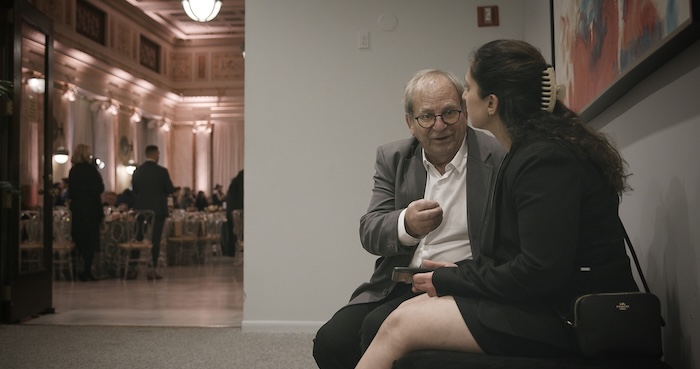
Since the massacre of Oct. 7, 2023, in Israel, most of the documentaries made about the conflict between Israelis and Palestinians have been told from the Palestinian perspective. Holding Liat, directed by Benjamin Kramer, centers on an American-Israeli couple whose daughter, Liat Beinin Atzili, was kidnapped, along with her husband, by Hamas during the attack and their attempts to secure their release. Most of the movie follows Liat’s father, Yehuda Beinin. The opening scene shows him in closeup talking on his cell phone to an official of the IDF about two weeks after his daughter’s abduction and getting no useful information. From that point, Beinin and other family members try to gain control of a situation that is frustrating in more ways than one. It’s not simply that the Israeli authorities give them nothing useful, but that the family, Yehuda in particular, quickly believes Liat is of little importance to the Israeli authorities and never was.
As a New Jersey native who built a kibbutz in Israel based on strict socialist principles that envisioned an Israel where Jews and Palestinians could live together productively, Beinin is a constantly conflicted figure. He believes that “both sides are led by crazy people,” but eventually his wrath is reserved for Benjamin Netanyahu and his enablers. It’s an attitude that’s understandable but nevertheless becomes controversial among his own loved ones, who believe they can’t risk alienating the government while trying to make sure that Liat is still safe and can be included in the prisoner exchanges that will start to take place down the road. This campaign finds the extended family—Liat’s siblings and in-laws, not to mention the extant American branch of the Beinins—suffering intramural scuffles that can get quite heated, including one particularly loud argument between Yehuda and his heretofore patient, neutral wife (“Yehuda is better at talking”), Chaya. In Israel and U.S. the family courts the media to gain exposure to Liat’s plight, but the gambit often backfires by instead exposing rifts within the family. “It’s the human side of the story,” says one American reporter unironically. Yehuda’s temper flares into denunciations of what the IDF is doing in Gaza, and while he never utters the G-word, some of his relatives are quick to condemn him for losing sight of the main goal, getting Liat and her husband back, thus undermining that goal with his political statements. When one of his granddaughters says, “Hamas needs to be eradicated” in front of cameras, she’s criticizing Yehuda as much as she is those in the U.S. who sympathize with the plight of people in Gaza. In perhaps the film’s most awkward scene a Palestinian political activist approaches Yehuda to offer his own sympathies and Yehuda has to tell the young man, in a whispered aside, that it wouldn’t look good for them to be talking.
Kramer’s attachment to Yehuda is understandable from a documentary standpoint since he is not only central to the story but also the most articulate member of the Beinin-Atzili clan. This focus itself sometimes undermines the movie’s balanced credibility because the other members can sound merely shrill in contrast, but for the most part Kramer gets at the heart of the problem, which is that politics itself has more to do with compounding the tragedy of Oct. 7 than any purely military actions, though, of course, it is those actions that have caused all the death and destruction. Despite the conditionally happy outcome, Holding Liat ends on the bitterest of sentiments when Yehuda reacts to the way his own efforts have been used for propaganda purposes: “This cannot be the way we live in the Middle East.”
In English and Hebrew. Now playing in Tokyo at Theater Image Forum Aoyama (03-5766-0114).
Celebrated for his meticulous, almost stately mise en scene, and noted for his often extreme use of violence, Park Chan-wook is rarely lauded for his visual jokes. In his last movie, the mystery thriller Decision to Leave, I smiled almost reflexively when the detective hero insouciantly pulled out a chain mail glove after confronting a knife-wielding suspect on a roof, the better to grab that knife during hand-to-hand combat. Park’s humor doesn’t announce itself, it simply shows up and fits in.
In his latest, the humor is blatant to the point of slapstick, which is not only totally intentional but expressive of the anti-capitalist themes at work in the story. Based on a fairly conventional thriller novel by the American writer Donald Westlake, No Other Choice adapts the 1997 story for 2025 Korea, where our hero, Yoo Man-su (Lee Byung-hun), lives the good life in a nice, big suburban house with his beautiful wife and kids and dogs. Less than five minutes into the film, Man-su is laid off by the American fund that has bought his paper company and he quickly enters into a state of denial followed by acute panic. He has been working for Solar Paper for 25 years, ever since graduating from high school, and knows nothing else. The term “no other choice” passes various characters’ lips along the way to justify all the terrible things they are about to do, whether it’s the anonymous American executive downsizing the employees he’s acquired or Man-su deciding he has to kill, literally, the competition for a job opening he envisions. The overriding joke in the latter case is that Man-su and the other men who have also been made redundant in the shrinking world of paper manufacture cannot possibly see themselves working in any other industry. The story is filled with beautifully rendered rhapsodies to paper and pulp that call attention to the fact that the medium is no longer practical—like these men. As Man-su embarks on his mission to murder people he has determined are his chief obstacles to getting back into the paper game, the viewer invariably empathizes with his predicament, because Park and Lee have so successfully shaped him as a victim of the system who had no choice; though, when you think about it, he has plenty of options, most of which are elaborated upon by his more sensible wife, Miri (Son Yejin). Park thrusts us so deeply into Man-su’s psyche that even his worse attributes—he’s a recovering alcoholic who falls off the wagon and it’s implied he was once an abusive husband and step-father—seem forgivable. And once he starts earnestly down the path to homicide you understand, not by rooting for him, but by trying hard to see the matter through his eyes.
As always, Park’s set pieces are tutorials in narrative concision. The various killings are blocked for maximum Loony Tunes effect, stemming from the idea that for all Man-su’s ingenious planning, he doesn’t possess the nerve needed to be a serial killer. The encounters between him and his victims (and in one scene, the victim’s wife as well) never proceed the way you expect them to. In fact, Park’s plot rationale is such that you can never predict from one moment to the next what might happen, which only makes the humor that much blacker, that much more uncomfortably hilarious.
In Korean. Now playing in Tokyo at Toho Cinemas Nihonbashi (050-6868-5060), Toho Cinemas Hibiya (050-6868-5068), Toho Cinemas Shinjuku (050-6868-5063), Kino Cinema Shinjuku (03-5315-0978), Bunkamura Le Cinema Shibuya Miyashita (0570-6875-5280), Toho Cinemas Roppongi Hills (050-6868-5024).
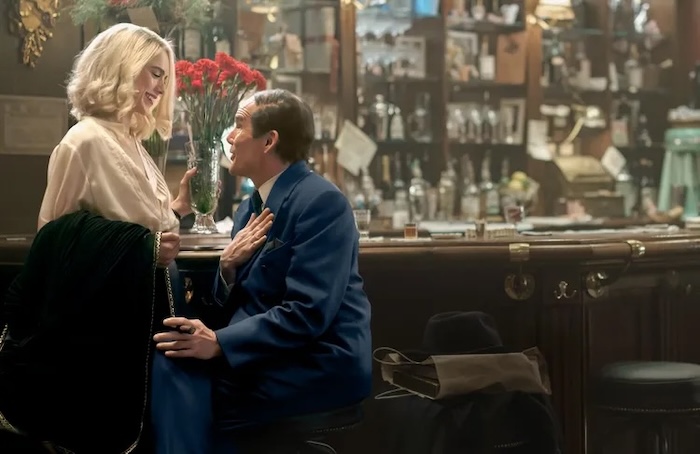
Richard Linklater’s chamber piece about the early 20th century American lyricist Lorenz Hart, Blue Moon, analyzes the nexus of art and entertainment, with the latter prevailing because the movie itself is nothing if not self-consciously witty and contrived. With a dialogue-heavy script by Robert Kaplow and the setting confined to Sardi’s restaurant on the 1943 night that the musical Oklahoma! opened on Broadway, the movie could have just as easily been a play, and often feels too theatrically chatty for its own good. Linklater’s metier is clever conversation, so he would seem to be up to the task, but he does nothing particularly interesting with it here, instead relying on his actors to push what the dialogue is selling. We already know from the opening scene that seven months after this fateful night Hart (Ethan Hawke) will be dead, so there’s a layer of doom coating every pithy bon mot, automatically loading the lines with meaning they may not have the strength to carry.
But Hart is great company, a truly cynical, self-regarding artist. We see him in the audience at the premiere of Oklahoma! seated next to his mother, who seems to be clearly enjoying the spectacle while Hart makes a show of leaving during the curtain calls. He repairs to Sardi’s where, later, the cast and crew will show up to await the reviews per Broadway tradition. Hart confides to the veteran bartender (Bobby Cannavale) his problems with the production, deriding its “third-rate cornpone humor” while praising the music of his long-time songwriting partner Richard Rodgers (“he can always get a melody to levitate”), who has turned to another lyricist, Oscar Hammerstein III, for what Hart correctly predicts will be a huge hit. It’s clear from the choice of words that Hart feels betrayed by Rodgers (Andrew Scott) and Kaplow strategically telegraphs that it’s Hart’s drinking and snobbery that have removed him from the composer’s good graces even though he hasn’t physically shown up in the movie yet to voice these opinions. The banter between customer (who at first contends he is on the wagon) and server, as well as a uniformed serviceman/saloon pianist who knows only a few of the maestro’s songs, also establishes Hart’s gay proclivities, which the bartender takes for granted (thus implying that everyone in the New York theater world does too), through some nicely nuanced criticism of Casablanca, even though Hart prefers to call himself “ambisexual,” a neologism that flies over the bartender’s head. This line of dialogue leads to what Hart claims is his real reason for being in the restaurant, which is to hook up with a young woman (Margaret Qualley) he hopes to have a love affair with, not for the sex but to affirm his celebrity and hallowed stature in the industry (she is an aspiring actress whose mother is a prominent figure in the Theater Guild), thus fortifying his self-importance.
All the actors develop these mutually supporting themes expertly and entertainingly—some of the lines are very funny—and Kaplow manages to insert real-life characters in the story in order to impress those of us who know who they are: E.B. White, Stephen Sondheim (as an adolescent), Weegee, George Roy Hill. Qualley has a moment near the end when her character describes an uncomfortable sexual dalliance in detail, and it comes across as a non sequitur, a well-intentioned acting exercise that seems to be about something else entirely. And that’s the central flaw of Blue Moon, which is supposed to be about the death of a monumental but deluded American artist whose greatness is parlayed only through his reputation and intellectual gamesmanship. I never got the sense of what made Larry Hart the genius he’s cracked up to be, except that he had the right attitude during a circumscribed period in the annals of American popular entertainment. And maybe that made all the difference in the world.
Oklahoma! is considered the first really successful book musical, so Wicked can, by any stretch of the imagination, be approached as its great-grand-progeny. The book is based on an actual book that’s a prequel to The Wizard of Oz, but it’s Stephen Schwartz’s songs that has made it one of the most enduring productions in Broadway history. Its popularity is such that the producers of the movie felt justified in adding a few songs and plot points in order to make two movies of the material rather than just one.
Whatever charms that were contained in part one, simply called Wicked, have mostly been exhausted in part two, titled facetiously Wicked: For Good. For sure, it’s hard to top part one’s big climactic production number, “Defying Gravity,” but the new movie starts slow and never really gains any kind of dramatic momentum, either in the music or in the story, which is oddly self-defeating since, according to reports (I’ve never seen the stage production), the second half of the play just whooshes on by. The whole point of “Defying Gravity” is that Elphaba (Cynthia Erivo), the nominally “wicked” witch of the west, had acquired the magical ability to fly, while her nominally “good” former BFF and fellow student of magic, Glinda (Ariana Grande), is still earthbound (Oz-bound?) because she’s never been able to cultivate any powers. It’s why the fascist enabler Madame Morrible (Michelle Yeoh) fashions a transparent bubble for Glinda to travel around in for the masses, making it look as if she’s got the juice when she doesn’t. This contrast between the two leads plays up the political dimensions of the story, wherein Elphaba is branded the bad guy and Glinda the good guy in order to advance Morrible’s authoritarian agenda with the help of the ineffectual and subservient wizard (Jeff Goldblum). Elphaba is cast as “wicked” because she’s trying to warn the populace of the elites’ plan to turn all of Oz’s heretofore animal citizens into slaves for their purely mercantile aims.
It’s a great story as far as fantastic tales go, but as a self-contained movie part two feels not only stretched out but padded, mainly with new songs and remodeled old songs that attempt to play up the seriousness of the themes, a move that effectively diminishes the overall entertainment value, giving beloved supporting players less to do and overworking the romantic aspects into insignificance. Of course, even viewers with little knowledge of the original musical will brighten up when they realize how several of the newer characters eventually evolve into the central figures of the ur-text, The Wizard of Oz, but it doesn’t make up for all the time you spend glancing at your watch.
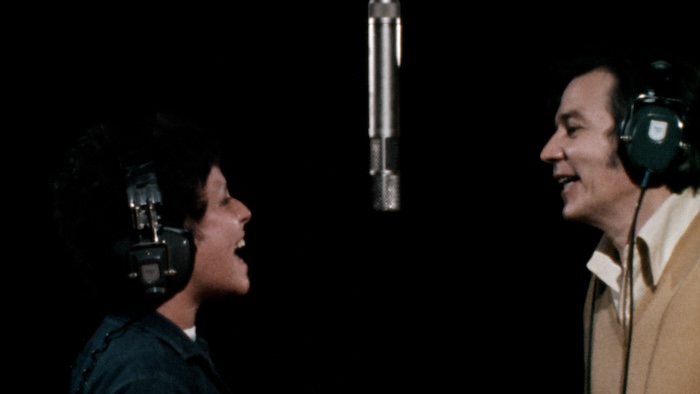
At no point during the documentary Elis & Tom, which uses film footage of Brazilian composer Antonio Carlos Jobim’s Los Angeles recording sessions with the fiery Brazilian vocalist Elis Regina in 1974 as a means of explaining his phenomenal influence on global jazz and pop in the 60s, did I wonder how much time was left, but as with Blue Moon, I left with more questions about the gensis of Jobim’s talents despite all the discourse about those talents from professionals as prestigious as Ron Carter and Wayne Shorter. The reason for this confusion is that the discourse isn’t coherently presented, which is understandable given the 50-year gap involved, but for me this obvious drawback would have simply provided a more compelling reason to dedicate more or the running time to the footage itself. Except for one take of “Aguas de Março,” the opening cut of the album being made, also titled Elis & Tom, the movie never gives us an entire song, but rather, in traditional music doc fashion, only a chorus before cutting back to the narrative, which in this case darts and weaves between first-person testimony about the recording session, a history of bossa nova centered on Jobim’s contributions, and various celebrity-focused addenda that, by themselves, could have made a more interesting movie. I mean, the TV snippet of Jobim and Sinatra dueting on “The Girl from Ipanema” will make the hairs on your neck stand up, and they leave it after the first verse.
More to the point, Regina’s role is given relatively short shrift. To the filmmakers’ credit they delve into her initial dislike of bossa nova, which she felt was too laid back. A singer who was as popular in Europe as she was in Brazil for her energetic performance style, it wasn’t until she actually worked with Jobim that she came to appreciate his novel harmonic approach and the way his style was uniquely suited to the Portuguese language. And perhaps a movie like this is not the place to go into her mental health problems or her death at age 36 from an overdose, but the manic qualities she manifests on film are never addressed as such, even though they dominate much of the footage that takes place in the studio. While some of the surviving musicians who talk about those sessions also elaborate on how bossa nova and Jobim lost their cultural cachet in the 70s, they neglect to point out how Regina herself kept the genre relevant for a younger generation of Brazilian artists.
Of course, if you have any interest at all in bossa nova, 60s pop, or 70s smooth jazz, Elis & Tom is required viewing. Since there is a criminal paucity of documentaries about Jobim and even bossa nova this may be one of the best we’ve got, and its aural riches are abundant. But it could have been so much more.
Blue Moon opens March 6 in Tokyo at Shinjuku Piccadilly (050-6861-3011), Toho Cinemas Chanter Hibiya (050-6868-5001), Human Trust Cinema Shibuya (03-5468-5551).
Wicked: For Good opens March 6 in Tokyo at Toho Cinemas Nihonbashi (050-6868-5060), Toho Cinemas Hibiya (050-6868-5068), 109 Cinemas Premium Shinjuku (0570-060-109), Shinjuku Wald 9 (03-5369-4955), Shinjuku Piccadilly (050-6861-3011), Toho Cinemas Shinjuku (050-6868-5063), Toho Cinemas Shibuya (050-6868-5002), Toho Cinemas Roppongi Hills (050-6868-5024).
Elis & Tom, in Portuguese and English, opens March 6 in Tokyo at Kadokawa Cinema Yurakucho (03-6268-0015), Yebisu Garden Cinema (0570-783-715).
Leonie Benesch is one of those seasoned European actors who wins awards and garners serious critical acclaim without breaking out in a big way. Her lead performance in the education drama The Teachers Lounge, as a Polish immigrant instructor trying and failing to defuse a student-faculty contretemps in a German public school, was a masterful evocation of flawless intentions that totally misread a serious situation; and her supporting stint as a German-English interpreter in September 5, about the murder of the Israeli judo team by Palestinian terrorists at the 1972 Munich Olympics, brought the tension of the circumstances to the surface as her character becomes the first to actually foresee the disaster. In the Swiss-German co-production Late Shift, she again plays a woman under crushing pressure, though in this case the pressure is not cumulative but incessant. Floria Lind is one of only two fully licensed nurses on duty during the “late shift” (basically, late afternoon to midnight) at a modern public urban hospital that is seriously understaffed. From the moment she arrives on the job, Floria is beset with multiple crises, some fairly routine, some life-threatening, and must get through them the best she can. Benesch’s special talent in this instance is the way she embodies her character’s practiced professionalism while conveying the frantic helplessness that’s gradually undermining her emotional equilibrium. It’s an unbearably taut thriller dressed up as a medical melodrama; The Pitt, but with the action centered on a single staff member.
As with all hospital dramas, this one is composed of individual patient stories that are treated in episodic fashion, as Floria tries desperately to complete her rounds in an orderly fashion. Each patient has unique needs and particular demands, and Floria is experienced enough to know how not only to satisfy those needs when she can but to work around them when she can’t. When an elderly woman with dementia becomes desperately disoriented she sings her a German lullaby that connects on a primal level. After a seriously depressed woman’s colostomy bag comes loose and her line falls out, Floria ignores her withering, fearful complaints and replaces the line with care and in silence. “It’s the first time anyone’s gotten it right the first time,” the woman remarks, impressed. Floria can be short with her subordinates and knows how to pass the buck when a patient gets too impatient, but she also knows she will have to pay for these shortcuts in the long run and the movie’s director, Petra Volpe, makes sure that payment comes due later in the movie. Toward the end, as the story’s pace intensifies and Floria’s temper frays to the breaking point, Volpe resorts to more real-time scenes that come across as single takes (they’re not, but she’s nothing if not a master of editing continuity), and the viewer is thus inundated by Floria’s feeling of helplessness.
Some of these outcomes are dramatically trite. The movie’s heavy is a harried corporate executive who is paying with private insurance and thus insists on special attention. His own personal anxieties get the better of him after Floria explodes with an act of foolish bravado. Both have crossed the line—she in terms of occupational protocol, he in terms of basic human decency—and their mutual resolution to the conflict feels contrived, as if it were designed to let some air out of the movie. The small glimpses into Floria’s private life—she has a small daughter but is separated from her partner—seem more like cliches than insights. Title cards at the close of the film inform us of a global nursing shortage, a touch that, while affecting and important, casts a clinical filter over all we’ve just witnessed; but it can’t dispel from your memory that look of quiet panic on Benesch’s face as Floria tries to catch her breath between each stop on her rounds. That look becomes seared into your brain.
In German, French and Turkish. Opens March 6 in Tokyo at Human Trust Cinema Yurakucho (03-6259-8608), Shinjuku Musashinokan (03-3354-5670).
After the Lower House election took place in February, some people on social media called into question the surprisingly good results of the newish Team Mirai party, which managed to secure 11 seats out of a total 14 candidates. There were claims that something fishy was going on because the numbers from one constituency to another were suspiciously alike. As it turns out, there was nothing unusual except maybe an acute case of cognitive dissonance.
Which isn’t to say the election overall was entirely on the up-and-up. Since last year, several mainstream media outlets have run stories about “mizumashi,” or vote-padding, in Tokyo’s Ota Ward. On January 16, Yomiuri reported that in last summer’s Upper House election, there was evidence that Ota Ward’s election committee “inflated” the number of invalid ballots by 2,600 in order to cover up a discrepancy between people who showed up to vote and the number of ballots submitted, a followup to an Asahi Shimbun article that appeared last July 20 that said pretty much the same thing but also mentioned that perhaps mistakenly counted absentee ballots were to blame.
In a March 2 report, TBS Radio attempted to explain the problem. In the average general election, about 5 percent of ballots are deemed invalid for various reasons. In Japan, a voter has to write the name of the candidate they want on the constituency ballot and indicate the name of the party and/or candidate they prefer on the proportional ballot. If they fail to write or indicate a name or write an invalid name, the ballot is considered void.
When election officials in Ota Ward counted the ballots in last summer’s Upper House election they found that the difference between the number of people who showed up to vote and the number of ballots was about 2,600. Asahi said that according to a retired election official, the people in charge of the vote in Ota Ward inflated the number of ballots in order to make the numbers add up. He stressed that these extra ballots were counted as being invalid or void, which means that the results didn’t change at all. And since it is fairly well known that 5 percent of votes are usually deemed invalid in a given election, the idea was that no one would question these numbers.
However, it is illegal to tamper with vote numbers, and the retired official who spilled this intelligence said he found out about the mizumashi while dining with current election officials, who, over drinks, revealed what they had done. They seemed to think it was no big deal and implied that they had been taught this method by their superiors. However, the retired official was quite shocked and posted his reaction on social media. That’s when the media picked up the story, though nothing came of it at the time.
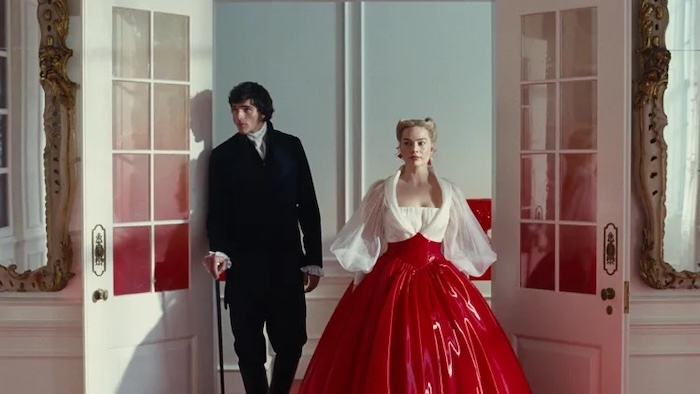
As with much of the classic literature I read in high school and college, Charlotte Bronte’s Wuthering Heights remains in my memory as more of a vibe than a story, and I imagine it’s this dynamic that director Emerald Fennell is working with in her new adaptation. The particulars of the torrid relationship between the heir to the titular Yorkshire estate, Cathy Earnshaw (Margot Robbie), and the urchin-of-no-known-provenance, Heathcliff (Jacob Elordi), adopted by her alcoholic, ineffectual father (Martin Clunes), have mostly evaporated with time, leaving behind vague memories of heaving emotions and eternally dark heavy weather. That’s mostly what we get from Fennell, along with a uniquely eye-popping production design that means to own the story for anyone who watches this particular movie version. I’ve never been the kind of filmgoer who begrudges a director their right to tell an already established property in their own way, and, truth be told, Bronte’s novel was never my cup of tea, so I was free to accept its peculiar charms in the way they were presented. I was also free to reject them.
The purple melodramatics make sense, especially in the beginning, when our two would-be lovers are children who simply offer each other a challenging companionship based on their sense of grievance with their respective lots—Heathcliff’s impoverished, stationless resentment versus Cathy’s empty entitlement owing to the simple stark fact that she’s female. They have no one else on this blasted heath but each other, and so when they’re grown and Cathy is married off to her wealthy neighbor, Linton (Shazad Latif), after Heathcliff self-exiles in a huff to make something of himself, the breach feels monumental, setting the stakes high for the latter’s return some years later as a nouveau riche epicurean whose best revenge is buying the now broken down estate where he was raised in order to taunt the woman who lives in moneyed misery next door with his newly elevated social status and disposable income. Having lopped off the last entire third of the book, Fennell is free to fill most of the movie’s run time with the central pair’s semi-incestuous reacquaintance, which amounts to a lot of moist sexual activity and hot emoting that flies over the head of Linton but hardly escapes the notice of Cathy’s lifelong personal servant, Nelly (Hong Chau), whose role in the unfolding tragedy is inflated to Hitchcockian proportions. Whatever nuance of romantic intrigue Bronte intended for the pair’s couplings is substituted with the most brazen class-conscious silliness. Moreover, during the second half of the film Cathy and Heathcliff are almost never apart physically or psychically. How can you miss someone the way you profess to miss them when neither of you will go away?
Then, of course, Heathcliff has the audacity to travel the extra Harlequin distance by boning Linton’s heretofore innocent younger sister (Alison Oliver), a move so blatantly provocative as to make you wonder why anyone would consider Bronte a good storyteller much less a writer for the ages; and, of course, that touch turns out to be purely Fennellian, who is by her own admission more interested in making you feel icky than in trying to get you to understand her characters. By the end of this Wuthering Heights I was frankly tired of being poked and prodded with aural-visual stimuli that had no basis in reality—or Gothic unreality, for that matter.
The sexual intercourse in Emma Seligman’s Shiva Baby, as in Wuthering Heights, mostly takes place off screen, but the sexual passion is more overtly effective in the overall film probably because Seligman plays it for laughs rather than stimulation, a move that earns a lot of mileage due to its New York Jewish milieu. Danielle (Rachel Sennott) is a college student who eschews her family’s offers of financial support by taking “babysitting” jobs that, in fact, turn out to be sex work. That her parents and other relatives believe she can come up with the tuition for her New York City liberal arts education through babysitting is the plot’s first stumbling block but one that Seligman quickly eliminates with the most intense bum rush of Jewish jokes since Lenny Bruce first landed in the clink.
The film comes off as a theater piece that’s been opened up for the camera, since it mostly takes place at the funeral of one of Danielle’s relatives that’s being attended by everyone she’s grown up with and quite a few she hasn’t but knows about through the grapevine. One attendant she didn’t expect to be there is Max (Danny Deferrari), her main client, so to speak, who, of course recognizes her immediately. Another thing she didn’t know is that Max is married to a beautiful shiksa, Kim (Dianna Agron), who also happens to be a successful entrepreneur and has just given birth to their first child. Complicating matters even more is the presence of Danielle’s former lover Maya (Molly Gordon), for whom she still carries a torch and who picks up on Danielle’s paranoia as soon as she spies Max walking into the not-so-somber shiva. Mix liberally with a lot of hilarious gossipy inquiries from stray relatives who, of course, wonder when Danielle will ever graduate and get married, and you’ve got a very satisfying early Philip Roth pastiche that delivers more emotional satisfaction than your usual sex comedy—or sex drama, for that matter—despite Seligman’s tendency to provide more information than necessary and overload the plot.
The best part of Shiva Baby is Danielle’s reaction to Max’s real life, something that she shouldn’t rightly care about but does because the point of the whole movie is that she’s not mature enough to separate sex from her feelings the way a good sex worker should. It’s a conundrum that Seligman handles cleverly by not making as big a deal out of it as Danielle does.
Wuthering Heights now playing in Tokyo at Toho Cinemas Nihonbashi (050-6868-5060), Toho Cinemas Hibiya (050-6868-5068), 109 Cinemas Premium Shinjuku (0570-060-109), Shinjuku Wald 9 (03-5369-4955), Shinjuku Piccadilly (050-6861-3011), Toho Cinemas Shinjuku (050-6868-5063), Toho Cinemas Shibuya (050-6868-5002), Toho Cinemas Roppongi Hills (050-6868-5024).
Shiva Baby now playing in Tokyo at Shinjuku Musashinokan (03-3354-5670), Human Trust Cinema Yurakucho (03-6259-8608).
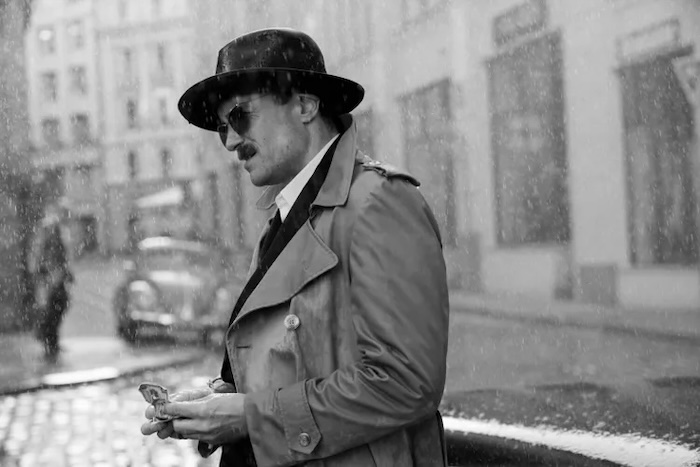
Though based on a French novel, The Disappearance of Josef Mengele, directed by the prolific expatriate Russian director Kirill Serebrennikov, offers enough convincing detail to make it feel not only closely researched but redolent of the historical moments it depicts. Mengele was the Nazi doctor who carried out horrific experiments on prisoners at Auschwitz, thus earning him the moniker “Angel of Death.” He managed to escape capture after the war and around 1950, with the help of a network of fascist sympathizers both German and non-German escaped to Argentina where the authoritarian Juan Peron presided. The novel and the movie presumes to imagine what his life in exile was like (he died in a swimming accident in 1979 in Brazil, though his body wasn’t properly identified until some years later), and though Serebrennikov liberally chops up the timeline it’s fairly easy to get a handle on how that life progressed from the 1950s to his death, and the strongest impression one gets is that the monstrousness of Mengele’s principles not only did not diminish over time, but that a lot more people than you might expect shared them.
There’s a certain measure of cognitive dissonace involved in the sequence that finds him sneaking back into Germany in 1956 to visit his rich family, which is still the dominant economic force in the town of Günzburg. His father and other kin try to convince him to stay. “Nobody is looking for you,” says his brother, and this discomfiting intelligence sets the mood for the rest of the film. Nevertheless, Mengele (August Diehl) is nothing if not self-righteously paranoid and he decides to return to South America, where Peron is soon ousted and he’s forced to flee to Paraguay with his second wife and her children from a previous marriage. Mengele’s paranoia is eventually borne out when Mossad captures Adolf Eichmann and he’s forced to escape to Brazil, where he lives under the radar with a Hungarian farm family who are refugees of the Soviet invasion. But while the couple’s own sympathies may scan right-wing—the money they receive from the Nazi underground for Mengele’s room and board seem to be more persuasive—Mengele’s insufferably imperious demeanor, which insists his hosts speak only German around him, gets him kicked out in the end. In his old age, he has to make do with his own wits, though the script hints that he’s still getting some money from the family. In a repeating, fractured sequence he’s visited in Sao Paulo by his grown son, Rolf (Max Bretschneider), a typical liberal postwar German male, who demands to know if the terrible stories about his father are true. Though Mengele doesn’t cop to his crimes, he berates Rolf about the weakness of his generation and the “natural superiority” of the German-Aryan race, and while these one-sided conversations become mind-numbing in their self-serving repulsiveness, Diehl keeps them organically attuned to the overall arc of the story, which implies that these kinds of anti-humanist impulses are universal and eternal. In fact, Serebrennikov, a vocal opponent of Putin, has said publicly that he made Disappearance as a comment on our present situation rather than as a completely historical document.
Typical of the director, the movie is a bit too long, padded out with redundancies. And while Serebrennikov’s visual style is smooth and sophisticated, some of the devices are unoriginal and self-defeating, such as filming everything in luminous black-and-white and reserving the color shots for 16mm “home movies” of his stomach-turning activities at Auschwitz, a move that conveys the idea that those were the happiest times in his life. We get the point very well without this device, which comes across as sarcastically sentimental.
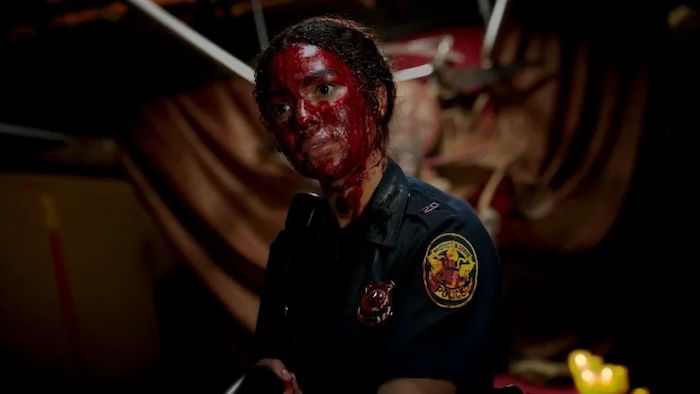
A more literal angel of death is the titular maguffin in the low-budget horror flick Malum, though the character doesn’t actually show up physically until near the end. The setup is everything: a rookie cop, Jessica (Jessica Sula), requests as her first assignment the late night shift at the mostly abandoned precinct station where her father (Eric Olson), also a cop, shot himself exactly a year earlier after killing several suspects of a Satan-worshipping cult that he had painstakingly uncovered. Jessica wants to get to the bottom of the story and, naturally, alienates her new colleagues, who have come to consider her father a guy who took his job too seriously and was driven mad by it. In essence, she’s on her own in the old station, which, on this particular anniversary, is suddenly besieged by malignant forces both within and without. Obviously, the surviving members of the cult are showing up for some kind of payback, but what does that mean?
Malum has a plot that becomes both more intriguing and less credible as the story develops, but the director, Anthony DiBlasi, makes the most of the linear journey with increasingly gory sequences set in the dimly lit hallways of the superannuated police station. In order to maintain momentum he keeps the viewer guessing as to what horrors are actually taking place in front of Jessica’s eyes and which ones are products of her overworked imagination, and I started getting itchy for something more substantial once these two threads merged and became indistinguishable. As often happens with modern horror, nothing is what it initially seems and the reveal turns out to be less compelling than the set pieces used to support it. Malum is not so much style-over-substance as it is vivid technique that overwhelms its poorly worked out intentions.
The Disappearance of Josef Mengele, in German, Spanish, Portuguese and Hungarian, opens Feb. 27 in Tokyo at Cinemart Shinjuku ’03-5369-2831), Cine Switch Ginza (03-3561-0707).
Malum opens Feb. 27 in Tokyo at Shinjuku Piccadilly (050-6861-3011), Human Trust Cinema Shibuya (03-5468-55519.
The Disappearance of Josef Mengele home page in Japanese
Tolstoy’s famous opening line from Anna Karenina about families sounds as if it could have been the jumping off point for Joachim Trier’s latest Oslo-set film, which is both a domestic melodrama and a slyly comic analysis of his chosen vocation. He quickly establishes what it is that makes the Borg family unhappy with a brief voiceover narrative about the provenance of the beautiful house built by an ancestor of the clan around the turn of the 20th century and what it witnessed starting around the time of the war, when Norway was occupied by the Nazis and the woman of the house—the mother of internationally admired film director Gustav Borg (Stellan Skarsgård)—was arrested and tortured by the Germans because they believed her work as a therapist undermined their authority. The main plot device of Trier’s film is Borg’s decision, at the age of 70, to make his first feature in 15 years based on a script inspired, but not necessarily “about,” his mother in the hopes that his estranged daughter, Nora (Renate Reinsve), a successful stage actor, will play the lead. She turns him down flat, because she still resents him for leaving her mother, another therapist who remained in the house after the divorce settlement and, as the film opens, has just died.
Trier’s elegant script, developed with his usual writing partner, Eskil Vogt, is almost too thorough in its dissection of the Borg family and how its history has, again to paraphrase Tolstoy, damaged each member in its own way. Nora is introduced on the opening night of a play almost catatonic with stage fright, delaying her entrance interminably until she has to be pushed out in front of an audience that has become seriously concerned. In contrast, Nora’s sister, Agnes (Inga Ibsdotter Lilleaas), who, though she once acted as a child in Gustav’s most beloved film (set during the war), has chosen not to go into the arts and instead is a historian, a convenient decision for the movie since it allows her access to records that explain her family’s background, which Trier can exploit when it suits his purposes. Agnes is contentedly married and has a small son, Erik (Oyvind Hesjedal Loven), who becomes one of the gravitational pulls, along with Nora, that draws Gustav back into the family orbit, and at first Agnes’s impulse to forgive him pits her emotionally against her sister, who still wants nothing to do with her old man. The audience has been prompted to take her side by Trier’s careful characterization of Gustav, which is that of an imperious blowhard who has been banking on his celebrity as a Bergmanesque artist for almost his entire career. He can be as rude and self-centered as he likes, so when he is feted at a French film festival and introduced to a young American movie star, Rachel Kemp (Elle Fanning), who wants to do something serious, he offers her the part that Nora turned down. The collaboration tests not only the young American’s wherewithal as an artist, but also Gustav’s muddled intentions for the film and Nora’s misgivings about her position in a family whose history she has rejected out of unmediated enmity. The worst part is that Gustav is determined to make the film in the family home to which he still has title and where his own mother killed herself, a move that further divides the sisters, since they grew up there without him.
This being a Scandinavian film not directed by Ingmar Bergman, the melodrama is spiked with drily humorous touches that make it not only bearable but relatable in ways that seem universal. In perhaps the movie’s most famous scene, Gustav explains to Rachel about how his mother hanged herself “on that very stool right there,” shocking the young actress speechless. When he relates this story to Agnes afterwards, his daughter looks over at the stool and says, “You mean that one, the one from Ikea?” The scene establishes Gustav’s mischievous and self-serving capacity for cruelty in a compact way, much the same way that the scene in the National Theater conveyed Nora’s exquisitely self-defeating chronic anxiety. In the end, of course, Gustav’s movie turns out to be about Nora, not his mother, and Sentimental Value‘s almost hermetical perfection starts to feel stifling. Unhappy families are indeed unhappy in their own way, but never this immaculately.
In Norwegian and English. Now playing in Tokyo at Toho Cinemas Hibiya (050-6868-5068), Shinjuku Piccadilly (050-6861-3011), Bunkamura Le Cinema Shibuya Miyashita (050-6875-5280), Toho Cinemas Nihonbashi (050-6868-5060), Toho Cinemas Roppongi Hills (050-6868-5024).
photo (c) 2025 Mer Film/Eye Eye Pictures/Lumen/MK Productions/Zentropa Entertainment S5 APS/Zentropa Sweden AV/ Komplizen Film/British Broadcasting Corporation/Arte France Cinema/Film I Vast/Oslo Film Fund/Mediefondet Zefyr/ZDF/Arte
The fun of a new Hong Sangsoo movie is in discovering what the prolific, wily director is doing this time in terms of structure. This 2023 feature has two narratives that alternate back-and-forth while sharing certain story elements. However, anyone who is familiar with Hong’s work will know better than to look for meaning in these shared elements, since they are often deployed more on a whim than anything else. Another thing to look for with a new Hong project is the English language title. Most Hong titles are merely descriptive of the action, but sometimes they play with words in interesting ways. The first impression one gets with In Our Day is that it’s going to have something to do with nostalgia, but while the two narratives are framed as an older, more experienced person conveying advice upon a younger person, any attendant generational distinctions are, at best, implied rather than stated.
In the first story, a minor actor, Sangwon (Kim Min-hee), who we soon learn is leaving the business, is staying at the apartment of a friend, Jung-soo (Song Sunmi). Title cards inform us that the two friends are somehow supporting each other, though, in fact, Sangwon seems to be the only one in need of support. The first portion of this section takes place during a morning when Sangwon wakes up later than usual, and when she arrives in the dining room Jung-soo is working (she appears to have some kind of shoe business) and already drinking wine, to boot. Their conversation is mundane, centering on Jung-soo’s laid back cat, Us. In time, Sangwon’s younger cousin, Jisoo (Park Misoo), arrives to talk to Sangwon about becoming an actor herself. The second story is about an elderly poet, Uiji (Ki Joo-bong), who is being documented on video by a female student (Kim Sunghyun) for a school project. Another title card tells us that Uiji is now enjoying some minor popularity among young people, and he, too, is visited by a young male admirer (Ha Seong-guk), who wants his counsel about life and love. It becomes clear rather early on, though, that while Uiji likes the attention, he’s more fixed on alcohol, or rather the lack of it, since his doctor recently told him that he has to give up drinking because of his weak heart. If you’ve ever seen a Hong movie, you know better than to imagine Uiji sticking to his pledge of abstinence.
Besides the modulated mentor-mentee dynamic, other mirrorings between the storylines involve afternoon naps, guitars, and some philosophical heart-to-hearts that the audience is meant to take with more than a handful of salt. Dramatically, the first story with the actor is fairly dull, even by Hong’s standards, while the second story with the poet is one of his funniest in terms of character development. That both protagonists are disaffected artists is a theme Hong covers in almost all his movies. In that regard, In Our Day, whose nostalgia is acutely felt without necessarily being intentional, is one of his more accessible features. You can also sit through it more than once, as I did, and get more out of it than you thought you would.
In Korean. Now playing in Tokyo at Euro Space Shibuya (03-3461-0211).









 philipbrasor.com