Review: A Normal Family

Probably no national cinema addresses the conflicts of social class with the directness of South Korea’s. There’s something almost perverse about Korean filmmakers’ willingness to expose the soul-destroying rot of the capitalist system on its citizens. Parasite is the most obvious example, but that’s more or less an allegory-fantasy, albeit an unusually insightful one. Hur Jin-ho’s adaptation of a Dutch bestseller locates its theme of irresponsible parenting in the specific trappings of Korean privilege, distilling a kind of horror movie effect in the process, not because of its occasional scenes of violence, either physical or emotional, but because of its ability to generate disgust. Maybe that makes it an allegory-fantasy too.

The family of the somewhat misleading title consists of two adult brothers, successful corporate lawyer Jae-won (Sol Kyung-gu) and successful pediatric surgeon Jae-gyu (Jang Dong-gun), who don’t really get along. Jae-won is the more materialistic of the two, a mild-mannered epicure who insists on expensive dinners once a month with his brother and their wives in order to present some semblance of fraternal harmony, though Jae-gyu, who prides himself on his service to humanity, finds his brother’s attitude toward life mercenary and cynical. After all, it is Jae-gyu, or, more exactly, his wife, Yeon-kyung (Kim Hee-ae), who is taking care of their senile and often violent mother while they look for a suitable nursing home for her. As the movie opens the two brothers are locked in a more immediate confrontation as Jae-won has been hired by one of his rich clients to defend the client’s wayward son, who has killed a man and sent the man’s daughter into a coma after a road rage incident. As it happens, Jae-gyu is the doctor who operated on the girl. But this confrontation becomes a sideshow to a more serious incident involving Jae-won’s high school senior daughter from his first marriage and Jae-gyu’s adolescent son, who, during one of their parents’ elaborate dinners, get drunk together at a party and later beat a homeless man almost to death. While the police look for the perpetrators, Yeon-kyung sees the CCTV video of the attack, which has gone viral, and recognizes her son and his cousin. All hell breaks loose between the siblings and their spouses as they decide whether to hand their kids over to the authorities or keep a lid on it. The ensuing indecision only exacerbates their desperation, and in the process the two brothers’ initial ethical distinctions start to shift.

This particular conundrum has been tackled by movies before. In fact, it’s been tackled by Korean movies quite a few times, the most potent example being Lee Chang-dong’s Poetry, in which an elderly, weak-minded woman is confronted with the crimes of her grandson, who she believes participated in the rape of a classmate. But whereas Lee’s depiction of this dilemma is centered on matters of conscience and empathy, Hur’s is stricly a class issue. Despite the fact that one of the brothers ends up doing what we would call “the right thing,” the audience still sees the people involved as being beholden to a hypocritical code of family unity that doesn’t stand up to scrutiny. It’s a tragedy that’s been manufactured to evince significant schadenfreude in the viewer, who is invariably stoked to see all these entitled monsters—their children, especially—receive their comeuppance. Had it been handled as a comedy, I probably would have liked it a lot better.

In Korean. Opens Jan. 17 in Tokyo at Toho Cinemas Nihonbashi (050-6868-5060), Toho Cinemas Chanter Hibiya (050-6868-5001), Toho Cinemas Shinjuku (050-6868-5063), Euro Space Shibuya (03-3461-0211).

A Normal Family home page in Japanese

photo (c) 2024 Hive Media Corp. & Mindmark
Posted in Movies | Tagged , , , | Leave a comment

Review: Teki Cometh

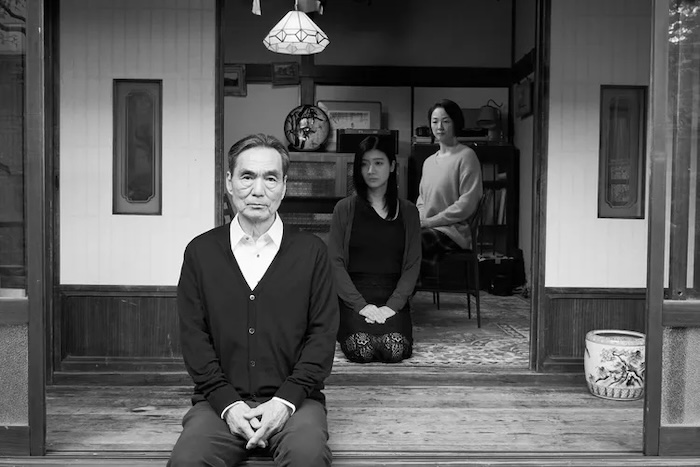
With its monochromatic palette and focus on quotidian activity, Daihachi Yoshida’s Teki Cometh, which won the Grand Prix at the most recent Tokyo International Film Festival, initially offers a disarmingly unassuming approach to the notion of passing into insignificance upon reaching one’s dotage. The central figure, a retired 77-year-old French literature scholar named Watanabe (Kyozo Nagatsuka), whose wife has been dead for about a decade, lives by himself in a well-appointed, spacious old house in an unnamed city and goes about his daily tasks with the poise and determination of a man who knows exactly what he’s about. However, the audience, clued in by sound effects and odd visual cues, recognizes that something is amiss in the professor’s purchase on reality, and as the movie progresses he is subjected to an increasing onslaught of disturbing sensory phenomena that may or may not indicate he is descending into a form of madness.

Is it dementia? The imaginings take on many forms, from inferences of sexual interest from a former female student (Kumi Takiuchi) who often visits, to pure paranoia, suggested by conspiracy theories expounded on the internet, that he will soon be visited by hordes of filthy outsiders—the teki, or “enemy” of the title, whose florid English rendering makes fun of the professor’s academic pretensions. Based on a novel by Yasutaka Tsutsui published in 1998, when the author was 68, the movie exaggerates the protagonist’s self-diagnosed decrepitude. It’s like a study of the scourge of hypochondria intensified to comic proportions, which makes the jump scares less frightening than tragic. Watanabe is still publishing a regular column in what is characterized as a journal of no importance, and you can discern from his self-deprecating remarks that he knows it; and yet, when the publication drops him he’s deeply disappointed, as if this denial of his intellectual contribution is the beginning of the end, and his decline essentially starts at this point, even though no physical manifestation has kicked in yet. “The government doesn’t like people who live long,” says an acquaintance when Watanabe confesses that he’s not much for annual checkups, and it’s easy to get the feeling that the professor welcomes the end even though he fears it profoundly. As his mind begins to play tricks on him and the fantasies gradually take over, the subtext of past sins catching up with him (Did he cheat on his wife with a student?) is both stressed and subsumed by the outrageous hallucinations. 

As bold and startling as the visual production is, the pedestrian pacing and haunted house cliches undermine the raw power of the story, as if Yoshida were taking pains to keep the presentation respectful of his protagonist’s delicate sensibility. Watanabe’s desperation never truly registers because the blurring of reality and dream loses meaning for someone whose interior world is so purposely opaque. When everything falls apart it feels sad but inconsequential, like one of those essays Watanabe writes for the publication nobody reads. 

In Japanese. Opens Jan. 17 in Tokyo at Theatre Shinjuku (03-3352-1846), Euro Space Shibuya (03-3461-0211), Yebisu Garden Cinema (0570-783-715).

Teki Cometh home page in Japanese

photo (c) 2023 Tekinomikata/1998 Tsutsui Yasutaka, Shinchosha

Posted in Movies | Tagged , , , | Leave a comment

Media watch: Former justice minister gets firsthand look at prison life—as an inmate

In June 2021, Katsuyuki Kawai was sentenced to three years in prison and fined ¥1.3 million for violating the Fair Elections Law after a judge determined he had bought votes for his wife, Anri, when she was running in the 2019 upper house election in Hiroshima as a member of the ruling Liberal Democratic Party, a seat she won. At the time, Kawai, also an LDP member, was not only a sitting lawmaker himself, but the Minister of Justice, having been appointed to the post by then-Prime Minister Shinzo Abe. Following the vote-buying allegations he resigned as justice minister, and in June 2020 was arrested along with his wife, who quit the Diet in February 2021. Katsuyuki quit two months later. 

On Nov. 29, 2023, Kawai was released on parole. He recently published a book about his time at Sakura Prison in Tochigi Prefecture, making the most of the fact that he is the first justice minister to ever be locked up. In recent weeks, he’s been making the media rounds to promote Prison Diary: The Justice Minister Who Went to Jail, and the coverage has not only been non-judgmental, it’s often been light and lively. A good example is his appearance on Abema TV’s “Abema Teki News Show,” which went as far as dramatizing several prison anecdotes described in the book. What was different, even refreshing, about the presentation is that Kawai seemed to have learned a lot about prison life that most politicians, including those interested in legal matters, would probably prefer not to have to talk about, and that such knowledge should be standard for the person who is essentially the highest ranking law enforcement official in the country, even if, practically speaking, most of the people appointed to that job aren’t really qualified to do anything except rubber stamp pronouncements from the bureaucracy or the ruling party’s leadership. 

Even Kawai’s overall assessment of the purpose of his imprisonment was startling, given that he was once a firebrand for the LDP and martyred himself for the sake of the party: It’s generally believed that the crime for which he was convicted amounted to following orders from his superiors, including Abe. At the beginning of his interview on Abema TV, he said that the facility where he was incarcerated is not referred to officially as a “prison,” but rather as a “center to promote rehabilitation,” a term that made him laugh since he received absolutely no instruction that could help him “reenter society.”

Most of the assigned work, for instance, was pointless in that no skills were transferred that might be useful on the outside. His first job was folding origami cranes (orizuru) for some private company, a task he never got the hang of. He was then sent to the prison library, where his main job was to inspect books donated for the prisoners’ use. Most were old and damaged, so he repaired them with glue and cellophane tape. He worked eight-hour days, Monday through Thursday. Friday was “instruction day,” when he was supposed to learn about the errors of his ways and how to be a good citizen, but most of it involved watching boilerplate videos, usually NHK programs. He then was told to write about the instruction as it applied to his own situation, an assignment that never made sense to him. Saturdays, Sundays, and holidays were free days during which he could do anything he wanted, but as he pointed out, most prisoners just slept because there were few options available and it was always cold, so instead of sitting around on the frigid floor (there were no chairs or beds) it was easier and more comfortable to just wrap up as best you could in the futon. 

Continue reading
Posted in Media | Tagged | Leave a comment

Review: Emmanuelle

Because Audrey Diwan directed Happening, a movie that honestly addressed abortion, it’s likely her remake of the 1974 softcore classic, which launched countless sequels and copies, will be described as a feminist take on the subject; but even if it was directed by a man it had its feminist defenders at the time, people who said that the title character owned her sexual agency and was therefore forward thinking. Having never seen the original I have nothing to add, but Diwan’s version is pretty boring, especially in the titillation department. (To be fair, it wasn’t her project. She was hired.) The sex is mostly of the imaginary kind, meaning Emmanuelle (Noemie Merlant) often fantasizes about it, thus conjuring up ideal sexual encounters to her own tastes. But much of the sensuality is submerged into the suggestive dialogue, which is in strained English even though Emmanuelle herself is French.

The setting is Hong Kong, more specifically a luxury hotel that Emmanulle is “inspecting” for the company that owns it. She occasionally checks in with the hotel’s manager (Naomi Watts), with whom she seems to have some kind of beef, probably because that’s her job, but the business talk effectively stops whatever passes for a plot dead in its tracks since the screenwriter, Rebecca Zlotowski, doesn’t betray much knowledge of the economics of running a hotel, especially one as self-consciously upscale as this one. She does manage to inject sexual innuendo into almost every conversation, though, including one about disaster management, and when champagne corks pop you get the idea of just how limited the filmmakers’ ideas are about conveying pleasure. Are they trying to intellectualize the original material, which, after all, started out as a novel? Or are they making fun of it? In any case, Emmanuelle seems to have the hots for one resident, a vaguely Japanese civil engineer named Kei (Will Sharpe), who picks up on her double entendres and treats them as philosophical puzzles rather than come-ons. 

In the end, Emmanuelle the movie is more about money than it is about sex, though I’m not sure that was the intention unless Diwan, after realizing what she’d gotten herself into, decided to sabotage the whole thing from the inside; meaning, it’s not a bad movie, only a pointless one. 

In English and French. Now playing in Tokyo at Toho Cinemas Hibiya (050-6868-5068), Toho Cinemas Shinjuku (050-6868-5063), Kino Cinema Shinjuku (03-5315-0978), Shibuya Cine Quinto (03-3477-5905), Toho Cinemas Nihonbashi (050-6868-5060), Toho Cinemas Roppongi Hills (050-6868-5024).

Emmanuelle home page in Japanese

photo (c) 2024 Chantelouve-Rectangle Productions-Goodfellas-Pathe Films

Posted in Movies | Tagged , , | Leave a comment

Review: Formed Police Unit

Sometimes the background of a movie is more interesting than the movie itself. This action blockbuster about a Chinese UN peacekeeping force sent to a wartorn African country had its shooting schedule extended about half a year after its star, Zhang Zhehan, caused a scandal when photos emerged on the internet of him visiting Japan’s Yasukuni Shrine, where Japan’s military dead, including Class A war criminals accused of atrocities in China during World War II, are enshrined. Moreover, another photo had him shaking hands with Dewi Sukarno, the Japanese widow of the Indonesian tyrant of the same name and a noted rightwing firebrand in Japan. Though there was some speculation that the photos were fabricated, Zhang didn’t do himself any favors by coming up with pretty lame excuses for their existence and has since been blackballed, and that meant all his scenes in FPU, as the movie is titled in Japan, had to be reshot. 

In any case, the film was picked up by a Japanese distributor, presumably because of its action pedigree, and on that front it has some crowd-pleasing elements, especially near the end when the gunplay, explosions, and mano-a-mano fist fights are ramped up to 10. Other elements are less enjoyable, in particular the script and the expository staging. The soldiers are policemen who’ve been selected to “form” the peacekeeping unit and then trained in warfare. This elite aspect translates as a jingoistic attitude that not only permeates the squad but imbues the plot with an unsubtle patronizing air toward anyone in the movie who isn’t Chinese. Supposedly based on a real PK mission in Sierra Leone that China participated in, the movie takes place in the fictional country of Santa Leonne, where a rebel leader, backed by evil white foreign mercenaries, is trying to overthrow the government, wiping out whole villages in the process. When the Chinese arrive they’re initially met with suspicion by the natives, but eventually they win their trust with excellent public service, a situation that’s conveyed through manipulative montages of FPU members putting up streetlamps and assisting in classroom lessons for children. When their activities run up against the stiff bureaucratic rules of the UN, they’re invariably scolded but in the end always end up on the right side of the argument, whether the situation is martial or not. The UN honchos are shitty negotiators and tactically inept, while the Chinese are disciplined and always act on moral principles.

There’s not a lot of nuance to the presentation. Subplots involving two young police recruits whose desire for real action gets them in trouble with their superiors and another recruit’s determination to live up to the example set by his policeman father, who was killed in action, are hackneyed and underdeveloped. But lack of nuance doesn’t hurt the violent set pieces, one of which takes place in a wild tropical storm that adds considerably to the visceral excitement. Suffice to say it could have been a lot better had the nationalistic prerogatives that had a hand in the film’s delay not been incorporated so forcefully into the screenplay, but what else would you expect from a Chinese blockbuster that touches on foreign policy? 

In Mandarin, English and French. Opens Jan. 10 in Tokyo at Toho Cinemas Hibiya (050-6868-5068), Toho Cinemas Roppongi Hills (050-6868-5024), Toho Cinemas Shinjuku (050-6868-5063).

Formed Police Unit home page in Japanese

photo (c) 2024 Zhongzhong (Huoerguosi) Films Co., Ltd. & Wanda Pictures (Huoerguosi) Co., Ltd.

Posted in Movies | Tagged | Leave a comment

Number 1 Shimbun, January 2025

Here’s our latest article for the FCCJ, which is about the Korean response to Japan’s newest World Cultural Heritage site.

Posted in Uncategorized | Leave a comment

Review: Blackbird Blackbird Blackberry

The character of Etero (Eka Chavleishvili) is familiar in a literary way. A single woman in her late 40s whose life has been in service to the males in her family, specifically an older brother and a widowed father who blames Etero for the death of her mother. Now that both men are dead themselves she is the token spinster in this Georgian mountain village, a reticent woman who runs a bleakly understocked general store and spends most of her free time picking blackberries near a gorge by the river, a pastime that almost gets her killed in the opening scene after she’s distracted by a particularly striking black bird. The metaphor is a bit heavy-handed, but the subsequent story about Etero finally finding love is unusual in ways that aren’t familiar.

Suffice to say that Etero’s near-death experience jolts something elemental in her, and she responds to this feeling by seducing her deliveryman, Murman (Temiko Chichinadze), later that day. Murman is married and even older than Etero—he often regales her with stories about his beloved grandsons—but he gives in to her and they make passionate love in Etero’s store room, a scene that the director, Elene Naveriani, adapting an award-winning novel, stages with all the awkward naturalism you would expect from two middle age people who don’t normally do this kind of thing. From there the affair is touch-and-go, as the pair meet clandestinely in places outside the village. But does being in love for the first time (“That’s what it’s like to lose your virginity” she says to herself after the initial tryst) actually change Etero? It’s hard to say because she is such an unreadable character. Chavleishvili maintains a stony, severe expression throughout the movie, wide-eyed but unsmiling, so on those rare occasions when she does smile, the effect is as chilling as it is comical. It also means that when she is transported by lust she seems all the more sensual, an attribute her female neighbors, all of whom are married and aspire to middle class affluence, could never imagine, as they look down on Etero despite knowing how cruel her upbringing was. Only Murman shows her the respect and kindness she’s never been afforded before, but believing that her independence has been hard won, she refuses to give it up, even when Murman proposes she join him in his new employment endeavor as a long-distance truck driver in Turkey, where they can live together, albeit in sin. The sin part doesn’t bother Etero. It’s the living together. She prefers her solitude.

Until the final scene most of the story’s twists and turns are gentle ones, and the ballast that stabilizes the whole enterprise is Chavleishvili, whose unique features and expressiveness are spellbinding. Even Naveriani occasionally seems transfixed by her lead actor, and will hold her face in the shot for an uncomfortable few beats too many. In that regard, Etero is totally unfamiliar, a rare bird who transcends the conventionally beautiful and enigmatic. 

In Georgian. Opens today in Tokyo at Human Trust Cinema Yurakucho (03-6259-8608).

Blackbird Blackbird Blackberry home page in Japanese

photo (c) 2023 Alva Film Production SARL-Takes Film LLC

Posted in Movies | Tagged , | Leave a comment

Review: The Beekeeper

Director David Ayer should have checked out some Korean revenge flicks before taking on this Jason Statham vehicle. The Koreans have produced hundreds if not thousands and in the process had to think up new and more interesting reasons for getting back at someone. Statham’s Adam Clay is one of those loners whose past had something to do with a secretive organization of killers that the screenwriter, Kurt Wimmer, never bothers to explain, but Clay’s provenance as a super badass isn’t the only deus ex machina in the film. The victim for whom Clay goes on a rampage is his landlady, or, at least, the older woman whose barn he uses to keep bees and produce honey. She commits suicide after being scammed out of her life savings and a $2 million charity fund she oversees. She seems to be only person in Clay’s life who has ever been kind to him, but that aspect isn’t explored either. Even worse, the woman’s grown daughter works for the FBI and has to deal with all the mayhem Clay causes in going after the scammers, a quest that takes him to the very top of the U.S. government.

So while The Beekeeper is pretty standard issue Statham, meaning he gets to keep his British accent and punches and kicks between pointed one-liners (most of which reference bees), there aren’t many elements outside of the violence and the jokes to keep the viewer interested beyond the first major reckoning, which involves Clay setting fire to an entire office building—right after warning the people who work there that that is exactly what he’s going to do. There also isn’t much to make us question the total lack of moral investigation in Clay’s actions, because the guy at the top of this pyramid of capitalist overreach (Josh Hutcherson) is as standard a villain as Statham is a vigilante, meaning it’s difficult to imagine such a man had not yet been offed by some other angry person before Clay shows up to destroy his business and his life. 

And then Jeremy Irons appears in a totally gratuitous role as a former government cop now in charge of security for people whose involvement in the scam isn’t revealed until the very end. Irons’ main job in the film, besides being the only character with a smidgen of conscience, is to essentially explain how dangerous this secret society is (it seems the U.S. government has used them in the past) and warn his underlings about Clay’s capabilities, which, of course, they ignore because of the standard villain thing that Wimmer feels he’s entitled to as a storyteller. The trouble with cheap revenge flicks is that they don’t really provide the kind of satisfaction that exacting revenge is supposed to supply. If you can’t believe in someone’s right to get back at patented assholes, then what can you believe in?

Opens Jan. 3 in Tokyo at Marunouchi Toei (03-3535-4741), Shinjuku Wald 9 (03-5369-4955).

The Beekeeper home page in Japanese

photo (c) 2024 Miramax Distribution Services, LLC

Posted in Movies | Tagged , | Leave a comment

Best Albums 2024

After way too much consideration, I finally pared my shortlist of good albums down to a manageable top 10 and then some, a development that would seem to suggest there was a surfeit of great music this year. I’m not going to go out on a limb and state categorically that there was or there wasn’t. As with all things having to do with taste and discernment, my choices had more to do with my own state of mind than with the quality of the product in general. Better critics than I have pointed out that every year the volume of music released increases exponentially and that there’s no way one can hear all of it. But more to the point, modern life is distracting, and I will go out on a limb and state that it’s more distracting than it was when I was younger. For one thing, I listen to much more music on headphones than I used to—or ear buds, if you prefer—and it has an effect. Though I still like loud music and raunchy outpourings of emotion, I think I find greater pleasure now in the intimate detail, regardless of how it’s presented. It could be a function of the way I listen to most music nowadays, but it probably has to do with aging. More than ever I long for the sought connection, because I want to feel seen in my senescence. That love song was written for me, and you can’t convince me otherwise.

Continue reading
Posted in Music | Leave a comment

Best Movies 2024

The three people who follow my movie reviewing exploits will notice an odd difference in this year’s best-of list: two-count-’em-two Japanese films. As I’ve written before, though I live in Japan I don’t see as many Japanese films as I should, mainly because I find most Japanese filmmakers today uninteresting and big budget Japanese studio films are basically showcases for idols, which I know doesn’t make them unique in the world but Japanese idols seem to have learned their craft at the same school for overactors. The real main reason I mostly review non-Japanese movies is because I think of this vocation as being a public service. There are no longer any Japan-based publications or websites in English that introduce foreign movies at the time they are released theatrically in Japan—which in many cases is much later than the respective release dates in their countries of origin. The movie writers at the Japan Times do an excellent job of covering new Japanese releases, so those films don’t need me. And since I don’t get paid for my efforts (any more), I’m free to speak my mind, which, if I were writing in Japanese, might get me into trouble with the publicists and distributors who keep me on their mailing lists, but they seem fine with my opinions; that is, if they actually read and understand them. In any case, the ones representing the movies mentioned below should be happy, but they probably won’t know unless I tell them, and I don’t plan to do that. That’s a task too far for someone who doesn’t get paid. 

Continue reading
Posted in Movies | Leave a comment