Review: Anselm

Wim Wenders’ portrait of Anselm Kiefer sketches in several biographical details of the septuagenarian Austrian-German multimedia artist, but for the most part dwells on his work and what that work means in the world. Consequently, there are holes in my understanding of Kiefer that would probably require a bit of in-depth reporting, such as how does he afford the cavernous warehouse-ateliers he uses as workshops—he uses bicycles to get from room to room—not to mention the staff they require. Anyone familiar with Kiefer’s work understands that the most apt adjective to describe it is “enormous,” with some mixed media paintings taking up entire walls and requiring movable platforms to work on, not to mention the vast outdoor installations. I know it’s crass to talk about the financial aspects of how art comes into being, but the documentary makes clear that Kiefer’s work is not designed as decoration, and the political subtexts, if not the overt content, is meant to be discomfiting. The movie made me appreciate the art and therefore I want to know more about the commerce.

Wenders’ concern is the way Kiefer incorporates into his art 20th century German history, whose depiction is referred to by one reporter as an “open wound.” Using relatives of the artist and the director to play him at various times in his life, Wenders dramatizes how his environment—he moved from Austria to Germany after the war when he was a boy—affected his creative impulses. An excellent draftsman as a young man who used some prize money to make a pilgrimage to study the life and work of Van Gogh, Kiefer eventually confronted his heritage with an infamous series of staged photos of himself giving the Hitler salute at various European landmarks related to Nazism as a “protest against forgetting.” And he didn’t stop there. “Germans have always had a problem with it,” he says of his art, which just became bigger and bigger over the years. Some of his museum installations are so large they have to be cut a certain way in order to allow people to enter and leave the room. Wenders doesn’t show the mechanical process of the installations, though he does show Kiefer working on parts of individual pieces. He also inserts archival footage, mainly of ruins after the war, sometimes with children playing in them, without comment as counterpoint to some of Kiefer’s “landscapes,” which can be forbidding, but more in what they suggest than what they show (“This is a scene where tanks have already driven through”). 

Kiefer’s spiritual indebtedness to the Jewish poet Paul Celan and his obsession with the Nazi-tolerant philosopher Martin Heidegger are covered mainly to provide points of influence on his thinking but come across as arcana in relationship to the art we see. Wenders obviously thinks we should draw our own conclusions, and he’s right in thinking that difficult art can’t be properly explained in a 90-minute film, but Kiefer’s work is so confrontational that I think the viewer can stand a bit more contextual explication without feeling as if they’re being led by the hand. Given that portions of the doc are filmed and presented in 3D, some of this stuff is bound to be overwhelming (the press screening I attended was in 2D), and in that regard you will probably want to know as much as you can about what drove the artist to create it. 

In German and English. Now playing in Tokyo at Toho Cinemas Hibiya (3D, 050-6868-5068), Shinjuku Musashinokan (03-3354-5670), Human Trust Cinema Shibuya (3D, 03-5468-5551).

Anselm home page in Japanese

photo (c) 2023 Road Movies

Posted in Uncategorized | Tagged , | Leave a comment

Review: Bad Boys: Ride or Die and The Watchers

Since the last installment in this bombastic comedy-action franchise practically determined that its two heroes, the buddy cop team of Marcus Burnett (Martin Lawrence) and Mike Lowery (Will Smith), were on the retirement track, this fourth episode feels kind of desperate, as if it were custom made to bring Will Smith, who’d effectively been cancelled since that Oscar slap, back to box office glory, which it did. More likely, the folks behind the franchise have been planning this movie since before the slap (which, by the way, is awkwardly but effectively incorporated into the action near the end) since there were a few loose ends at the close of the previous movie that could justify another go. Most critics I’ve read so far have been charitable with the movie probably because the filmmakers and the cast seem so invested in the appeal of the characters, their sardonic give-and-take, and the patently ridiculous action set pieces. It’s nothing if not earnest, and may be a step less intolerably loud than the two Michael Bay-helmed installments, but it’s still teeth-gratingly convoluted and, at times, downright stupid. 

And while the duo’s put-upon mentor, Captain Conrad Howard (Joe Pantoliano), is already dead, his spirit keeps the plot going in the new one. With Mike marrying his sweetheard, Christine (Melanie Liburd), who barely appears in the movie after the ceremony, and Marcus suffering a heart attack at the wedding that puts him in a temporary coma, the two are haunted by the captain in their dreams just as an investigation into his aborted search for a cartel mole in the Miami police force is instigated, threatening to soil Howard’s legacy, which Mike and Marcus won’t stand for. The increasingly involved plot eventually takes in an evil cartel enforcer, McGrath (Eric Dane), who is framing Howard’s memory; Mike’s criminal son, Armando (Jacob Scipio), who has inside knowledge of the cartel in question; a Miami politician (Ioan Gruffudd) who is now going out with Mike’s ex (Paola Nunez), who also happens to be his new boss; and Howard’s daughter (Rhea Seehorn), a U.S. Marshall, as well as her daughter (Quinn Hemphill), because the movie is nothing if not a family affair. 

The Moroccan-Belgian directing team of Adil & Bilall try to leave their stamp on the action with funny camera moves and colors you’ll remember from 90s techno raves, but the best you can say about the style of the movie is that it isn’t as nerve-wracking as what Bay produced. Then again, I don’t really think people come to Bad Boys for that kind of thing. They come for the Lawrence-Smith chemistry, and in that regard Smith’s annoyed straight man shtick remains effective, while Lawrence’s increasingly unhinged purchase on reality (Marcus believes here that, having survived a heart attack, he’s now invincible) will either have you in stitches or looking for the nearest exit. I left a long time ago.

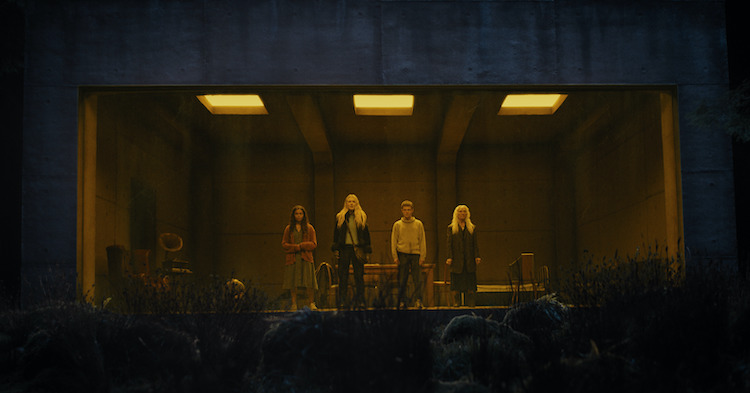
Though fantasy fever dream The Watchers isn’t part of a franchise, it was written and directed by M. Night Shyamalan’s daughter, Ishana Night Shyamalan, and produced by M. Night, so it also feels as if it takes place in the Shyamalan alternate universe, where pretty much anything weird can happen. The source novel by A.M. Shine doesn’t seem to lend itself to an easy transfer to the screen, and a lot of the plot points feel forced, the most glaring one being the lead character, Mina (Dakota Fanning), a depressed young American woman living in Galway on the west coast of Ireland, a fine city that nevertheless would be the last place a depressed young American woman would probably choose to live. Mina spends her days working in a pet store and her nights dressing up as someone else and hanging out at bars. Ordered to deliver a parrot, she gets lost in a dense forest and her car breaks down. While being chased by some unseen force, she comes across a bunker, where she is met by an older woman named Madeleine (Olwen Fouere).

There are two other people in the bunker, Ciara (Geortina Campbell) and Daniel (Oliver Finnegan), who inform the new arrival that they are trapped in what they call “the coop” and must display themselves in front of a bunker-long one-way mirror for the denizens of the forest after nightfall. During the day, they can go wherever they want, but at night they must be in front of the mirror. If they aren’t, they are promised a violent death. 

Basically, Shine’s story is about mythical creatures and how they’ve entered our folklore, but the younger Shyamalan doesn’t seem to know how to work with allegory. Everything about Mina is trite and obvious, from her trauma-filled back story to her habit of talking to herself as a means of providing plot exposition. Though there are a few tense scenes the scares never make a deep impression. Most annoying is the lack of any real substance to the titular monsters’ existence, which is explained every which way but coherently. And the suggestion that they may, in fact, be creatures of somebody’s imagination is just insulting. 

Bad Boys: Ride or Die now playing in Tokyo at Toho Cinemas Nihonbashi (050-6868-5060), Toho Cinemas Hibiya (050-6868-5068), Marunouchi Piccadilly (050-6875-0075), 109 Cinemas Premium Shinjuku (0570-060-109), Shinjuku Wald 9 (03-5369-4955), Shinjuku Piccadilly (050-6861-3011), Toho Cinemas Shinjuku (050-6868-5063), Toho Cinemas Shibuya (050-6868-5002), Toho Cinemas Roppongi Hills (050-6868-5024).

The Watchers now playing in Tokyo at Toho Cinemas Nihonbashi (050-6868-5060), Toho Cinemas Hibiya (050-6868-5068), Marunouchi Piccadilly (050-6875-0075), Shinjuku Piccadilly (050-6861-3011), Toho Cinemas Shinjuku (050-6868-5063), Shibuya Humax Cinema (03-3462-2539), Toho Cinemas Roppongi Hills (050-6868-5024).

Bad Boys: Ride or Die home page in Japanese

The Watchers home page in Japanese

The Watchers photo (c) 2024 Warner Bors. Ent.

Posted in Movies | Tagged , , , | Leave a comment

Review: The Holdovers

Though he’s made a number of movies I don’t like much—and I couldn’t get past the first episode of Billions—Paul Giamatti for me is maybe the most pleasurable American film actor to watch. He never resorts to realism, and, in fact, exudes a kind of contagious joy in his creation of a character. He obviously had a ball with Paul Hunham, the curmudgeonly, generally reviled (by both students and administration) history teacher at Barton Academy, an elite New England male boarding school where he’s been on the faculty forever. When he lights into a class of “rich and dumb” (“a popular combination around here”) students who bridle at his assignments he savors every stinging insult as if he’d been saving it up for just such an occasion. He sprinkles his observations with pointed anecdotes from classical history and adheres to the philosophy of Marcus Aurelius because he’s an unabashed atheist. Hunham doesn’t mind being pegged as an intellectual snob because he has nothing else to show for his life, so of course everyone hates him, which is how he ended up being assigned the task of babysitting the “holdovers”—those students who, for one reason or another, have no place to go during Christmas break. It’s a thankless job and since Hunham actually lives on campus full-time it’s not as if he’d be put out, but, of course, that’s how he feels. In the end, he’s stuck with only one student to watch, Angus (Dominic Sessa), whose newly remarried mother is on her honeymoon. 

Since the story takes place in the early 70s, there are no cell phones, internet, or much in the way of visual entertainment to take up time, and Angus, we’ve already come to understand, is an angry young man whose future prospects are not assured despite his mother’s money since he possesses a temperament that could easily sabotage those prospects. He’s already been thrown out of three other boarding schools. Naturally, he and Hunham rub each other the wrong way on a nearly constant basis, with the school cook, Mary Lamb (Da’Vine Joy Randolph), their only other companion, acting as reluctant mediator. As it stands, David Hemingson’s script is extremely well structured and predictable, and Alexander Payne, the director who essentially made Giamatti a leading man with Sideways, tries too hard to fashion a work that looks as if it were made in the 70s, from the shock zooms to the fonts of the title and ending credits, not to mention the wintry hues of the film stock. It also has the leisurely pace of those New Hollywood films that allow the characters to reveal their most intimate details over time, and all three leads take full advantage of it to deliver extremely well-defined characters. The pleasures just multiply as the story progresses.

Eventually, the traumas and mistakes that bolster each character’s outward bitterness are disclosed with unnerving assurance, and while the plot resolves itself accordingly, the characters feel less credible and, for that matter, likable, though we’re now meant to see them as more fully human. Hunham’s story is particularly moving, and his means of owning up to it with a late act of moral courage is satisfying without being particularly momentous, which, in a way, is the most surprising thing about The Holdovers. Losers will always be losers to those who look down on them, which will never include audiences for this kind of drama. I just wanted the funny stuff to continue indefinitely. 

Opens June 21 in Tokyo at Toho Cinemas Chanter Hibiya (050-6868-5001), Kino Cinema Shinjuku (03-5315-0978), Toho Cinemas Nihonbashi (050-6868-5060), Bunkamura Le Cinema Shibuya Miyashita (050-6875-5280).

The Holdovers home page in Japanese

photo (c) 2024 Focus Features LLC

Posted in Movies | Tagged , | Leave a comment

Review: One Life

The unsung historical hero is irresistible, though it takes a discerning interpreter to make such a subject both relevant and moving to sensibilities that have developed in the meantime. Spielberg set the template with Schindler’s List by going big in every way. James Hawes’ One Life comes across as Schindler lite, or, more charitably, as a movie whose mood attempts to mimic the staid, unassuming character of its hero. And Nicholas Winton, played by Anthony Hopkins, really deserves to be called a hero. He rescued more than 600 Czech children, mostly Jews, from the Nazis during the months after Hitler annexed the Sudetenland but before England declared war on Germany. 

The reason we know about Winton and his exploits is because of a British TV morning variety show that invited Winton to sit in the audience of a live production where, unbeknownst to him, he was surrounded by dozens of the people he saved as children, now grown up, but had never met. It’s a very powerful sequence in the movie, even more so than the real thing, which you can easily find on YouTube. But because the TV segment is what drives the story—meaning the whole movie leads up to it—and will attract an audience, history is short-changed. Hawes creates drama by juxtaposing the excruciatingly drawn-out process of Winton securing visas for refugee children whom England didn’t want with his retired life in late 80s rural England, where he keeps busy cleaning up all the files he kept of the adventure because that was the past. A friend suggests he donate his scrapbook of the operation to the local newspaper, which doesn’t seem interested in it, and then to Betsy Maxwell (Marthe Keller), the wife of media powerhouse (and, later, convicted fraudster) Robert Maxwell, who was a Czech refugee himself. Betsy knows what to do with it, especially since her husband has deep television connections.

In the contrasting sections we see the young Winton (Johnny Flynn, a good cognate for Hopkins as he seems versed in the latter’s familiar acting tics), working with his activist mother (Helena Bonham-Carter) cajoling and begging British bureaucrats to issue the precious visas while the invading Germans are still mildly tolerant of allowing Czechs to leave the country. Though Hawes does fairly well in keeping all this paperwork-oriented plot development intriguing, he neglects to show the larger picture of how the Germans carried out the invasion and why the British were so reluctant to admit that it was an invasion—until, of course, it was too late. In its alternately leisurely and tense lead up to the money shot of Winton meeting his “children,” One Life can feel rather pedestrian, even if the stakes are life or death. 

Opens June 21 in Tokyo at Human Trust Cinema Yurakucho (03-6259-8608), Shinjuku PIccadilly (050-6861-3011), Bunkamura Le Cinema Shibuya Miyashita (050-6875-5280).

One Life home page in Japanese

photo (c) Willow Road Films Limited. British Broadcasting Corporation 2023

Posted in Movies | Tagged | Leave a comment

Review: Louder Than You Think: A Lo-Fi History of Gary Young & Pavement

Here’s a documentary that develops its thesis on several levels of lowered expectations, as if the director, Jed I. Rosenberg, felt he had to hedge his bets owing to the central focus of attention, Gary Young, the first drummer for the indie rock band Pavement who only played on their early singles and first album before being dropped for reasons that the band’s followers know by heart but which Rosenberg and his team of fanboy filmmakers believe will be of interest to a wider cross-section of music lovers. That’s debatable, though in the end I found that the almost obsessive attention afforded Young and his story helped me appreciate Pavement’s singular achievements in a new way. In retrospect, and even while they were extant, the group has been hailed as the seminal indie band of the 90s, and this movie drives home that point, albeit a bit tangentially.

Young, who was almost 20 years older than anyone else in Pavement, is introduced as he was at the time the doc was made (he has since died): a slurring alcoholic who takes oodles of medication to regulate his shaky physical plant. A quick summary of his musical background ensues, illustrated with well-executed recreations of anecdotes using puppets, which includes stints as a drummer in various hard rock bands that served as the recreation of choice by transgressive types in the 1980s Central Valley blighted suburb of Stockton, California. He managed to transpose his slight reputation for creative integrity to a homemade recording studio called Louder Than You Think, which proved to be the only game in town for the budding punk outfits who thought they could break out of there. Stephen Malkmus and Scott Kannberg, who called themselves Pavement (Kannberg had studied urban planning in Arizona), solicited Young’s help in recording some songs and when those songs proved exciting to the ‘zine and college radio crowd, they enlisted Young as their drummer for concerts, which sealed their reputation as the next big thing after Spin magazine—a “real” music publication—gave a glowing review of the demos for their as-yet unreleased debut album that Young engineered and produced. Malkmus and Kannberg were cautious and canny about their career prospects, but Young was, to paraphrase a pop credo, prepared to rock and lent their live shows a visceral component that went beyond his prog fills and aggressive time-keeping and into the realm of theater. Rosenberg provides plenty of shot-on-the-fly video to bolster Young’s reputation as a booze-fueled wild man whose on-stage antics contradicted the rest of the band’s image as slacker savants. However, the rep always endeared him to fans who eventually supported a short-lived post-Pavement indie rock career (which he also destroyed by dint of his own uncontrollable urges), including a stint as an advice columnist for none other than Japan’s own Rockin’ On magazine.

Both Malkmus (via Zoom) and Kannberg, as well as all the subsequent members of Pavement except Steve West, the drummer that replaced Young, profess their love for Gary as well as their frustration that, as great a drummer as he was, he didn’t fit in with the band’s artistic outlook. In fact, the move that got him canned was his attempt to get Columbia Records to sign the band against their wishes. Though it may sound pious to say that Pavement really tried to maintain the 90s indie ideal of defying the music establishment, their principled decisions turned out to be wise in the long run and even remunerative. In any case, those principles also held that they wouldn’t betray a friend, even one who attempted to betray them, and Young continued to receive substantial income from the band until he died, according to Gerri Young, who had been with Gary since they were sweethearts in high school in upstate New York. Though Gary Young never fully “got” Pavement and bristled at the lo-fi label they engendered (“Why would I make it sound shitty on purpose?”), he was always grateful that they supported his right to drink himself to oblivion and be the outsized Spinal Tap-like caricature he wanted to be, and in that regard this is a fitting testament. 

Now playing in Tokyo at Theater Image Forum Aoyama (03-5766-0114).

Louder Than You Think home page in Japanese

Posted in Movies, Music | Tagged | Leave a comment

Review: How to Blow Up a Pipeline

Some movies are so carefully conceived and worked out that they can feel contrived due to their meticulous attention to detail. The script of this eco-thriller by director Daniel Goldhaber, based on a manifesto by Andreas Malm, brings together a disparate group of people driven less by idealism than by personal angers that make it impossible for them to exist in today’s world the way the rest of us do. Such emotional contours are difficult to depict, especially since they justify, dramatically speaking, an act of terrorism that Goldhaber obviously feels is justified, and what saves the film from its own slickness is the way it makes the varying plot points play into the suspense-action premise that keeps the viewer tense and alert at every turn.

Malm’s thesis is that organized pacifist protest against the generators of climate change will never have any effect because the corporate mind that makes such destruction possible will never be receptive to moral arguments. If we take it as a given that climate change leads to global self-destruction, then we in fact have a moral responsibility to stop it by any means necessary, including violence. The people in the movie who plan to destroy an oil pipeline in west Texas are adamant that their actions not hurt people, only property, but the stakes are so high in terms of what could happen if they fail or are caught that the viewer automatically assumes their burden of anxiety. The leader of the group, which is brought together carefully through clandestine connections both online and off, is Xochitl (Ariela Barer, who also co-wrote the screenplay), a woman who tried the pacifist route and quickly realized it was a dead end. Having grown up near the refineries of Long Beach, California, she’s seen how an accepted toxic environment destroys lives, including that of her friend Theo (Sasha Lane), who is dying of cancer and joins the sabotage team to make one last statement. Theo brings her lover, Alisha (Jayme Lawson), on board because that’s what lovers do. Shawn (Marcus Scriber) is Xochitl’s college friend who bonded with her over ecological concerns and has long harbored a desire to get back at the faceless monolith that is the energy industry. Branching out from this core quartet is the explosives expert Michael (Forrest Goodluch), a Native American from North Dakota who has seen his tribal home despoiled by capitalism; the older Dwayne (Jake Weary), a good ol’ boy from Texas whose land has been seized by the owners of the pipeline by means of eminent domain; and a young couple of hippie firecrackers (Kristine Froseth, Lukas Gage) who are drawn to the dangers of the project with a palpable sexual energy. 

Goldhaber provides just enough backstory to elucidate each member’s rationale without diminishing the thrust of the main plot, which is laid out like clockwork. As with all great thrillers, there are sequences of heart-stopping suspense and even several late twists that keep you guessing (Is there a mole? Are the authorities already hip to the scheme?) as to the real purposes of some of the characters. It’s a movie that doesn’t let up, thus providing no window of opportunity to question these people’s motives and practices. And in the end, it’s only a pipeline. 

Now playing in Tokyo at Human Trust Cinema Yurakucho (03-6259-8608), Cinemart Shinjuku (03-5369-2831). 

How to Blow Up a Pipeline home page in Japanese

photo (c) Wild West LLC 2022

Posted in Movies | Leave a comment

Review: IF

Though the title of this family fantasy stands for “imaginary friends,” the purport of the conditional conjunction lends the film a wistful character that suits its dramatic purposes more adequately. By rights, the plot is a downer. Twelve-year-old Bea (Cailey Fleming) lost her mother some years ago and now her dad (John Krasinski, who also wrote and directed) is about to go under the knife for a heart problem. Living with her over-solicitous grandmother (Fiona Shaw) and bombarded with painfully obvious optimism on the part of her father, Bea is constantly reminded of the precariousness of her future, which gives her anxiety an edge of irritation that feels more realistic than such feelings would normally evoke in this kind of movie; and Krasinski winningly puts over the dark humor of the situation.

But the movie is really concerned with something else entirely. Ryan Reynolds plays Cal, a guy who lives upstairs from grandma and who Bea quickly learns, after hearing all sorts of weird noises and seeing phantom shapes, is a caretaker for imaginary friends who have nowhere to go and nothing to do after their human hosts grow out of their supposed need for them. One of Cal’s tasks is to find new gigs for the IFs, a job he seems temperamentally unsuited for, since he tends to fly off the handle easily; but Bea, intrigued by the vocation, volunteers to assist in the placements and quickly becomes close to the various figments of somebody’s imagination, which range from a big, purple, overzealous hairball named Blue (Steve Carrell), to a ballerina-cum-bumblebee named Blossom (Phoebe Waller-Bridge). Krasinski has great fun exploring this premise and the production design crew comes up with some eye-popping visual ideas to bring the concept to life, including one of the better musical numbers of the year that is meant to present Bea’s own imagination with regard to what she envisions as the ideal retirement home for these creatures. But while the fantasy sequences channel some of the poignancy of the framing story, especially with regard to Bea’s frustration at intitially not being able to successfully understand how kids like her “create” imaginary friends, the two plot strands never come together in a meaningful way.

The obvious problem is that Krasinski had too many good ideas and not enough collaborative input to realize one or the other was good enough for a feature film. As it stands, Bea as a character (not to mention Fleming) is over-extended, since she has to do double work as both an adolescent victim of circumstance and a go-getting figure of youthful entrepreneurship. In the end, the two personalities cancel each other out. 

Opens June 14 in subtitled and dubbed versions in Tokyo at Toho Cinemas Nihonbashi (050-6868-5060), Toho Cinemas Hibiya (050-6868-5068), Shinjuku Wald 9 (03-5369-4955), Toho Cinemas Shinjuku (050-6868-5063), Toho Cinemas Roppongi Hills (050-6868-5024).

IF home page in Japanese

photo (c) 2023 Paramount Pictures

Posted in Movies | Tagged , | Leave a comment

Review: Mr. Nelson on the North Side

The Japanese distributor of this 2021, 68-minute documentary obviously picked it up to release it theatrically in Japan on Prince’s 66th birthday, which is June 7. You’d be hard pressed to find much information about it on the internet, despite the high caliber of the talking-head celebrities (Chaka Khan, Macy Gray, Billy Gibbons, Orianthi…Dennis Quaid?) recruited to praise the late purple one, but there’s a pretty good indication right up front of why it’s received so little notice. The opening title card reveals that the estate of Prince Rogers Nelson had no involvement with the doc, which means no actual Prince music is included, except for a brief bit of a concert he did in Montreaux. The directors, Daniel D’Or and Eric Wiegand, do the best they can despite this very significant limitation, and their aim is mainly to show how Prince was shaped by his upbringing in the musical environment of Minneapolis. 

Chuck D is again on hand to explicate the early 20th century African-American migration from the fields of the South to the factories of the Midwest to illustrate how Minneapolis acquired a vital Black community, and various locals with long historical memories then provide first- or second-hand anecdotes about how that community produced its own native musical culture through a unique education program called The Way, where a pre-teen Prince learned how to play multiple instruments and started working professionally while still in high school, sometimes practicing up to 16 hours a day. And while his volatile relationship with his father, which got the full dramatic treatment in Purple Rain, is covered, the directors avoid the psychological analysis that usually informs these kinds of movies about dead artists. Much is made of Prince’s withdrawn private behavior and how it contrasted starkly with his outrageous and sexually aggressive stage image, but the point is always that his workaholic temperament served his self-identity as a performer. If anything, his over-achiever status as a musician—he was as dominating a bandleader as James Brown, as prolific a creator as Stevie Wonder—was cultivated to present a persona to the world as a faultless entertainer. Consequently, the movie dwells on his accomplishments and how his fans reacted to them while downplaying the disappointments that such a regimen was bound to engender, such as his problems with Warner Bros. and his doctrinaire rejection of hip-hop and EDM. And though everyone mourns his death no one mentions how he died and what led to it.

That said, it would be unfair to call Mr. Nelson a hagiography, if only because it feels both incomplete and well-made. Prince really deserves something more thematically oriented, like the massive Moonage Daydream, which honored David Bowie’s complications with both awe and discernment. Prince wore his insecurities on his brocaded sleeves while pushing a kind of supreme artistic confidence that few great artists can boast of. It’s a contradiction that won’t be properly explained on film until his estate finally loosens up. 

Now playing in Tokyo at Shinjuku Cinema Qualite (03-3352-5645).

Mr. Nelson on the North Side home page in Japanese

photo (c) Prince Tribute Productions Inc.

Posted in Movies | Tagged , | Leave a comment

Review: Challengers

Though much of the talk about Luca Guadagnino’s popular tennis movie is about how sexy it is, I found myself fixating on those elements that spoke to the characters’ class and wealth—or lack thereof. A number of reviewers have said that while Guadagnino tends to pile on the luxury accoutrements, he isn’t really interested in exploring the financial circumstances of his characters, but you can’t really tell a love story like Challengers without addressing the characters’ material circumstances. The three leads, aggressive, self-centered Patrick (Josh O’Connor), more down-to-earth but no less competitive Art (Mike Faist), and the woman they share early in their collective relationship, Tashi (Zendaya), were all at one time positioned to become top professional tennis players, though only Art has actually made it that far. As King Richard made abundantly clear in showing what the Williams sisters were up against, tennis pros tend to be the products of privileged upbringings, and during the temporally early portions of this very flashback-driven movie, all three characters appear to be well-off. As the story moves through time, however, Patrick gets stuck at the bottom of the rankings and his career continues to stall. By the time he enters the Challenger tournament, which provides the climax to the film, he’s practically hit rock bottom, sleeping in his car and skipping meals. But even Art and Tashi, who are now married, seem to be living their lives in hotel rooms they can barely afford, and when Art himself enters the Challenger tournament, it’s because his game has fallen off in recent years and he needs an easy win to boost his confidence.

So while the matchup between Patrick and Art is framed as a kind of reckoning—the two were best buddies and champion doubles partners before Tashi entered their lives—there is also something seriously at stake in the game, namely their futures. Even if Art does get his mojo back, he’s now in his 30s; his years as a pro are numbered. Meanwhile, this tournament is absolutely Patrick’s last chance. Tashi, of course, is in Art’s corner, but she plays on Patrick’s affections—they were lovers before she married Art—to get him to see the light and perhaps throw the match in favor of his old friend, a gambit that, given what we know about Patrick’s volatile temperament, seems foolish. As a plot device it’s also trite. There’s a lot to the love story that doesn’t make sense in Justin Kuritzkes’ script, and Guadagnino doesn’t seem to care. He’s more invested in the bodies of our protagonists and the mechanics of a tennis match, even if a lot of the amazing camera shots he accomplishes don’t jibe with what I learned in physics class. With Trent Reznor’s and Atticus Ross’s techno score setting the rhythms of the volleys with deafening precision, there’s the feeling that Guadagnino means to have the last word on how to shoot a tennis movie, even though in interviews he has said he finds the game boring. That would explain a lot, including how unrealistic the romantic components are. Even the famous scene where Tashi teases her two suitors at the same time and they end up making out with each other doesn’t really lead to anything. The homoerotic aspects of the two men’s relationship are a given, but the hotness is reserved for the court and I suppose that hotness explains the ending, which can be interpreted any number of ways but nevertheless leaves us hanging as to the actual result of the game. After all, the dramatic rationale of the previous two hours completely hinges on the outcome of this one match.

So the lack of resolution renders much of the story useless in retrospect. Tashi, who was the best athlete of the three when they weren’t entangled, has had to channel her competitive spirit through Art ever since an injury ended her career before it even started, so her manipulation of these two horndogs has real meaning for the plot. Likewise, Patrick’s lingering desire for Tashi after she marries Art provides the requisite tension—will they or won’t they? Only Guadagnino and Kuritzkes know for sure, and they’re being coy. As much as I enjoyed the movie for its sense of fun and realistic approach to sex, it doesn’t work as a sports movie, probably because Guadagnino seems to hate sports movies. Obviously, he was trying to prove something, and he probably thinks he did, but I can’t see what it is. 

Now playing in Tokyo at Marunouchi PIccadilly (050-6875-0075), Shinjuku Piccadilly (050-6861-3011), Human Trust Cinema Shibuya (03-5468-5551), Toho Cinemas Roppongi Hills (050-6868-5024).

Challengers home page in Japanese

photo (c) 2023 Metro-Goldwyn-Mayer Pictures Inc. 

Posted in Movies | Tagged , , , | Leave a comment

Review: Drive-Away Dolls

The Coen brothers’ films always seem to flirt with pastiche without actually going the distance, so it’s interesting to watch Ethan Coen, working with his partner and editor, Tricia Cooke, rather than Joel, go deep into not just one genre but several. Drive-Away Dolls is a comic put-on of the kind of outrageous noir-adjacent B-thrillers that were ubiquitous in the 70s, filled with ridiculously conceived characters and situations that tested even the most game audience’s capacity for suspending disbelief. On the other hand, it’s a lesbian rom-com, which may not sound like a genre but, in Coen and Cooke’s hands, it practically convinces you that you’ve sat through this kind of thing before. 

As in all proper rom-coms the protagonists are opposites: Horny, up-for-anything Jamie (Margaret Qualley), a waitress with a drawl as big as her native state of Texas; and prim office factotum Marian (Geraldine Viswanathan), who speaks in complete sentences, reads Henry James, worked for Ralph Nader’s presidential campaign (the movie takes place around the turn of the millennium), and whose sexual experience seems limited to one monogamous relationship that happened some time ago. Marian plans to rent a car to visit a relative in Florida, and Jamie, who means to skip town (in this case Philadelphia) in order to avoid the wrath of her police officer lover (Beanie Feldstein) after Jamie cheats on her big time, tags along, much to Marian’s annoyance. They pick up a clunker from a disreputable car rental agency managed by the most enervated customer rep (Bill Camp) you’d ever want to meet, and unknowingly end up in the possession of a mysterious attache case that was supposed to be delivered to Florida by a pair of knuckleheaded hoodlums (Joey Slotnick, C.J. Wilson). So while Marian and Jamie take a leisurely road trip that, thanks to Jamie’s insatiable appetites, turns into a kind of Sapphic Green Book tour, they are being pursued by the hapless goons at the express order of their ruthless boss (Colman Domingo), and in true Coen style the bad guys prove to be out of their league when it comes to sleuthing or even making coherent conversation. Though cartoon violence ensues, the two women never seem to be in danger only because their somewhat carefree attitude precludes the concept that they could ever be in danger, and when everything comes together all they have to do is stand back and let their nemeses literally shoot themselves in the feet. 

Coen and Cooke don’t try to make any of this meaningful, but they lend the movie a distinct style that makes an impression, even if the resolution of the mystery is even stupider than the kinds of denouement that characterized the 70s crime capers the movie pokes fun at. I’m assuming that stupid was the operative word during the production, because everyone is in on the joke, especially the actors, who appear to be having much more fun than I was, though I did laugh quite a bit. With any other director, I might find that a problem, but Ethan Coen has always seemed smarter than me, so I give him the benefit of the doubt. 

Opens June 7 in Tokyo at Toho Cinemas Nihonbashi (050-6868-5060), Toho Cinemas Chanter Hibiya (050-6868-5001), Toho Cinemas Shinjuku (050-6868-5063), Shibuya Cine Quinto (03-3477-5905).

Drive-Away Dolls home page in Japanese

photo (c) 2023 Focus Features LLC

Posted in Movies | Tagged , | Leave a comment