I’ve only seen two of Andrew Haigh’s previous movies, but Lean on Pete and, especially, 45 Years gave me the impression he is a director who has little use for conventional sentimentality, no matter how much the material warrants it. His new one, however, exudes an emotional earnestness that relies on the viewer’s faith in its sticky fantasy premise, and by the end, though I found the love story affecting, it also struck me as corny. Perhaps the stickiness was already there in the source material, a 1987 novel I haven’t read by Taichi Yamada, but since Yamada’s tale took place in Japan and centered on a heterosexual affair, I would assume Haigh made significant changes when he moved it to London and adapted the love story for two men. I’m not the kind of person who thinks that queer love is substantially different from the straight kind once you remove the social elements (and I know many people will disagree), but I can’t help thinking that Haigh lightened the mood artificially. One of the main characters, after all, is presented as being depressed, maybe suicidal.
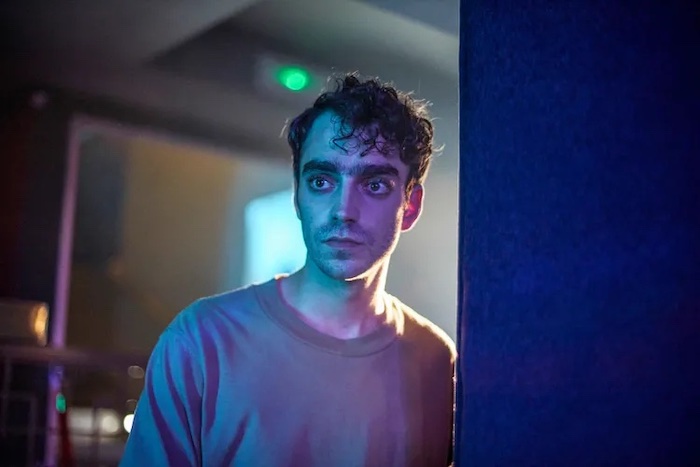
What All of Us Strangers shares with the above-mentioned two films is a spare cast. Adam (Andrew Scott) is a writer living in a modern apartment tower that appears to be almost deserted. The only other person in the block is someone he spies one evening while looking out his window. This man, Harry (Paul Mescal), notices the attention and, drunk, shows up at Adam’s door suggesting they spend some time together. Adam politely refuses the entreaty but it’s obvious he’s both intrigued and perplexed by the attention. Though he has made peace with his homosexuality, it’s still something he dwells on obsessively, conditioned by a closeted adolescence. Before we know it, Adam is back in his suburban home town, lingering outside the house where he grew up. His parents (Jamie Bell, Claire Foy) see him out on the sidewalk and invite him in, happy for the unannounced visit, and as Adam passes a mirror in the living room we catch a glimpse of him as a pre-teen. His parents, we learn, died in a car crash when he was about that age, and he was never able to talk to them about his sexuality. Here is the chance, and while these imaginary conversations are clearly ripe with longing and self-actualization, their implied value as therapy for a soul that’s never had the chance to hash out its confusions and paradoxes feels forced.
When Adam applies the insights he gains from these fantasies to his new relationship with Harry—a relationship that Adam, like a good patient, pursues with a positive attitude—the results are also positive: the sex is honest and satisfying, the emotional payback enlightening and empowering. Eventually, the relationship itself goes dark and enters the realm of fantasy, though to what end is never really clear. As heartbreaking as All of Us Strangers is, the use of these diversions to make sense of unpleasant truths has the effect of sentimentalizing the story.
Now playing in Tokyo at Toho Cinemas Nihonbashi (050-6868-5060), Toho Cinemas Chanter Hibiya (050-6868-5001), Toho Cinemas Shinjuku (050-6868-5063), Shibuya Cine Quinto (03-3477-5905), Toho Cinemas Roppongi Hills (050-6868-5024).
At its most sensitive, Spanish director Carlos Vermut’s fourth film is about a burgeoning love affair between two lonely but very different people. Julian (Nacho Sanchez) is a modeler for a video game company who specializes in weird, terrible creatures. He is the most engaged when working alone in his Madrid apartment on his creations, using a VR headset to filter his vivid imagination into visual monstrosities. Otherwise, he keeps himself aloof from others. Diana (Zoe Stein), the friend of a work colleague he meets at a party, is more vibrant—talkative, intellectually stimulating, and outgoing—but hemmed in socially by her obligations to an invalid father, whom she cares for religiously. Their mutual attraction is casual at first, since whereas his nature is uptight, hers is carefree, and it takes a while for them to connect on an emotional level. We’ve already seen how Julian’s anxieties get the best of his impulses. He picks up a woman in a bar and can’t get it up in bed, so the gradual approach with Diana is obviously more his speed; but as the source of Julian’s anxieties becomes clearer, the sensitive aspect of Vermut’s approach turns sinister.
Because at its base, Manticore, a word that describes a creature which is half man, half beast, isn’t a love story at all. It’s a horror story, but one whose power to frighten comes from its ability to evince disgust rather than any intent to evoke terror. Early on in the film, Julian saves a neighbor, a young boy named Christian, from a house fire, and while the purport of this valiant act isn’t telegraphed as anything more than a character-establishing incident, it continues to reverberate in ever increasing waves throughout the film, first making itself felt in Julian’s digital creations, and then in his physical state, wherein certain thoughts make him actually ill. Though the viewer starts to understand what’s going on, the love story washes over the real meaning of Julian’s troubled mind, keeping it submerged beneath his desire to form a relationship with Diana; that is, until circumstances converge to make him realize what it is that he really desires, and then he can’t face the truth.
Vermut’s true talent as a filmmaker is the way he renders these various indicators organically. The repulsion he manifests in the end isn’t triggered. It’s brought about through an accumulation of subtle hints that, in hindsight, seem way too clever—everything from Julian’s seemingly innocent confession that as a child he wanted to be a tiger when he grew up, to Diana’s pixie hairstyle—but they have been so carefully curated that you don’t notice as they pop up just how penetrating they are. They linger in the imagination, because just like Julian’s creatures, they are visceral and unique. It’s only Julian himself, a sullen introvert with a secret he can’t acknowledge to himself, who is terrifying.
In Spanish. Opens April 19 in Tokyo at Cinemart Shinjuku (03-5369-2831), Cine Quinto Shibuya (0303477-5905).
Back in 2020, shortly before Tokyo Governor Yuriko Koike ran for a second term, a journalist named Taeko Ishii came out with a book about Koike called Jotei (Empress) that became an instant best-seller. Ishii included an interview with a woman who said she was Koike’s roommate when she was attending Cairo University in the 1970s and claimed that Koike never graduated from the university, which was significant since much of Koike’s brand as a public figure has been tied to not only graduating from Cairo University, but graduating at the top of her department, as she said. This achievement led to her reputation as being an expert on the Middle East and a fluent speaker of Arabic, which in turn helped get her a job as a TV news announcer and then boosted her prospects in politics. For a short time after Ishii’s book came out, Koike’s c.v. came under suspicion, since lying about one’s educational history violates election laws (and, in fact, seems to be a common practice), but eventually a statement appeared on the Facebook page of the Egyptian Embassy in Japan stating that Koike had indeed graduated from Cairo University and the matter was forgotten; or, at least, it was forgotten by the mainstream media.
Earlier this month the matter came up again when an article appeared in the May issue of the monthly magazine Bungeishunju by Toshiro Kojima, a former Koike aide who wrote that he inadvertently assisted in the coverup of Koike’s allegedly fraudulent c.v. in 2020. There was also an essay by the former roommate, Momoyo Kitahara, who had been referred to pseudonymously in the initial editions of Jotei, but who allowed Ishii to use her real name in the subsequent paperback editions. Kojima says in his piece that Koike summoned him to her office in the Tokyo Metropolitan Government building in June of 2020 after the book came out and asked him to help her get on top of the bad publicity it had stirred up. Kojima, who believed that she had graduated from Cairo University, said it was simple: Just call the university and get them to issue an official statement confirming that she had graduated. He assumed they would have to go through the Egyptian Embassy, which meant it might take time, so he was surprised when the desired statement appeared on the embassy’s FB page only three days later.
Kojima went into more detail in a video interview with Bungeishunju that was posted on the magazine’s website. He begins by explaining that he became acquainted with Koike when he was working for the Environment Ministry as the chief of the Global Environment Bureau. At the time, Koike was a Diet member in the ruling Liberal Democratic Party and had been appointed environment minister. They worked together on several ideas and came up with the Cool Biz policy wherein men were encouraged to eschew jackets and neckties in the summer to reduce energy consumption in offices. Later, she decided to run for governor of Tokyo in order to “destroy” the LDP’s dominance of the prefectural assembly, and she asked Kojima to join her team. His main task was moving the wholesale fish market from Tsukiji to Toyosu. When Koike left the LDP to form the Tomin First party, she selected Kojima to head it.
After Jotei was published and Koike summoned Kojima to talk about the c.v. problem, she showed him an invitation to a “Science Day” event being held by Cairo University. The invitation was for alumni, and Koike seemed to be showing it to him as proof she had graduated, which he didn’t need because he believed her. However, he thought it strange that the invitation included “unnecessary” information about the date she entered the university and the date she graduated. First, he told her just to get out her diploma and send copies to the media, but she seemed to think it wouldn’t be enough to convince people, and that’s when he suggested she contact the university to get proof from the source. The next day she called Kojima and asked what kind of information the statement from the university should include.
Kojima recalls that time was of the essence, since the LDP was planning to use the c.v. controversy against Koike in the assembly as a means of getting back at her. Also, she was planning to announce that she would run for a second term as governor of Tokyo and wanted to get the matter out of the way before the press conference. So while Kojima was surprised at the speed with which Koike was able to produce the statement, it was just as well she did.
In the posted statement, Cairo University affirms that Koike graduated from the Sociology Department in October 1976 and was issued a diploma. The statement also criticized the Japanese media for doubting Koike on the matter, since such doubt tacitly defamed the university and its alumni. The university said it would take legal action if it deemed such action was appropriate. Kojima told the Bungeishunju interviewer that the LDP immediately put a halt to their investigation of Koike and the media dropped the subject. Koike went on to win reelection easily.
However, after the election was over, Kojima was visited by another Koike advisor, a journalist he refers to as “A.” The journalist told him that it was he who wrote the Japanese language version of the Cairo University statement that appeared on FB, and he showed Kojima the email correspondence between him and Koike related to the matter. He added that Koike herself wrote the English language version of the statement, which also appeared on the FB page.
When the interviewer asks Kojima why he wrote the article for Bungeishunju, Kojima replied that he felt responsible for the coverup, especially after Kitahara had the courage to allow her real name to be used in subsequent editions of Jotei. He mentions that when he was in the Environment Ministry he was involved in the Minamata pollution matter, and was dismayed that those responsible for the widespread poisoning tried so hard to cover it up. It was one man, a doctor for Chisso, the company that caused the pollution, who made a difference by coming forward, just as Kitahara did. “So I felt that I had to come forward too,” says Kojima. Moreover, he had admired Koike because of her stated determination to break up the hidebound nature of Tokyo government, where all decisions were made by a handful of leaders in the LDP and some top bureaucrats. But during her second term she seemed to abandon this stance, since the same group of men are still running the show without any regard for the needs and desires of Tokyo residents. He now sees Koike as being the kind of politician who seeks office only for their own personal gain.
The title of Alex van Warmerdam’s latest feature is meaningless in terms of describing the film. It is called No. 10 because it is van Warmerdam’s tenth film, nothing more and nothing less; and, in fact, given the slippery nature of the plot, it sort of makes sense to give it a numeric marker rather than a title. Because van Warmerdam knows how to make quality films on a technical level, the pacing and atmosphere are assured, and the first half exudes a potent sense of intrigue with its story about a minor theater actor, Günter (Tom Dewispelaere), having an affair with his leading lady, Isabel (Anniek Pheifer), who is also the wife of Karl (Hans Kesting), the writer/director of the play he is presently rehearsing. The pair’s clandestine assignations are eventually noticed by Günter’s rival, Marius (Pierre Bokma), a sullen, incompetent amateur with an ailing wife. Moreover, Günter’s grown daughter, Lizzy (Frieda Barnhard), is also suspicious, and once Karl is hipped to the affair he starts tormenting Günter within the framework of the play they’re putting on.
Van Warmerdam uses the vacant, industrial-tinged setting of the Dutch city where this story is set to great advantage, and the grayish cast of the various interiors makes the movie feel cold and claustrophobic. Above it all hovers Günter’s provenance, which is mentioned in passing in the beginning, suggesting that he was raised by foster parents after being found wandering in a forest when he was five years old. Eventually, this part of the story takes over, with a whole additional group of characters, including two Catholic priests and a bunch of men who skulk around like secret agents. By the time Günter’s story is revealed, the entire love affair/stage play plot line has been abandoned.
It’s difficult to know what to make of No. 10, which feels experimental in that it doesn’t really have much reason to exist as a narrative work of art, because the two storylines are so alien to each other that the film could have been divided at the midpoint without any attendant loss of meaning. Joined together, however, they’re just baffling, especially since neither reaches any sort of conclusion. This is the first film I’ve seen by van Warmerdam, though I’ve heard of him—he seems like a major figure in Dutch cinema—and most of what I’ve heard is that he’s an acquired taste. I can now see why. I really don’t know what kind of viewer this would appeal to.
In Dutch, English and German. Now playing in Tokyo at Shinjuku Cinema Qualite (03-3352-5645).
In terms of verisimilitude, Sophia Coppola’s dramatization of the relationship between Elvis Presley and Priscilla Presley (nee Beaulieu) is much more convincing than Baz Luhrmann’s Elvis biopic, which was an obvious fantasia. Based on Priscilla’s own 1985 memoir, the new film necessarily centers on her experience, so what we get of Elvis is limited in scope: very little recreation of his music or performances, absolutely no Colonel Parker, and no inkling of what his life was like before he met Priscilla. Coppola is thus free to fix her attention on the kinds of things she’s famous for, like American kitsch (acres of shag carpet), the foibles of youthful desire, and a rather dreamy take on sexual attraction. At first, I thought the total absence of Presley’s own music in the film was a function of rights acquistion—though Priscilla is one of the film’s producers, she hasn’t controlled the estate for decades—but Coppola isn’t interested in Elvis as an icon or an artist, so she fills the soundtrack with anachronistic but familiar pop songs that have scant connection to the action they accompany. In the context of the movie, Elvis is simply a privileged male who lacks the maturity to understand his appetites, and thus is doomed to failure as a husband and, in the long run, a functioning organism.
For all that, the movie lacks any real drama. The opening sequence, which takes place in Germany during Elvis’s army stint, is the most effective. Fourteen-year-old Priscilla (Cailee Spaeny) is wasting away on the base where her officer step-father has been assigned. She hates being out of the U.S., and, as it happens, so does Elvis (Jacob Elordi), who makes up for it on the weekends by throwing elaborate parties for fellow G.I.s and other American expats. A soldier spies Priscilla sitting at a base soda fountain and invites her to one of these get-togethers. Of course, her parents object and a great deal of diplomatic discourse is expended to gain their permission, but once Elvis locks eyes on her he’s hooked, and for the rest of his stint won’t take no for an answer, despite the Beaulieus’ understandable reservations. When his obligation to the army is up and he returns to Memphis and his show biz career, Priscilla is heartbroken, and both Spaeny and Coppola elegantly capture the sense of utter despair that accompanies a foreshortened adolescent love affair. Eventually, Elvis moves Priscilla, still a minor, to Graceland, with her parents’ permission, where she finishes school (just barely) under the gaze of his stern father and big-hearted grandmother, and while during this time it’s clear that there’s no sex (much to Priscilla’s frustration—though Elvis obviously has other women for “that kind of thing”), Elvis’s gallant but domineering behavior toward his teenage bride-to-be is undeniably creepy. Even the storied Memphis Mafia, those good ol’ boys who were constantly at Elvis’s beck-and-call, realize this relationship is kind of sick, but no one has the courage or wherewithal to call it as they see it.
After Priscilla and Elvis marry in 1967, all bets are off, and once she’s given birth to Lisa Marie, she realizes she must resolutely contend with Elvis’s weaknesses, especially when it comes to pills and cheap, quick thrills that he believes have no consequences. Coppola’s characteristic directorial m.o. of mostly standing back from the interpersonal dynamic in her films and concentrating on the atmosphere and trimmings works while the dynamic is in development, but after Priscilla finally gains a measure of adult self-awareness, the movie sprints to its tragic finish with little regard for the emotional stakes. When Priscilla files for divorce, the feeling I got was: What took you so long?, even though they’d been married less than six years. Verisimilitude has its limits, too.
Opens April 12 in Tokyo at Toho Cinemas Chanter Hibiya (050-6868-5001), Kino Cinema Shinjuku (03-5315-0978), 109 Cinemas Premium Shinjuku (0570-060-109), White Cine Quinto Shibuya (03-6712-7225), Toho Cinemas Nihonbashi (050-6868-5060), Toho Cinemas Roppongi Hills (050-6868-5024), Yebisu Garden Cinema (0570-783-715).
As a chip off the old block, Brandon Cronenberg lacks his father’s ability to connect a viewer emotionally to the outrageous images he conjures up, unless you consider disgust an emotion. Whereas David Cronenberg’s patented body horror has something to do with the imagination, Brandon’s is wholly visceral in that he shows in almost loving detail how violence affects flesh and bone. In his first film, Possessor, various remotely controlled assassins find creative ways of killing that seem extreme compared to the usual cinematic hitman m.o., but I hesitate to call it gratuitous because the nature of a remotely controlled assassin, by definition, can’t be clearly understood. However, in Cronenberg fils’ new movie the violence, the sex, and particularly the cruelty are clearly gratuitous, because the story is so catastrophically ridiculous, even on an allegorical level. The movie doesn’t generate enough confidence in its premise to render the gross-out elements as anything but pointless provocations.
Since the subjects of the movie are rich white folk, the cruelty, wherever positioned and pointed, is taken for granted. The setting is a fictional tropical country where the resorts are separated from the poor inhabitants by barbed wire fences. James (Alexander Skarsgård), a blocked novelist, and his wealthy publishing heir wife, Em (Cleopatra Coleman), are vacationing here when they meet CM actress Gabi (Mia Goth) and her French architect husband Alban (Jalil Lespert). Gabi attaches herself to James because she loved his one novel, attention that flatters the monumentally insecure writer to no end. After the two couples borrow a car—a vintage Cadillac, no less—and take a forbidden drive off the resort compound to frolic on a deserted beach, James hits a local while driving drunk and kills the man. Though they try to sneak back into the compound the police catch up to them and the head detective (Thomas Kretschmann) informs them that the law of the country dictates that the son of someone killed by another person has the right to kill that person himself. But this country also has a loophole for those who can afford it: The authorities will produce a clone of the condemned and have that clone killed in the condemned’s place—while the condemned watches. Though stupid, this high concept is exactly the kind of thing that brings out the creative in Cronenberg, and the gory sequence that shows how it works reveals an original, if downright sick, imagination.
But that’s not the end of the silliness. James, forced to watch his own mutilation, gets turned on by it, and he is soon welcomed into a secret society of privileged seasonal regulars who’ve been through the same thing and now get their rocks off by throwing off all social and moral constraints and doing whatever they like, including killing and raping, because they can always pay for clones to receive the punishment. Though I can understand the message Cronenberg is pushing, the means of delivery make me wonder if he also doesn’t get off on it. The characters just fall deeper and deeper into depravity with no ethical or rational reckoning. Meanwhile, the director gooses the repellant images with odd camera angles and a slick electronic score from Tim Hecker in an attempt to turn it all into entertainment. It felt more like punishment.
Now playing in Tokyo at Shinjuku Piccadilly (050-6861-3011), Human Trust Cinema Shibuya (03-5468-5551).
To those of us who do not follow professional wrestling, it’s often difficult to separate the athletics from the theatrics, and one of the strengths of Sean Durkin’s feature about the real-life Von Erich family, who were stars of the sport from the late 70s to the early 90s, is how it brings these two components together without making a big deal of it. Much of the movie’s drama is derived from one or another of the four Von Erich brothers striving for a championship title, and while my own understanding of what that entails has never been complete—If it’s mostly theater, who and what determines a champion?—the dedication and passion these brothers demonstrate in their quest for glory is impressive, though not necessarily inspiring. For one thing, they are constantly under the pummeling tutelage of their father, Fritz (Holt McCallany), a former wrestler whose own ambitions for the title were cut short. As in all great family sagas, the father channels his hopes and dreams into his sons, who not only honor those wishes but sacrifice themselves to a discipline they may not fully believe in. The reason has less to do with filial piety and more to do with fraternal love. These brawny men will do anything for each other.
The story’s parade of tragedy is truly cinematic in scope. The oldest brother, Kevin (Zach Efron), is the one who most eagerly pursues greatness as a wrestler. He truly loves being in the ring, but he’s willing to sacrifice his legacy if it means his brothers can have their shot. Kerry (Jeremy Allen White) is also into the sport, but he’s less sure of himself and clinically self-destructive. David (Harris Dickinson) is the family’s brain and clown, a born performer who gets off on the attention while not necessarily taking the sport seriously as a sport. And Mike (Stanley Simons) is the sensitive artist who isn’t interested in wrestling at all, but participates in order to prop up the family business—Fritz has his own company, which trains wrestlers and stages matches. (In reality, there was a fifth brother whom Durkin decided to elide from the family portrait.) Over the years, the four brothers are plagued by injury—some horrific—and psychological turmoil, mostly at the hands of their father, but they always have one another. At times, Durkin has trouble developing his story. It’s mostly one triumph or tragedy after another, though as a family saga it has depth thanks to the synergizing energy of the sport. Durkin attempts to do with wrestling what Scorsese did with boxing in Raging Bull—make the visceral aspect of the battles seem fantastical. The fact that the theatrical component is fantastical to begin with only heightens the spectacle on screen.
The real message of the film is that family ties, no matter how strong, can rarely remedy individual flaws. In that regard, the two principal female characters, Von Erich matron Doris (Maura Tierney) and Kevin’s wife, Pam (Lily James), have to shoulder the burden of that hoariest of family saga cliches, the sensible, practical, feminine counterbalance to the overriding male ego, but since the hyper-masculine temperament required by pro wrestlers is here extended by the peculiar macho aesthetic of Texas, the two women really have their work cut out for them. Durkin often gets carried away with the sweep of the saga, but along the way he supplies not only valuable instruction on how pro wrestling works, including the business side, but why so many people just can’t get enough of it.
Now playing in Tokyo at Toho Cinemas Nihonbashi (050-6868-5060), Toho Cinemas Hibiya (050-6868-5068), Kino Cinema Shinjuku (03-5315-0978), Toho Cinemas Shibuya (050-6868-5002), Toho Cinemas Roppongi Hills (050-6868-5024).
There’s an air of lofty criticism drifting through Rebecca Miller’s new film that feels at odds with its production design. Though the decor of the sunny, expansive Brooklyn flats where it’s set convey the kind of aspirational fantasy evident in all of Woody Allen’s work, it mainly seems to be a wry comment on what passes for intellectual bohemianism these days. The protagonist is, of all things, a blocked opera composer. Steven (Peter Dinklage) is obviously successful since he lives in these expensive digs with his wife, Patricia (Anne Hathaway), a therapist who met Steven when he was a patient, and Anne’s 18-year-old son, Julian (Evan Ellison), from a previous relationship. Given Steven’s present professional predicament, it would appear that Anne’s ministrations haven’t been successful, but now she seems to be his agent, an angle that Miller should have explored more thoroughly for its humorous potential. In fact, what this putative romantic comedy really lacks is comedy. Instead, it tries to deliver pointed irony, which isn’t the same thing. One of the running jokes is that Steven calls Anne “Doc.”
The romance component comes in the form of Katrina (Marisa Tomei), a barge pilot whom Steven meets while walking his French bulldog and stopping into a deserted bar for a pre-noon drink. They strike up a conversation and Katrina invites Steven back to her vessel, docked conveniently nearby, where they have sex after Katrina explains that she’s a “romance addict,” a condition that prods her to stalk men with whom she has casual dalliances. This intelligence spooks, intrigues, and inspires Steven all at once. As a result, he has the subject of his next opera. Again, the comic potential in the idea of a blocked creative type becoming newly provoked to make a great work isn’t fully exploited. You get the feel for the material’s potential when one of Steven’s financial patrons raves about the new work as “a female Sweeney Todd,” since Steven plays up the more troubling aspect of his one-afternoon stand with Katrina and blows it up into full-on murderous psychosis. But the element of the story that Miller seems more concerned with is the conventional one—how to keep this brief affair a secret from Anne, who, as it turns out, has her own psychological demons to deal with, not to mention Julian and his under-18 girlfriend, Tereza (Harlow Jane), whose immigrant mother (Joanna Kulig) is Anne and Steven’s housekeeper and whose step-father (Brian D’Arcy James) is a conservative firebrand who accuses Julian of statutory rape. In contrast to this subplot, Steven’s extramarital fling feels insubstantial, and yet Miller insists on elaborating it to lengths it doesn’t warrant.
Even when Katrina finds out that she is not only the muse of Steven’s new opera but its lead character, things become really tricky, not just for Steven but for Miller, too. I can’t say I completely understood the point of where it all leads, but the final joke at Patricia’s expense—worthy of Allen in his pre-Annie Hall days—is the only one I laughed at. It’s easy to imagine Miller coming up with this joke first and then working backwards, which I would say is not the wisest strategy when writing a comedy.
Opens April 5 in Tokyo at Human Trust Cinema Yurakucho (03-6259-8608), Shinjuku Piccadilly (050-6861-3011).
Celine Song’s debut feature, which didn’t win any Oscars despite being the most acclaimed indie movie of 2023 in the U.S., may be the purest cinematic distillation of the Korean emigrant experience, even more so than Minari. Centered on a woman whose family moved from Seoul to Canada when she was twelve, the film explores the sense of connection with the past that fades over time only to be pulled back into emotional purview when a figure from that past returns. Nora (Greta Lee), a playwright living in New York with her white novelist husband, stumbles upon her first girlhood crush from Seoul, Hae-Sung (Teo Yoo), as he seeks her out online, and they embark on a long-distance Skype relationship that eventually becomes overwhelming, at least for Nora. Years later, Hae-sung comes to visit her after breaking up with his girlfriend, and the encounter is as fraught as an overloaded container ship. I’ve seen the movie twice, the first time in South Korea with a Korean audience, which was educational. “There but for the grace of God,” everyone seemed to be moaning during the quiet, devastating climax.
The second time I concentrated more on the plotting and was perplexed by the details of the various interactions, which felt calculated without being complete. Nora’s parents are both artists, and their move to Toronto for professional reasons was never explained satisfactorily. (In interviews, Song admits that the story is based very much on her own history.) Consequently, Nora’s success as a writer, while hardly phenomenal, seems preordained, and when she meets her future husband, Arthur (John Magaro), at a writers’ workshop, it all comes down to chemistry. Song understands how such a marriage might appear to others, and makes it the point of the opening scene, which depicts Nora, Arthur, and Hae-sung in a bar together near the end of the story. Since Arthur doesn’t understand Korean and Hae-sung’s English is barely passable, Nora can control the separate conversations but is basically frank about her feelings when talking to either man. This is where Past Lives comes into its own as a study of intimate interaction. Though much has been made of the philosophical dimension of Nora’s approach to Hae-sung’s attentions, her marriage appears to fulfill her practical needs, something she doesn’t take for granted. Romantic love, in fact, isn’t a primary motivator, which may confuse viewers expecting a conventional melodrama; it’s more of a struggle between the unavoidable pull of nostalgia (or “inyun,” a very specific Buddhist term that describes how past lives affects one’s present one) and the more natural push of connubial comfort. What I wished Song had interrogated more closely was Nora’s and Arthur’s relationship as fellow writers, since they seem to be at least partly in competition with each other. (Arthur, upon hearing the background of his wife’s relationship to Hae-sung, remarks that it’s a “great story,” as if he wished he could write it himself.) As it stands, Nora skillfully keeps the two vectors running in parallel, so they never truly intersect, even in that very moving last scene.
Song keeps the tone melancholy and autumnal (even if it seems to take place in early summer), making Past Lives one of the best New York movies of recent memory: These conversations, these feelings could never have been generated in any other place. In comparison, the early scenes in Seoul feel tentative, as if the crew weren’t sure they were even allowed to film here. There’s a lot to appreciate, but I suspect there’s more to the story than meets the eye and ear.
In English and Korean. Opens April 5 in Tokyo at Toho Cinemas Nihonbashi (050-6868-5060), Toho Cinemas Hibiya (050-6868-5068), Toho Cinemas Shinjuku (050-6868-5063), Bunkamura Le Cinema Shibuya Miyashita (050-6875-5280), Toho Cinemas Roppongi Hills (050-6868-5024).
There’s a scene about halfway through this disturbing but frustrating Icelandic film that puts everything before and after in such plain perspective that it threatens to upend the whole meaning of the production. A young Danish clergyman, Lucas (Elliott Crosset Hove), charged with building a church in a remote village on the Iceland coast in the late 1800s, is talking to his host, Carl (Jacob Lohmann), a fellow Dane and the nominal leader of the village, about the arduous journey the priest and his entourage of locals experienced in order to reach the village, a journey that claimed the life of at least one man and several pack animals. Carl asks, with genuine curiosity, why Lucas chose to sail to the opposite end of the island country and then travel on foot and horseback for weeks through forbidding terrain when he could have more easily sailed directly from Denmark to the village. Though we already know Lucas’s answer (“I want to get to know the country,” is how he explained it to his superior back in Denmark), the stark logic of Carl’s question injects another one into the viewer’s head: Why did the movie’s director, Hylnur Pálmason, put his protagonist through such hell based on such a flimsy rationale? Obviously, because he wanted to test the man, and show off Iceland’s unique landscape in the process.
There’s no getting around the effectiveness of this plot device—much of the first half of Godland (a purposefully ironic title) is a cinematic essay in how a natural environment can be at once monumentally beautiful and mortally terrifying—but given how the trip changes Lucas, whose religious piety is a manifestation of his privileged arrogance, the calculation on Pálmason’s part feels equally arrogant. The director compounds this connection by affecting ethnographic documentary qualities, such as a 4:3 aspect ratio and occasional scratches on a non-existent film surface. The analog between Lucas and Pálmason is further enhanced by the former’s avocation, photography, which necessitates the portage of a huge box camera, not to mention a crate of glass plates, over mountains and through raging rivers, just so that he can record the virgin country, usually with a local stevedore hired for the journey adding the human dimension. But the first inkling of Jacob’s overall attitude toward his fellow humans is his petulant reluctance to learn Icelandic (there are apparently as many ways to say “shut up” as there are words for “rain”), a trait that annoys his guide, Ragnar (Ingvar Sigurdsson), a burly, older man of endless resource whose temperament is to question the existence of anything he can’t see, smell, touch, or hear—like God. Though Ragnar saves Jacob’s life, after they arrive at their destination and he supervises the building of a church he would never attend, the enmity between the two men only becomes more intense.
Pálmason’s narrative style is elliptical, so when Carl’s two daughters show up on screen without introduction it takes a few scenes to establish not only their relationship to each other, but their meaning within the story. The younger girl, Ida (Ida Mekkin Hlynsdóttir, the director’s daughter), exudes a weirdly cosmopolitan sensibility in the way she addresses Jacob about the religious versus the secular life, and while she does it to gauge his compatibility as a mate for her older sister, Anna (Vic Carmen Sonne), it’s obvious that such a match would never go over with Carl, who tolerates Jacob’s seething resentment of everything this place represents simply because he has to keep the village together—religion is something the Danish expats feel they need. But none of this melodramatic business gets at the heart of the hatred between Jacob and Ragnar, which is elemental under such circumstances, and by the time their conflict reaches its violent resolution you may wonder why, just as with Jacob’s preferred sea route, the movie couldn’t have gotten to where it was going with less fuss.
In Danish and Icelandic. Now playing in Tokyo at Theater Image Forum Aoyama (03-5766-0114).





 philipbrasor.com