Media watch: A 1945 marine tragedy comes back to haunt the Japanese government

Ukishima-maru in operation

Last week the Gunma prefectural government removed a monument from a park in the city of Takasaki that commemorated Korean laborers mobilized to work in the prefecture during World War II. The monument was installed in the park in 2004, but in 2014 the prefectural government refused to renew the permit for it, saying that the citizens group that petitioned to have it placed in the park had violated one of the conditions for its installation, which is that the group not hold “political events” related to the monument. Apparently, during a memorial ceremony a member of the group had referred to the Koreans it honors as having been “forcibly mobilized,” a situation the Japanese government denies. When the monument was removed, there was a large contingent of police on hand to make sure people who were protesting the removal did not clash with right wing groups who approved of the removal. 

Prior to the removal the web talk show No Hate TV covered the matter in relation to the issue of forced Korean labor during the war. The governor of Gunma insisted that the removal had nothing to do with “historical awareness” but was simply an unavoidable response to the citizens group’s “breaking a rule,” though no one really believes that. Ruling Liberal Democratic Party lawmaker Mio Sugita, a well-known right-wing politician, publicly said that she agrees with the removal of the monument because it commemorates what she calls a lie. However, as the discussions on No Hate TV elucidated, the forced mobilization of workers from Korea, then a Japanese colony, for the war effort has been acknowledged by historians as a fact, at least with regard to some of the workers. The Japanese government has acknowledged, albeit tacitly, that some Chinese workers were forcibly mobilized during the war, but not Koreans. 

During the discussions on No Hate TV, one of the unavoidable historical incidents that came up was the sinking of the transport ship Ukishima-maru in Maizuru Bay on the Japan sea coast in August 1945. According to the government, the ship was carrying more than 3,700 Korean workers from the Shimokita peninsula to Pusan in the wake of Japan’s August 15 surrender when it hit a U.S. mine while entering the harbor. The government estimated that 524 Koreans lost their lives, but survivors and others have disputed this number, saying it was much higher. In any case, the government has never carried out a proper investigation of the incident and in 1993 survivors and families of people who died sued the government in Kyoto District Court, demanding an apology and compensation, which, after an initial trial and the usual series of appeals, was eventually denied. Another matter discussed on No Hate TV was the Japanese media’s coverage of the Ukishima-maru Incident, as it’s called. The show’s host, Yasumichi Noma, said that at least two long Japanese reports on the sinking and its controversial aftermath were produced in the past, one by NHK in 1977 and another by Mainichi Broadcasting System. NHK’s report is presently unavailable for public viewing, but the MBS report, first broadcast in 1994, was on YouTube when Noma talked about it, though he predicted it might be removed, and in fact it was a few weeks ago with no reason given. (There is also a Japanese feature film made in the 1990s about the tragedy that is frank about discrimination against Korean workers. It is still available on YouTube.)

Continue reading

Posted in Media | Tagged , | Leave a comment

Review: Ghost Tropic and Here

Ghost Tropic

The films of 39-year-old Belgian director Bas Devos share three traits: a square aspect ratio, credit sequences where all cast and crew are presented on one materializing screen instead of a scroll, and an almost total lack of tension. This latter trait is especially interesting given the subject matter of the two features being released simultaneously in Japan. Both focus on immigrants, and when film buffs place Belgium movies and immigrants in the same thought, it’s usually in relation to the Dardennes brothers’ formally strict social issue body of work. But while the protagonists of the two movies under discussion likely reside at a lower level of socioeconomic comfort than the average Belgian citizen, they aren’t depicted as being subjected to the kind of indignities that typically befall immigrants in the Dardennes’ movies. 

This characteristic is particularly notable in 2019’s Ghost Tropic, which follows a Muslim cleaning woman, Khadija (Saadia Bentaïeb), who awakes in the middle of the night on the subway at the last station on the line, having slept through her stop. Since it is also the last train of the night, she is forced to walk all the way back to her apartment in the Brussels neighborhood of Molenbeek. The movie is essentially a low key odyssey, and though at one point she is questioned by a white man when she strays too close to an upscale apartment building where she used to work, her journey is anxiety-free, though it doesn’t lack for drama. At one point she discovers an unconscious homeless man on the street and calls an ambulance, which transports him to a hospital. Later, worried about the man, she sneaks into the hospital (as a non-relative, she is denied any information by the reception nurse) to check on his condition. We come to see how Khadija negotiates her transacations with others and can discern a pattern wherein she endeavors to do what’s right while remaining as aloof as possible. When she asks a building security guard to let her use a lobby ATM to get money for a taxi, she doesn’t tell him afterward that the machine did not give her any money—her account is overdrawn—because she doesn’t want him to think his kindness was for nothing. After buying some tea in a convenience store that is about to close, she is offered a ride by the clerk but only takes it so far, perhaps uncomfortable with this woman, who is nice but a bit too chatty and personable. In any case, she spies her teenage daughter hanging around a liquor store with a male companion and then informs the police that the store is selling alcohol to minors, a bit of self-serving vigilantism that may or may not get the clerk—another person of color—into trouble.

Though these incidents don’t have a thematic through-line they do feel of a piece since Devos keeps a tight grip on the somber tone through unfussy shots of empty city streets and a sound design embellished with a plaintive acoustic guitar score. This strategy lends the film an enigmatic quality that is stingy with details about Khadija’s life and mindset, a choice that may frustrate some viewers given the abrubt narrative shift in the very last scene. 

Here

Khadija is obviously a long-time resident of Brussels, but Stefan (Stefan Gota), a construction worker from Romania, seems less settled. In fact, most of the action in Devos’s latest movie, Here, involves Stefan getting ready to go back to his native country, though whether it is only for the summer or permanently seems to be a question he hasn’t answered yet, even as the day of departure draws close. He carefully packs up his things in his small apartment and cleans out his refrigerator, making a large pot of soup with the remaining vegetables. He then delivers containers of the soup to friends and acquaintances, many of them fellow Romanians, as a kind of farewell gesture, and Devos explicates Stefan’s situations through the attendant conversations. It seems he hasn’t seen his family in a number of years. In a conversation with his sister, who manages a cafeteria, he reveals his doubts as to whether he will return to Belgium at the end of the summer, and she seems to understand though withholds her opinion. 

While waiting out a rainstorm in a Chinese restaurant, Stefan makes the acquaintance of Shuxiu (Liyo Gong), who moonlights there. We already know that Shuxiu’s main occupation is botany. She teaches at a local university and her specialty is mosses. Later, when Stefan is cutting through a huge forested park in the middle of the city to deliver another container of soup he happens upon Shuxiu again and they spend the rest of the day together collecting moss samples and talking about nothing in particular. It’s clear the two are attracted to each other, and while Devos doesn’t make a big deal out of it the suggestion is planted that Shuxiu may give him a reason to return to Brussels, and I asked myself afterwards: Did they sleep together? Again, many viewers may not appreciate Devos’s tricky narrative feints, but they impart a distinctive sense of intrigue to situations that we would normally take for granted. 

Ghost Tropic in French and Dutch. Here in French, Romanian, Mandarin and Dutch. Both now playing in Tokyo at Bunkamura Le Cinema Shibuya Miyashita (050-6875-5280).

Ghost Tropic and Here home page in Japanese

photos (c) Quetzalcoatl

Posted in Movies | Tagged | Leave a comment

Review: Stop Making Sense

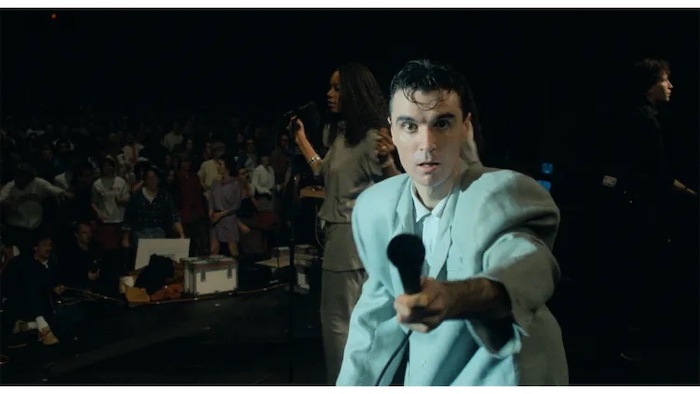
There’s very little to say about the 40th anniversary 4K restoration of the late Jonathan Demme’s 1984 concert film Stop Making Sense that hasn’t already been said except that if you plan to see it you really ought to see it in an IMAX theater. I don’t have any particular fondness for IMAX since I tend to think it only works with movies that are made with the IMAX technology in mind, and most of those movies usually incorporate special effects that don’t need any more emphasis. Talking Heads, the band whose uniquely personal concert experience is the whole purpose of Stop Making Sense, offer up an extremely visceral live show that Demme captures with rare empathy and intelligence. By now everyone knows how David Byrne conceptualized and choreographed the concert down to the way the crew added and subtracted elements to a bare stage throughout the show, but less credit is given to the way Demme highlights these elements while focusing on each member (the 4 Heads augmented by five African-American musicians) in ways that reveal not only the synergy of the music, but its individual components as well. In that regard the movie might even be better as a concert experience than the actual concert itself, audience immersion or no audience immersion.

I saw the original stage production in 1983 in Berkeley but I never saw the movie in a theater. The first time I watched it was on video, and by then I had already listened to the soundtrack album hundreds of times, so the IMAX experience was not only a potent blast from the past, it was a startlingly new experience because the concert, for all the care Byrne and Demme put into its presentation as a portrait of a band’s aesthetic in historical context, is itself predicated on joy and love, which come through so directly in the IMAX rendering that you have no capacity to think of anything else except what is up there on the screen.

Now playing in Tokyo at Toho Cinemas Hibiya (IMAX, 050-6868-5068), Shibuya Cine Quinto (03-3477-5905), Toho Cinemas Shinjuku (IMAX, 050-6868-5063), Toho Cinemas Roppongi Hills (050-6868-5024), Toho Cinemas Nihonbashi (050-6868-5060).

Stop Making Sense home page in Japanese

photo (c) 1984 Talking Heads Films

Posted in Movies | Tagged , , | Leave a comment

Review: Dumb Money

I’m a sucker for dramatic features that take place in the worlds of business and finance, especially if they’re based on true stories, since I figure I get education along with my entertainment. That credo, however, presupposes that the movie is actually entertaining and that I do learn something. It’s why I liked The Big Short, even though its comedy was a bit too broad at times. Adam McKay was careful to make all the technical explanations undergirding his version of the 2008 financial meltdown clear; but to tell the truth, I already had a thorough grounding in the topic from watching Charles Ferguson’s excellent 2010 documentary Inside Job. That may be why Craig Gillespie’s Dumb Money, though as wry as McKay’s comedy, is less affecting for me. I didn’t pay much attention to the news reports about the film’s subject, the GameStop short squeeze of 2021, while it was happening, and thus came to the movie cold—most of the technical stuff about why it was such a big deal went over my head. Consequently, the conflict didn’t make much of an impression, even while I appreciated its theme of a bunch of underdogs making another bunch of fat cats anxious.

The underdogs in this case are retail day traders, average people who go on the internet and buy and sell stocks to augment their insufficient wages. These people trade in “dumb money,” according to big Wall Street traders, specifically hedge fund managers who know how to game the system to their own advantage even if it purposely hurts businesses and the folks who work for them. Paul Dano plays Keith Gill, a professional financial analyst who moonlights as a YouTube and Twitter star called Roaring Kitty dispensing investment advice to the hoi polloi. Gill’s catchphrase for tips is “I just like the stock,” which endears him to his fans because he comes across as someone who takes securities trading for what it’s supposed to be—beneficial for all involved—as opposed to what financial sharks take to heart, which is that it should be beneficial only for them and screw everybody else. The stock that Gill likes here is GameStop, a chain of video/computer game stores that no one on Wall Street thinks much of. Gill and his loyal coterie of small-time players, including a nurse (America Ferrera) and some smart but poor college students (Talia Ryder, Myha’la Herrold), take on the mantle of freedom fighters, while the rich know-it-alls, including New York Mets owner Steve Cohen (Vincent D’Onofiro) and Melvin Capital CEO Gabe Plotkin (Seth Rogen), come across as cartoonishly evil Scrooge McDuck types. So when Gill champions GameStop to the utter hilarity of the hedge fund crowd and gets his followers on board, boosting the stock’s value through the stratosphere, all hell breaks loose on Wall Street as the shiny suits make it their mission to not only turn the spree to their advantage but destroy Gill in the process. 

One fact the movie can’t avoid is that it takes place during the height of the pandemic, and thus everything happens online. Gillespie can’t quite get the dramatic elements (not to mention the comic ones) to spark effectively when all the players are essentially interacting through computer monitors and iPhone screens. And while Dano is totally convincing as a righteous crusader for everyday Joes and Janes and the jokes at the expense of the monster money elite hit their marks with little effort, the entire logic behind the big fund managers’ grievance at being outmaneuvered by this kid with the ridiculous red headband and the dirty mouth didn’t land in the proper subsection of my brain, so I didn’t experience as much satisfaction or sense of disappointment as I should have when the script indicated that these were the reactions I should be feeling. In any case, capitalism wins in the end, and where’s the transgressive fun in that?

Opens Feb. 2 in Tokyo at Toho Cinemas Hibiya (050-6868-5068), Kino Cinema Shinjuku (03-5315-0978).

Dumb Money home page in Japanese

photo (c) 2023 BBP Antisocial LLC

Posted in Movies | Tagged , | Leave a comment

Review: Sound of Silence

When horror movies could no longer top themselves in terms of gross-out imagery and the split-second timing of jump scares, filmmakers had to think of newer ways to frighten us. As one solution, they’ve mostly replaced the visceral with the suggestive, and this Italian low-budget feature, directed by three horror buffs who go by the collective moniker T3, hits on pure sound as a means of getting its creep on. In that regard, it has to work overtime to make any kind of impression compared to A Quiet Place, which it very much resembles in terms of concept, though the sound design by itself is more inventive.

A wannabe singer named Emma (Penelope Sangiorgi)—according to her boyfriend, Seba (Rocco Marazzita), “the next Ariana Grande”—is summoned home to Italy from New York after her parents are involved in an accident. When she arrives she learns that her father (Peter Stephen Wolmarans) is in the ICU after being pushed down the stairs by her mother (Sandra Pizzullo), who is also hospitalized for observation. The doctor suspects that the mother was defending herself during a domestic violence dispute, and she admits to her daughter that her father did attack her, “but it wasn’t him.” Emma and Seba repair to the family home by themselves where the former finds an odd antique radio in her father’s amateur sound studio—the place where she learned how to sing. Left alone while Seba goes out to pick up food, she turns on the radio and hears odd voices that often increase in volume suddenly, and when that happens…

T3 don’t pursue the usual suspense cycles that characterize modern horror. Instead, they use shadows and dim, fleeting peripheral images to intensify their unsettling sound effects, and as the movie progresses the viewer learns the logic behind the scares and what they represent. The mystery at the heart of the movie isn’t original enough to make up for the bad acting, but the unease created as it unfolds has a cumulative power that’s eventually squandered by a pat climax, which turns out to be not even a climax, because there is a ten-minute coda where it appears the directors want to recreate the same horror concept in a visual context, perhaps for their next movie? Can’t say it was intriguing enough that I would look forward to it.

In English and Italian. Now playing in Tokyo at Human Trust Cinema Shibuya (03-5468-5551), Shinjuku Cinema Qualite (03-3352-5645).

Sound of Silence home page in Japanese

photo (c) 2022 T3 Directors SRL

Posted in Movies | Leave a comment

Review: Poor Things

The inspiration for Alasdair Gray’s novel on which Yorgos Lanthimos based his movie is Frankenstein, though Lanthimos tends to make fun of the more serious themes that Mary Shelley traded in, particularly the idea of a man aspiring to be God. The Dr. Frankenstein character in the story is Dr. Goodwin Baxter (Willem Dafoe), who with his elaborate scars looks more like the monster than the creator but nonetheless has cultivated the kind of scientific approach that only a truly enlightened mind could conjure. His own creature, whom he names Bella (Emma Stone), is the reanimated body of a dead young woman whose brain has been replaced with that of her unborn child and, thus, is a fully formed adult with the mind of an infant that Baxter means to educate as benevolently as possible. Lanthimos plays this idea for all the laughs he can squeeze out of it but for the most part the slapstick formula of having Bella learn how to use a grown-up body while absorbing the world and what it has to teach her at breakneck speed makes for comedy that would quickly exhaust itself if everything else in the movie wasn’t so equally absurd. Stone is mainly responsible for the emotional tone of the film, but it’s the production design that prevents everything from flying out of the story’s dramatic orbit. Though ostensibly set in Victorian London, the world is a Gilliamesque jumble of anachronistic and imagined technologies. Baxter fits right in and so isn’t as frighteningly strange as he might have been in a more straightforward period melodrama.

The movie charts Bella’s odyssey of self-awareness, which in the context presented is a journey made gender-specific. She’s courted by not one but two eligible men, the first of whom is Baxter’s innocent and well-meaning young assistant (Ramy Youssef), who proposes marriage when Bella has yet to grok the concept; and the other the lascivious, worldly lawyer, Wedderburn (Mark Ruffalo), who, without any such scruples but a surfeit of money and chauvinist intentions, virtually abducts Bella to Lisbon, where she undergoes a crash course in sex and materialism, both of which her still developing sensibility appreciates immediately for how they fulfill her adolescent neediness. Her appetites become so fulsome that even Wedderburn can’t keep up with them, and then she meets a pair of intellectuals (Jarrod Carmichael, Hanna Schygulla) on a cruise who plant in her mind the idea that the world is also a place of pain, and suddenly sees it all around her. She now understands human agency and realizes just from everyday experience that, as a woman, she is not always her own person and leaves Wedderburn, taking employment at a brothel in Paris, because sex is the only economically viable activity she knows, even if she has to rewire her circuitry in order to make it work as a non-equitable transaction. In her relationship with the establishment’s madame (Kathryn Hunter), she sees where women fit into the capitalist ethos and means to change it.

There’s more, and if Poor Things has a narrative problem it’s that the plot never stands still long enough to make its wide-ranging thematic points fully felt. The last fourth, in fact, exploits the movie’s latent Victorian cliches in a way that’s too clever by half. The inventive machinations Gray incorporated into the climax are wasted, since they could have anchored a perfectly good full-length potboiler all by themselves. But that would have been a very different monster, so to speak. The one Lanthimos has built is unique in its sprawl and ambition, though I’d have to see it again to decide if it’s as good as he thinks it is.

Now playing in Tokyo at Toho Cinemas Nihonbashi (050-6868-5060), Toho Cinemas Hibiya (050-6868-5068), 109 Cinemas Premium Shinjuku (0570-060-109), Shinjuku Piccadilly (050-6861-3011), Toho Cinemas Shinjuku (050-6868-5063), Shibuya Parco White Cine Quinto (03-6712-7225), Toho Cinemas Roppongi Hills (050-6868-5024).

Poor Things home page in Japanese

photo (c) 2023 20th Century Studios

Posted in Uncategorized | Leave a comment

Review: The Quiet Girl

Like its titular protagonist, Colm Bairéad’s debut fiction feature hides its emotional contours beneath a hushed facade, a gambit that first feels frustrating since the mileu depicted—rural Ireland in the early 1980s—seems ripe for critical consideration from outsiders like me who, relying on hindsight and little direct experience with that milieu, will be quick to pass judgement. Cáit (Catherine Clinch), the nine-year-old girl in question, is quiet because she’s troubled. She underperforms in class and whenever given the chance hides out in the fields behind her house. In the opening scene she appears to have wet her bed, though the situation doesn’t incur scolding from her put-upon pregnant mother (Kate Nic Chonaonaigh), who has three other girls to contend with, or her alcoholic, sexually incontinent father (Michael Patric), probably because it’s happened before. I waited for the other shoe to drop, for some indication toward the callousness of this Catholic life, but I was given my comeuppance by Bairéad’s unassuming shift to a gentler environment after the father deposits Cáit at the home of a middle aged couple, Eibhlín (Carrie Crowley) and Seán (Andrew Bennett) Kinsella, without any explanation. 

Cáit’s situation turns out to be not particularly extraordinary, though Bairéad’s telling of it is. Quietude demands special attention, and the movie rewards close scrutiny to passing gestures and things unsaid. Most of the movie is in Irish (Cáit’s father is the one character who uses only English, thus lending him a kind of interloper status) and, in a way, the subtitles are more revealing of the principals’ real feelings than would be the case if we had to rely on aural dialogue only. As it turns out, Cáit is with the Kinsellas for the summer, seemingly at their invitation—Eibhlín is a cousin of her mother—and the overly solicitous manner in which they address the child hints at secrets the movie explains carefully and sparingly. We can tell by the way that neighbors and friends act toward the couple that they understand why Cáit is there, even if the viewer doesn’t, and one of the ways Bairéad eases us into the story is by making the quaint house—clean and bright versus the grimy chaos of Cáit’s home—a kind of paradise. And if in the beginning we believe that Cáit is there for her own benefit (“She wants to find the good in others,” says Eibhlín, “and is sometimes disappointed”) it turns out that the welfare on display is mutually dispensed. Bairéad keeps the drama to a minimum, which makes the ending, after Cáit returns home, that much more devastating. 

The Quiet Girl is not a coming-of-age story—the only thing Cáit learns is how rare genuine kindness can be—but instead a tale (it’s based on a novella) that simply chronicles an eventful summer, except that Bairéad means to make the events as unassuming as possible. It’s the everyday interaction between individuals that people remember most vividly, even when those interactions have no particular distinction of their own. It’s enough for Cáit that she spends two months with people whose goodness she can’t take for granted because of who she is. 

In Irish and English. Opens Jan. 26 in Tokyo at Human Trust Cinema Yurakucho (03-6259-5606), Shinjuku Cinema Qualite (03-3352-5645), Shibuya Parco White Cine Quinto (03-6712-7225).

The Quiet Girl home page in Japanese

photo (c) Insceal 2022

Posted in Movies | Leave a comment

Review: When You Finish Saving the World

As an actor, Jesse Eisenberg occupies a clear thematic space in many moviegoers’ minds that is most readily filled by his nervous portrayal of Mark Zuckerberg in The Social Network; which is a shame, since Eisenberg is capable of a much wider range of interpretation. Nevertheless, his directorial debut, based on an audiobook he made in 2020, plays up that image by focusing on two narcissistic liberal types whose crusading activities more or less hide deep wells of insecurity. It’s as if Eisenberg is making fun of the prototype character that essentially gave him his career.

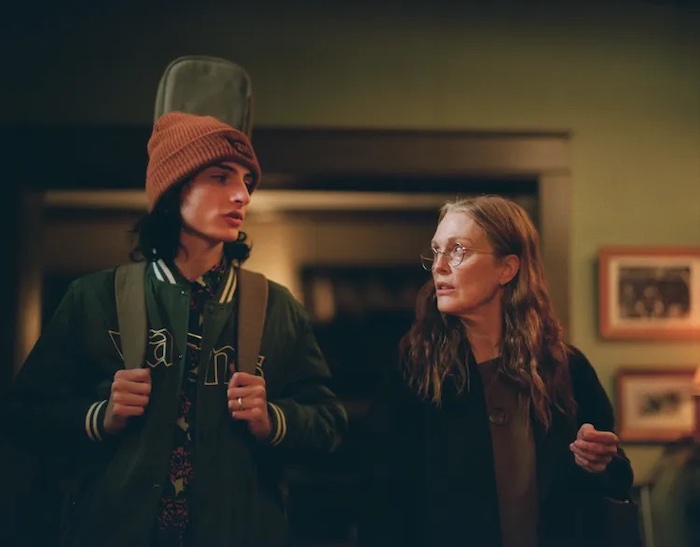
The two principal assholes are a woman and her teenage son. Evelyn (Julianne Moore) runs a women’s shelter somewhere in Indiana. She is a veteran adherent of second-wave feminism and has been a social welfare firebrand her whole life, but privately she’s a mess. Her marriage to a university administrator (Jay O. Sanders) achieved zero inertia years ago and their time together is mostly spent talking past each other. Moreover, middle age has prompted her to question the point of her life, as she no longer derives satisfaction from work that requires a constant need to compromise. It just takes too much energy. So when a woman (Eleonore Hendricks) enters the shelter to escape her abusive husband with her own teenage son, Kyle (Billy Bryk), in tow, Evelyn latches on to Kyle as a project, since he conveys native intelligence and wherewithal despite being from what she perceives as an “underprivileged” background. It’s clear to the viewer that she’s using this boy to make up for her neglect of her own son, Ziggy (Finn Wolfhard), a total failure in terms of the kind of social skills needed to survive American public schools, a failure he addresses by boosting himself as a sensitive singer-songwriter with a social media presence visited and subsidized by lonely adolescents in foreign lands. Ziggy’s own project, to make a truly socially invested female classmate (Alisha Boe) interested in him, is the most overtly wince-inducing element of this so-called comedy, since it’s so obvious that Ziggy has no conception of how he comes across with his earnest attempts at appearing smart and in-the-know, when, in fact, he has no genuine interest in the world. Even Evelyn, who reads and keeps up on current affairs, can’t seem to use her knowledge to navigate everyday existence, and her cultivation of Kyle manifests as a kind of grooming that puts others off when they actually stop and look at it. 

Eisenberg’s short New Yorker pieces prove he has a sharp wit, but When You Finish is over-extended. The characters never make an impression outside of their cringe characteristics, and in the end it’s impossible to empathize with them. Eisenberg doesn’t seem to realize that when you laugh at characters because of their cluelessness, you at least need to connect with their situation in order to maintain any interest in where they are going. I was tired of Evelyn and Ziggy after 30 minutes. 

Now playing in Tokyo at Toho Cinemas Nihonbashi (050-6868-5060), Toho Cinemas Chanter Hibiya (050-6868-5001), Kino Cinema Shinjuku (03-5315-0978).

When You Finish Saving the World home page in Japanese

photo (c) 2022 Saving the World LLC

Posted in Movies | Tagged , | Leave a comment

Review: Rifkin’s Festival

A common complaint about Woody Allen’s films ever since they moved from overt comedy to more cerebral fare is that the dialogue didn’t change accordingly. It still had that stilted, artificial quality that sounded more appropriate coming off a stage during a standup routine, but wasn’t necessarily supposed to be funny. Because of Allen’s prodigious output over the years, most of us became used to this style and adjusted as long as the characters and stories made sense, but the director’s most recent work has mostly been a reshuffling of already covered themes and the dialogue problem has thus become more pronounced. Though there are certainly extraneous reasons why his latest English-language comedy (I’ve heard he’s finished a more recent French language film) has failed to enjoy the kind of wide distribution he used to take for granted, the neglect may simply be due to the fact that the movie itself feels so inconsequential: Another Woody Allen movie that in a year or so no one will be able to distinguish from dozens of other movies he’s made.

Allen’s avatar here is Mort Rifkin, who, as played by Wallace Shawn, only makes the stereotypical Woodyisms that much less tolerable. Though Shawn can be amusing and even affecting within his own acting wheelhouse, he seems to have been shoehorned into the role of a retired film studies professor who accompanies his younger wife, Sue (Gina Gershon), to San Sebastian for the film festival, where she has a job as a publicist for a hot young French director played by Louis Garrell. Though Shawn is 8 years younger than Allen, it feels as if the director decided that if he went with a stand-in with his own distinctive screen persona he could make viewers forget about the various disparities incumbent in the film’s main connubial dynamic, but it isn’t possible, especially given Shawn’s patented schlubby screen appeal contrasted with Gershon’s well-seasoned sexual panache. The pair’s scenes together, compounded by the aforementioned stilted dialogue, are almost unwatchable since these differences aren’t alluded to at all. When Sue predictably starts sleeping with her client, Mort reacts not as someone who, by dint of his age and appearance, should have seen something like this coming, but as someone who blames it all on the over-familiarity bred of a long relationship, which makes little sense in this context. But it does provide the justification for Mort, after experiencing some slight chest discomfort, to seek out the services of a young female cardiologist (Elena Anaya) whose intellectual interests make more of an impression on him than her physical attributes. Not that Mort thinks he’s going to get to first base with her, a development that might have provided some queasy but actionable comic potential. Instead, Rifkin’s Festival is just another story about an older man’s need to have his worth acknowledged as a man.

Even Allen’s penchant for skewering intellectual pretentiousness falls flat. Whatever pushback Mort gets at the festival for his doctrinnaire approach to the old European cinema masters feels tired and trite. At least Garrell, playing a new shining light who endeavors to inject more Hollywood glitz into his art, provides some self-conscious rakishness; and Christoph Waltz’s cameo as a chess-playing foil pulls off the kind of non sequitur joke that Allen used to be so good at. Though I almost hate to say it, what Rifkin’s Festival really needs is Woody Allen the comic actor, but at 88 he’s obviously past all that now. He’s just running on whatever fumes fuel his old typewriter.

In English and Spanish. Now playing in Tokyo at Toho Cinemas Hibiya (050-6868-5068), Shinjuku Piccadilly (050-6861-3011).

Rifkin’s Festival home page in Japanese

photo (c) 2020 Mediaproduccion S.L.U., Gravier Productions, Inc. & Wildside S.r.L.

Posted in Movies | Tagged , , , | 1 Comment

Review: Green Night

Chinese director Han Shuai’s first movie, 2020’s coming-of-age story, Summer Blur, was such a big worldwide festival hit that programmers and distributors have been maneuvering ever since to be advantageously positioned when the followup finally dropped. In that regard, Green Night is certainly a surprise. A surreal gangster tale set in Korea, the movie’s entire vibe implies that Han was determined to not repeat herself. The casting alone would seem to reward the anticipation: Chinese star Fan Bingbing makes her own long-awaited return to the screen as an Incheon Port security guard married to a violent Korean man of faith, and rising Korean actor Lee Joo-young plays a punky drug mule who seems to have the hots for Fan’s character. 

Han sets the movie in the seedier environs of Seoul and its suburbs, a gambit that highlights the contrasting sensibilities of the core relationship. Fan’s Jin Xia is a Chinese woman trying to get out of her disastrous marriage-for-convenience and secure a resident visa, while Lee’s unnamed, green-haired retrobate seems to function as more or less a monkey wrench thrown into Jin Xia’s plans. There’s not a lot of coherence to the sequence of events that follow their first meeting at the security checkpoint in the port when Jin Xia attempts to scan a Korean woman for contraband and she responds by coming on to her. When Jin Xia tries to report this scofflaw to her boss, he doesn’t seem to care, thus indicating some kind of under-the-table quid pro quo. Jin Xia’s humiliation is exacerbated when she finds herself being stalked by the Korean woman, who readily admits she’s carrying drugs into the country for some Chinese concern. Without reason, Jin Xia succumbs to green-hair’s charms and allows her to crash at the crappy apartment she rents away from her husband, who pesters her with calls begging her to come back when he isn’t dropping in to give her another beating in the name of the Lord. Green-hair tries to return the favor by involving Jin Xia in a big drug deal, which will make her enough money to get a visa, albeit illicitly. The rest of the movie supplies plenty of transgressive potential, including copious violence, harrowing medical emergencies, and nasty language, but Han never gets a purchase on the underlying motivations and settles instead for a kind of artsy narrative ambience, which just comes across as being coy.

Even the promise of a cross-cultural romance fails to play out convincingly, though affection born of desperation does manage to develop between the two mismatched women. The structure, which is episodic to the point of distraction, fails to support the whole, even as a genre exercise. If you want to convey grit, you have to offer more than just the trappings of reality. 

In Korean and Mandarin. Opens Jan. 19 in Tokyo at Human Trust Cinema Yurakucho (03-6259-8608), Shinjuku Musashinokan (03-3354-5670), Shibuya Cine Quinto (03-3477-5905).

Green Night home page in Japanese

photo (c) 2023 DEMEI Holdings Limited (Hong Kong)

Posted in Movies | Tagged , , | Leave a comment