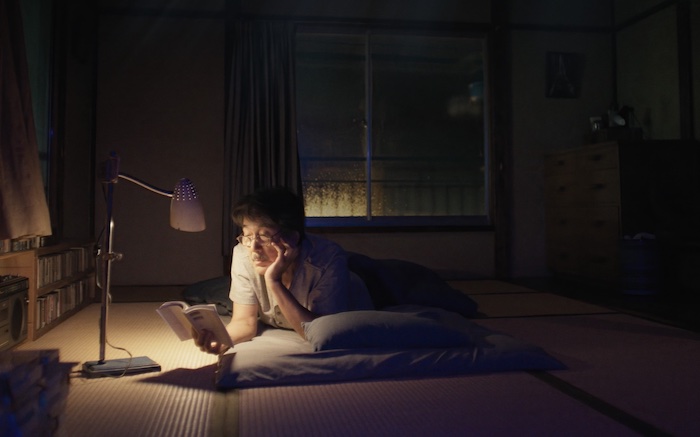
Review: A Light Never Goes Out

Nostalgia, as in the longing for something lost, takes on a double meaning in Anastasia Tsang’s debut feature. On the surface, the thing lost is the craft of neon sign-making, which the film’s protagonist, Heung, played by veteran Hong Kong actor Sylvia Chang, attempts to maintain after the death of her husband, Bill (Simon Yam), who was a master of the art. In another sense, it is the loss of Hong Kong itself, which once boasted a brilliant night glimmer thanks to its neon-lit boulevards, now garishly illuminated by LEDs and fluorescent lights. Of course, Hong Kong has lost much more in recent years, but Tsang thinks that the end of that neon glow is enough to represent it all.

Her movie is a strictly sentimental affair. Heung was always skeptical of Bill’s calling, especially as the years passed and fewer and fewer businesses availed themselves of his wares, but after his death she begins to appreciate his contribution, visiting locations where his works once made their mark indelibly, and she meets others who miss the neon, including Leo (Henock Chou), a young man of no particular distinction who claims he was Bill’s “apprentice” and continues to squat in Bill’s old workshop. Leo and Heung eventually try to extend Bill’s legacy against all odds. Then there’s Heung’s daughter, Prism (Cecilia Choi), who fortifies the allegory. Like many of her compatriots, she sees no future in her beloved city, and is planning to move with her fiancee to Australia. 

Tsang seems to be saying that the whole economic rationale behind the elimination of neon points to a future that disdains creativity for the sake of convenience. In Bill’s workshop, Heung and Leo endeavor to recreate his most indelible creations for the enjoyment of people who have nothing else to hold onto as they approach the end of their lives. In interviews, Tsang has acknowledged that her film was difficult to produce in today’s environment because of its “literary flavor,” and while the script has no overt political message, its piquant nostalgia says more than the characters themselves let on.

In Cantonese. Opens Jan. 12 in Tokyo at Bunkamura Le Cinema Miyashita Shibuya (050-6875-5280), Cinemart Shinjuku (03-5369-2831).

A Light Never Goes Out home page in Japanese

photo (c) A Light Never Goes Out Limited

Posted in Movies | Tagged | Leave a comment

Media watch: Some fast food operators handle price increases better than others

Gyoza no Osho

Most businesses that survived the pandemic are now doing well owing to something called “revenge” spending, which is essentially a reflexive action by consumers after they’ve been liberated from reduced spending due to restrictions, whether mandated or market-driven. At the same time, many of these businesses have increased prices due to a number of factors, and in that regard some are doing better than others.

One who is not doing better is McDonald’s Japan, which has lost customers in the past year. According to a Dec. 20 report in Gendai Business, the Japan arm of the world’s most famous fast food company posted a 5.3 percent decrease in patrons last June compared to June 2022. Like all retail businesses McDonald’s lost a lot of customers starting in March 2020 when COVID took hold, and a year later those customers started to return. The numbers improved steadily thereafter until last January, when the trend reversed. 

Gendai asked an analyst why this was happening, and he gave several reasons, the main one being price increases on McDonald’s part. The first was implemented in March 2022, but seemed to have little effect. The second came about in Sept. 2022 and affected 60 percent of the menu items with increases ranging from ¥10 to ¥30. Then in Jan. 2023 there was another price hike on 80 percent of the menu items that resulted in a maximum increase of ¥150. To put this into perspective, a regular hamburger went from ¥100 to ¥130 in March 2022; from ¥130 to ¥150 in Sept. 2022; and from ¥150 to ¥170 in Jan. 2023. The price increase for a Big Mac was even more pronounced in Tokyo (Tokyo prices tend to be higher than in other regions): ¥390 to ¥450. A small order of fries increased from ¥150 to ¥190. The expert gave various reasons for the hike: higher cost of ingredients, exchange rate fluctuations (McDonald’s imports almost all its ingredients), and higher wages. The latter reason especially affected McDonald’s, which tends to hire almost exclusively part-time staff, and in order to ensure full crews at all times they have to offer higher pay than what part-timers usually earn.

The analyst theorizes, however, that it wasn’t just the higher prices that discouraged some customers, but rather the fact that there was no attendant increase in cost effectiveness. He points out that, in fact, McDonald’s was more expensive in the past. A hamburger was ¥210 in 1985, when the exchange rate was almost ¥200 to the dollar. In 1990, a Big Mac was ¥380, meaning the price had barely gone up in 30 years. He observed on social media that many consumers knew about these price differences over the years. While increasing prices, McDonald’s Japan also eliminated or curtailed some of its more popular campaigns, thus effectively driving up the price even more in the minds of regular customers. They cut back on the distribution of coupons, which save customers money on certain items like coffee and side orders. The set menus were changed. In the past, hamburger sets included a drink and a side order, but now they no longer include the side order; whereas the Big Mac set used to include only a drink for ¥400, but now the set also includes a side order and is ¥750, which most customers will think is too expensive if the drink-only set option is unavailable.

McDonald’s is doing away with bargain options because it wants to get more money out of each customer visit. But as the analyst points out, if this strategy was implemented to address declining patronage, it will only make the matter worse, meaning McDonald’s would theoretically have to keep increasing prices to bring in the same amount of revenue, and that would be self-defeating.

Continue reading
Posted in Media, Money | Tagged , , | Leave a comment

Review: 20,000 Species of Bees

The topicality of the Spanish film 20,000 Species of Bees is its main selling point, but focusing on its LGBTQ themes does it a disservice. Set in the Basque Country during the summer, the story centers on 8-year-old Aitor (Sofía Otero), whose struggles with identity issues have come to a boil as he leaves his home in southern France with his mother, Ane (Patricia López Arnaiz), and two siblings for Ane’s childhood home in northern Spain. It’s clear from the fraught opening scene that some minor scandal has occurred between Aitor and a female classmate, and also that Ane’s relationship with her husband, Gorka (Martxelo Rubio), is going through a bad patch. (Gorka elects to join his family later for reasons not explained) Aitor’s sullen demeanor waxes and wanes after he arrives at his grandmother Lita’s (Itziar Lazkano) house, where all his relatives comment on his long hair and sudden insistence that he be called Cocó rather than Aitor. This fluid attitude toward names will continue, as Cocó decides to adopt the more resolutely feminine moniker Lucia after he hears the story of St. Lucia, the patron saint of poor people. 

But Aitor’s gender confusion is embedded in a larger tale about transformation as a normal part of life. As Aitor addresses that confusion, maintained by the acceptance of his choices by his great-aunt Lourdes (Ane Gabarain), a beekeeper who encourages him to talk about his feelings and says he can be anything he wants (“What do you want to be called,” he asks Aitor, who replies, “Nothing.”), and the rejection of those choices by Lita, who blames Ane’s constant state of distraction for Aitor’s situation, we also see Ane rekindle her student love of art, as she attempts to commandeer her late sculptor father’s workshop in order to re-enter a field she gave up when she became a wife and mother. Her own transformation is met with similar resistance, though of a more passive-aggressive type, and the two conflicts come to a head in the final reel. Writer-director Estibaliz Urresola Solaguren, whose first feature this is, adds just enough backstory to clarify Ane’s choices as a means of explaining her seeming ambivalence toward Aitor’s. Though she is willing to allow her child to follow his own impulses until it feels right, she thinks she needs the approval of others in order to fulfill her own needs. Lourdes recognizes this ambivalence and chides Ane for it, saying that it is her lack of attention to Aitor’s dilemma that exacerbates Aitor’s stuggle, but to Ane it’s a lose-lose situation. 

Aitor sees no way out of this struggle—which is more about not wanting to be a boy than wanting to be a girl—except transformation, though he is too young to understand exactly what that entails. After Lourdes explains a local custom of striking a beehive several times with a stick when someone is born, Aitor asks her if it would be easier for him to just be “reborn” as a girl. Lourdes answers that there is “no need to die” in order to become a girl, which is probably the first statement from an adult regarding his struggle that Aitor can work with. 20,000 Species of Bees is one of those rare movies that actually offers a resolution to the specific personal conflict depicted, even if it isn’t necessarily a resolution to the more general conflict the story symbolizes. It has a lesson for everyone. 

In Spanish, Basque and French. Now playing in Tokyo at Shinjuku Musashinokan (03-3354-5670), Human Trust Cinema Shibuya (03-5468-5551).

20,000 Species of Bees home page in Japanese

photo (c) 2023 Gariza Films Inicia Films Sirimiri Films Especies de Abejas AIE

Posted in Movies | Leave a comment

Review: Concrete Utopia

Um Tae-hwa’s disaster movie was South Korea’s official submission for this year’s International Oscar. It didn’t make the shortlist, and it’s easy to see why. Concrete Utopia plays like a genre movie, which normally don’t rate with Academy members. So why did the Korean Film Council, which had a ton of very good movies to choose from last year, pick Concrete? Probably because the movie’s genre conceits served a critique of modern Korean society, thus making it similar in purpose to Parasite, which, of course, won not only an Oscar for best International Feature, but one for Best Picture. However, the similarities end abruptly there. Though Concrete is at heart a black comedy about how ownership turns people against one another during times of extreme hardship, it’s also an entertainment filled with extreme special effects, disturbing violence that you would more likely find in a horror movie, and plot points that revolve around mysteries the characters have to solve. It’s not just a genre film, it’s a multi-genre film, and all the aspects designed to pull us into the story overwhelm its sociological themes.

The horrific earthquake that destroys Seoul and provides the backdrop for the action takes place before the opening titles. The Hwang Gung apartment complex comprises the only structures still standing for what looks like many kilometers, so naturally outside survivors flock to it for food and shelter from the cold, much to the consternation of the homeowners who live there. At first, they take pity on the refugees and allow them into the building. Some, like the meek civil servant Min-sung (Park Seo-jun) and his wife, nurse Myung-hwa (Park Bo-young), even allow several to camp out in their apartments, but after multiple incidents involving visitors getting into fights or making demands that strain the good will of their hosts, the residents council votes to kick them all out, and elect the brooding Yeong-tak (Lee Byung-hun) to carry out the effort. He proves to be effective, and after a violent struggle the “cockroaches” are banished and Yeong-tak becomes a dictator whose credo is that the strength of the collective is defined by the integrity of the home; meaning only owners have rights in such a situation. This way of thinking infects the complex and turns it into an authoritarian oasis: selfishness becomes the justifiable default mode of all activities. Bands of residents venture out into the fallen city to loot businesses and abandoned apartments for food and supplies, while a bureaucratic system takes hold within the complex that supposedly guarantees equal treatment, but certain residents demand a heirarchy based on presumed “contributions” to the whole. 

However clever the humor (fortified by the martial music on the soundtrack) or the mystery sub-plot of Yeong-tak’s shady provenance as a resident, the viewer knows exactly where the story is headed and all Um can really do to add variety is ratchet up the ensuing violence and intensify the bad behavior. Had Um stuck with his opening gambit of showing how Korea’s predatory real estate boom has made the country less secure, he might have created something more provocative. Concrete Utopia is a well-made film, but it rarely transcends its urge to appall the viewer with atrocious behavior. A better Korean movie of this ilk is 2022’s Dream Palace, about a new condo resident who fights against the collective for what she believes are her own specific rights as a homeowner. That movie doesn’t require a catastrophe to show how self-interest can corrupt, and stars the invaluable Kim Sun-young, who plays the head of the residents’ council in Concrete Utopia. In fact, some of the council members say they recently moved to the Hwang Gung apartments from a nearby condo called Dream Palace, which is obviously inferior in status—after all, it collapsed. As with apartments, it’s impossible not to compare movies that cover the same ground. 

In Korean. Opens Jan. 5 in Tokyo at Marunouchi Piccadilly (050-6875-0075), Shinjuku Wald 9 (03-5369-4955).

Concrete Utopia home page in Japanese

photo (c) 2023 Lotte Entertainment & Climax Studio, Inc.

Posted in Movies | Tagged , , | Leave a comment

Media watch: Korean actor criticized for knowing about history

Han So-hee

If you’re into K-dramas, you’re probably aware that on Dec. 22 a new one called Gyeongseong Creature premiered on Netflix. Like the titular monster it’s a hybrid: part sci-fi horror mystery, part historical melodrama. Set in the spring of 1945 in Gyeongseong, the old name for Seoul, the story centers on a man and a woman who learn about horrible human experiments being carried out by the Japanese Imperial Army, first in northeast China and then in Gyeongseong. The idea was inspired by real experiments the Japanese military conducted on Chinese prisoners during World War II. The creatures under development in the drama are designed to be weapons. 

To announce the launch of the series, actor Han So-hee, one of the stars, posted a brief poetic description of its theme on her Instagram account accompanied by 8 photos, one of which depicted the Korean independence activist Ahn Jung-geun. The comments thread for the post quickly filled up with reactions, many of them angry, not at the post itself but at the photo. Ahn was the man who assassinated Hirobumi Ito, Japan’s first prime minister who later became resident-general of Japan’s occupation of the Korean peninsula, in the Chinese city of Harbin in 1909. Ahn was against Western influence in Asia and welcomed Japan’s victory in its war with Russia, but was disappointed when it became obvious that Japan was bent on colonizing Joseon (the old name for Korea), which it would do the following year through annexation. According to the late Japan scholar Donald Keene, Ahn always felt an affinity for Japan since he believed the two countries shared many values and traditions. He was put to death by the Japanese military.

Nowadays, Ahn is a national hero to Koreans and a terrorist to many Japanese. By posting Ahn’s photo, Han offended her Japanese followers, who thought she was making a political statement at their expense. Han did not mention Ahn in the text of her post, but by attaching his photo she appeared to be connecting the idea of Korean independence to the drama series, which takes place during the last year of Japan’s colonial rule, Korea’s “darkest time,” according to the show’s catch copy. None of the complaints let on that Japan officially governed Korea from 1910 to 1945 (and unofficially for some years prior to 1910), and during that time endeavored to turn Koreans into subjects of the Japanese emperor by force. The authors didn’t seem to make the connection. They took Han’s gesture as an affront without even thinking about the context, if, in fact, they even knew about it. 

Continue reading
Posted in Media | Tagged , | Leave a comment

Best Albums 2023

Though I no longer earn income writing music criticism (I still earn a bit covering the biz), I find that the annual task of compiling this list has become more and more time consuming, so, in a way, it’s good that I’m semi-retired since it gives me that much more time to waste on it. Then again, once you have time to waste, you end up taking your time, so maybe my notion of cause-and-effect is backwards. In any case, once I did get down to it, I tumbled down the rabbit hole of African electronica, specifically the South African genre called amapiano, which has actually been around for a number of years. I just didn’t know that particular species of house music had a name, but once I did it became like a drug and in mid-November I stopped listening to the stuff I had been listening to regularly all year and dove into it head first, seeking out other writers who knew more about it than I did (thanks, Frank Kogan) and scouring the internet for related artists. Consequently, by mid-December my shortlist was top heavy with African DJs and I wondered if—to beat these metaphors to death—I hadn’t gone overboard. So I’ve spent almost every waking minute of the last three weeks going through all the stuff I’ve liked even glancingly during the past 11 months to make sure I wasn’t overlooking anything, and, as you can probably guess, I found a lot of things I liked that I didn’t expect to. In the end, three amapiano artists remained on the list, and two (DJ Black Low, DJ Finale) were removed, so for once I added a Best Songs list in order to give them—and some other artists I jettisoned—the recognition they deserve.

Continue reading
Posted in Music | Tagged , , , , , , , , | Leave a comment

Best Movies 2023

Owing to Japanese distributors’ habit of taking their time to promote overseas releases, foreign films often don’t show up in theaters here until well after they’ve shown up elsewhere. This trend was exacerbated by COVID and thus I figure more than half the features on my best of 2023 list might seem like ancient history to moviegoers from outside Japan. Sometimes, as with Oppenheimer, the reason for the delay is different, but despite the local controversy I always knew Christopher Nolan’s blockbuster would eventually get a theatrical release here, and the tentative date is this spring, hopefully (for the distributor) before the Oscar show. Still, sometimes a filmmaker has a built-in audience in Japan that means the distributor can do away with extensive promotion, which is why the Aki Kaurismaki movie is on my list. In that regard, the biggest surprise is the Kelly Reichardt feature, which came out in the US this year. Reichardt has been making critically acclaimed movies since the early 90s and Showing Up is her first standard theatrical release in Japan—well, simultaneously with her 2019 movie, First Cow—which means somebody finally caught on (local streaming service U-Next, to be precise). Of course, I can’t use the promotional delay excuse to explain the absence of Japanese fiction features, something I’ve talked about in the past and which I won’t discuss here, but suffice to say that I saw the Hirokazu Kore-eda film and liked the story but not the characters; and didn’t go out of my way to see the Hayao Miyazaki movie because I’m not a big fan of anime. I did, however, see Ryusuke Hamaguchi’s latest, Evil Does Not Exist, and would have put it high on this list but it won’t come out in Japan until next year, so even Japanese films can be subject to the promotional delay. And if you’re wondering why Killers of the Flower Moon isn’t here even though it did receive a limited theatrical release in Japan, well, actually, I did see it, and, in fact, enjoyed it—or, at least, the parts I remember. There was something about the rambling quality of the nearly four hour film that left me afterwards with gaping holes in my recall of the story. I’d blame it on encroaching old age, but I remember almost every minute of Wang Bing’s documentary Youth (Spring), which I saw at Busan, and that was three-and-a-half hours. It just depends on what makes an impression in the moment, I guess. 

Continue reading
Posted in Movies | Tagged , , , , , , , , , | Leave a comment

Media watch: Extended Henoko timeline means US military gets what it really wants

Asahi Shimbun

Last Wednesday, the Fukuoka High Court ordered Okinawa Governor Denny Tamaki to “approve” the modified plan for landfill work ordered by the central government for relocating the US Marine Corps Air Station Futenma to the Henoko area of Nago on the east coast of the prefecture. Tamaki had rejected the revised plan, saying that further research was needed into the soft seabed discovered at the reclamation site. The court found that Tamaki’s action had harmed “the public interest,” despite the fact that Tamaki’s stated reasons for rejecting the plan was that his constituents opposed the base construction project and wanted Futenma to be moved out of the prefecture altogether. 

If Tamaki refuses to approve the revision, the land minister can circumvent his authority and approve it himself, which means that the governor of Okinawa has no real authority over the prefecture he was elected to govern because the central government can do whatever it pleases. The courts in this case simply have a rubber stamp function for anything the government wants. After all, it was the central government that sued Tamaki for not approving the plan, a rare move in the first place. He can still appeal the ruling to the Supreme Court, but it doesn’t take a legal expert or fortune teller to figure out they’ll decide the same thing.

The Henoko construction project is already a fiasco. Futenma, built by the US in 1945 after the Battle of Okinawa, is located in the densely populated city of Ginowan, which has complained for decades about the danger of US military aircraft flying above it, not to mention attendant noise and air pollution issues. In 1996, the central government reached an agreement with the US. to relocate the base. Camp Schwab in the Henoko coastal area of Nago was chosen in 1999. Local residents and other Okinawans have opposed the relocation ever since, saying construction will destroy the area’s marine ecology and, besides, the prefecture shoulders too much of the burden of hosting the US military. However, the Americans insisted that the Marine air base is essential to its task of policing the Pacific, which includes protecting Japan, and Okinawa is the optimum location for such a base. The landfill work was originally approved in 2013 by the governor at the time, but his successor revoked the approval two years later. Then the Supreme Court ruled that the retraction was illegal and landfill work began in earnest in 2018, when Tamaki was first elected. In 2020, it was discovered that a major portion of the seabed where the reclamation work is being carried out is much softer than initially thought, and so more work and money would be needed to reinforce it. Tamaki rejected the revised plan and work was paused. In the meantime, protests against the construction by local activist groups intensified.

Continue reading
Posted in Media | Tagged | Leave a comment

Review: Perfect Days

Wim Wenders’ ode to everyday wonder works best when its protagonist (Koji Yakusho), who could have been named Analog Man without raising anyone’s eyebrow rather than Hirayama, is simply going about his business, whether its cleaning the very stylish public toilets in Shibuya Ward, taking photos of tree canopies with his film-loaded camera, reading bunko paperbacks of classic novels in his 6-tatami room in Kameido, or puttering around the streets and expressways of Tokyo in his kei truck listening to cassettes of classic rock. These scenes are as immaculate as Hirayama’s morning toilet and ascetic digs, and convey a personality that feels natural and realistic, even if Wenders’ efforts to romanticize his life can sometimes feel precious. (An early scene is set to the Animals’ “House of the Rising Sun” as the actual morning sun appears over the Tokyo skyline.) Hirayama is a man who seems to have found peace with simple pleasures, meaning he’s most alive in his loneliness. It’s when Wenders injects other people into the proceedings that the movie becomes hard to accept. You understand the impulse. Hirayama is no misanthrope, but he’s obviously averse to the trappings of the social media age and would prefer keeping to his routine. If, as the saying goes, hell is other people, it’s because they demand attention from somebody who rejects it constitutionally. 

Wenders injects these interactions into the film as a means of trying to explain Hirayama’s isolation, which is not only unnecessary, but offensive. His younger toilet-cleaning colleague, Takashi (Tokio Emoto), drags Hirayama against his will to a used record shop because he thinks the older man can make some good cash selling his vintage cassettes. The scene does nothing except expose Takashi as an asshole, something that Hirayama, in his Wenders-granted purity, would prefer not to be made aware of. Later, after a fairly idyllic sequence of a day spent with Hirayama’s teenage niece (Arisa Nakano), who shows up on his doorstep unannounced, Hirayama’s sister (Yumi Aso) drops by in a chauffeur-driven sedan to take her home. So he’s from that kind of family! That explains everything! In fact, it explains too much. Can’t Hirayama remain a mystery? Now that we suspect he’s a dropout, he becomes more of a cliché. If we are meant to admire him for eschewing the digital life and appreciating the work he does, and seems to love, because it benefits society in a direct way, why does it have to be qualified by his rejection of his past? We never see him drink or smoke (his preferred beverages are canned coffee, milk, and ice water), but when he accidentally happens upon the mama-san (enka star Sayuri Ishikawa, who does her own version of “House of the Rising Sun”) of the little bar he visits once a week in the arms of a stranger, he bolts to the banks of the Sumida River with three cans of highballs, as if he’d just fallen off the wagon. Moreover, the stranger (Tomokazu Miura) inexplicably finds and confronts him in order to set things straight. Who asked him to?

It’s hard not to suspect that the choices made by Wenders and his co-scenarist, Takuma Takasaki, are designed to make the movie more conventionally story-driven; but in actuality they make it that much less cinematic. There’s more drama and feeling in Hirayama attacking a urinal with his brush and sponge than in any of his close encounters with humans, all of whom are caricatures. Wenders named the movie after one of Lou Reed’s greatest songs, a meditation on quotidian ecstasy that itself is perfect in its simplicity. Wenders should have left well enough alone. 

In Japanese. Now playing in Tokyo at Toho Cinemas Chanter Hibiya (050-6868-5001), Toho Cinemas Nihonbashi (050-6868-5060), Toho Cinemas Shinjuku (050-6868-5063), Kino Cinema Shinjuku (03-5315-0978), Toho Cinemas Roppongi Hills (050-6868-5024), Toho Cinemas Shibuya (050-6868-5002).

Perfect Days home page in English and Japanese

photo (c) 2023 Master Mind Ltd.

Perfect Days will be shown with English subtitles from Dec. 29 to Jan. 4 at Toho Cinemas Chanter at 10:15 am.

Posted in Movies | Tagged , | Leave a comment

Review: The Hunger Games: The Ballad of Songbirds & Snakes

As a series, the Hunger Games movie tetralogy had one thing going for it that made it impossible to dismiss: The unrelenting cruelty of the whole concept of the titular games. And while I wasn’t completely convinced that the Armageddon-like climax in the fourth installment was the best way to end it, what led up to it made my argument less than airtight. So I rolled my eyes when I learned that Lions Gate was adapting Suzanne Collins’ prequel to the series, which shows how the Hunger Games showrunner, Coriolanus Snow, played by Donald Sutherland in the tetralogy, came to power as a young man. I was heartened, however, when I learned that Francis Lawrence was returning to direct it, so at least it would be consistent. 

The Hunger Games, created by the overlords of Panem to defuse the resentments of the lower class residents of the deprived districts by pitting one district against another in a winner-take-all contest to the death centered on “tribute” child warriors, have been up and running for nine years, but ratings for the broadcast, which is presented as a sporting event duded up as an emcee-run game show, have been dropping steadily. The rulers from the Capitol know they need to make it more exciting or else the natives will get restless. Thus they charge the elite students of Panem’s most prestigious prep school with mentoring individual contestants in order to goose the Games’ PR value. Snow (Tom Blyth) is one of these students and already a seething mass of ambition owing to his own family’s loss of economic station. The showrunner is Volumnia Gaul (Viola Davis), a sociopath of limitless cunning whose enthusiasm for seeing children kill one another seems to be the driving force in her life. Throughout this very long film, Snow and Gaul will match wits in ways that belie the YA tenets of the source material and recall something more along the lines of Orwell crossed with Jerzy Kosinski. When Snow is assigned the popular District 12 folk singer Lucy Gray (Rachel Zegler), the story moves in the direction of a tragic romance, and its the development of this relationship that keeps the viewer involved because it keeps shifting as Snow’s ambitions are checked repeatedly by superiors who question his wherewithal. And that’s not to mention Gray’s own machinations, whose ends are never quite clear.

Songbirds and Snakes also has grittier action sequences. The more camera-ready forest setting of the Games in the original series, with its clever contraptions and video-game logic of gaining and losing weapons, has yet to be developed (by Snow?). Here the competition is more primal and takes place in a derelict arena where none of the tributes can hide. Every kill is direct, brutal, and final. It’s much more effective as an exercise in barbarity than anything in the original series. Even Jason Schwartzman’s emcee is cruder than his descendants in the job as he is basically a weatherman moonlighting. In fact, the cynicism on display is so overwhelming that you wonder if it could possibly qualify as YA material. If the overlords of the original series were basically civilized monsters, here they are bona fide human beings driven to blood-thirsty madness. 

Opens Dec. 22 in Tokyo at Toho Cinemas Nihonbashi (050-6868-5060), Toho Cinemas Hibiya (050-6868-5068), Toho Cinemas Shinjuku (050-668-5063), Toho Cinemas Roppongi Hills (050-6868-5024).

The Hunger Games: The Ballad of Songbirds & Snakes home page in Japanese

photo (c) 2023 Lion Gate Films Inc. 

Posted in Movies | Leave a comment